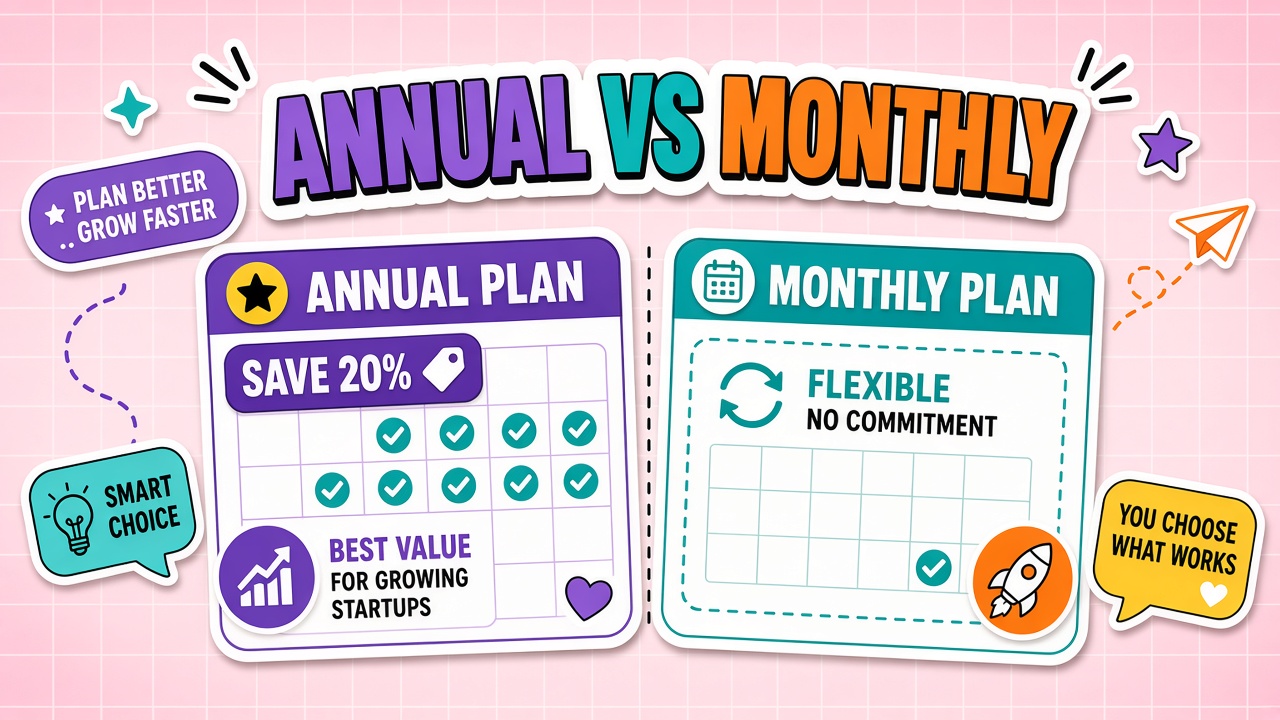
Checkout offers two prices: twenty-four dollars monthly or two hundred forty dollars annually, "two months free." The annual button looks obvious until the vendor ships a breaking UI change, your team shrinks, or a better tool wins the pilot. Choosing between annual vs monthly AI subscription plans is a bet on product stability and your own forecast accuracy, not just discount percentage.
This guide covers typical annual discount ranges, cancellation and refund policies, roadmap risk, seat scaling on annual contracts, and when monthly pilots are safer. Compare AI productivity and AI writing tools with break-even math before finance prepays a stack.
Typical Annual Discount Ranges
Annual AI discounts often land between fifteen and twenty-five percent off equivalent monthly spend, sometimes marketed as one or two free months. Enterprise annual quotes may include larger discounts tied to seat minimums, not just billing interval. Convert every offer to effective monthly cost before comparing vendors.
Break-even formula: if annual price equals ten times monthly, you need ten stable months to match paying monthly twelve times. Shorter retention means annual loses. Add implementation months where usage is partial.
Cancellation and Refund Policies
Read cancellation clauses before annual prepay, not after disappointment. Red flags include: no prorated refund after thirty days, auto-renewal with short notice windows, credits instead of cash refund, and fees to export data on downgrade. Favorable terms include prorated refund within a defined window and clear data export without penalty.
- Auto-renewal date and required notice days
- Refund form: cash vs account credit
- Downgrade timing: immediate vs next renewal
- Data retention after cancel
Feature Roadmap Risk With Annual Lock-In
Annual commit assumes the vendor's direction still matches yours in month nine. AI products change models, limits, and interfaces frequently. A tool perfect for Q1 may lag competitors by Q3. Annual lock-in reduces switching flexibility when the market moves fast. Weight discount savings against expected category churn in your stack.
Team Growth and Seat Scaling on Annual
Annual seat bundles complicate headcount changes. You may prepay for ten seats while hiring freezes at six, or face true-up at list price when growth exceeds commitment. Ask how mid-term seat additions price on annual vs monthly and whether unused seats transfer or expire.
| Scenario | Annual tends to win | Monthly tends to win |
|---|---|---|
| Proven daily driver tool | Yes, after six plus stable months | Rarely |
| Pilot or category experiment | No | Yes, until go/no-go |
| Volatile headcount | Only with flexible true-up terms | Yes |
When Monthly Is Safer for Pilots
Monthly billing fits pilots, seasonal campaigns, and any tool without six months of proven ROI. Pay a small premium for option value. Convert to annual only after usage dashboards show stable weekly active users and security sign-off on the tier you will keep.
AI annual subscription discount negotiation tips
Vendors advertise AI annual subscription discount as two months free, but enterprise buyers can sometimes stack multi-year commits, case study rights, or reduced seat minimums. Monthly vs yearly AI plan math should include implementation months where utilization is partial. Read AI tool contract terms for auto-renewal and price increase clauses that apply at renewal even if you paid annually upfront.
Frequently Asked Questions
Are mid-term upgrades prorated on annual plans?
Policies vary. Some vendors credit unused time toward upgrades; others charge full new tier immediately. Get written proration rules before upsell during annual term.
Do downgrades issue prorated credits?
Consumer SaaS often issues service credit; enterprise may negotiate true-down only at renewal. Assume no cash back unless contract states it.
What AI tool contract terms matter most besides price?
Data handling, model change notice, rate limit changes, export rights, and SLA. Annual magnifies exposure to unfavorable terms because you live with them longer.
The Bottom Line
Annual AI plans save fifteen to twenty-five percent when you keep the tool twelve stable months. Monthly plans buy flexibility during pilots and headcount uncertainty. Run break-even math, read cancellation red flags, and delay annual prepay until usage and compliance are proven. Compare productivity and writing subscriptions on EliteAI.tools with your retention forecast, not checkout urgency.