A blind viewer presses play on a streaming drama. Dialogue carries the plot, but a character silently reads a letter, a car explodes off-screen, and the villain enters through a door the script never names. AI audio description video pipelines aim to fill those gaps automatically: computer vision detects scenes and objects, large language models draft concise narration, and text-to-speech or cloned voices insert descriptions into dialogue pauses. Studios, broadcasters, and platform giants face growing legal pressure to make video accessible, yet professional audio description remains expensive and slow to produce at scale.
Accessibility managers and video producers evaluating automation need to understand what today's models can detect, how WCAG and broadcast standards define quality, and where human describers remain indispensable. Teams exploring AI chatbot narration should apply the same skepticism to claims about fully autonomous description. More explainers on creative accessibility sit on the EliteAI.tools blog index.
What AI Audio Description Video Means in Plain Language
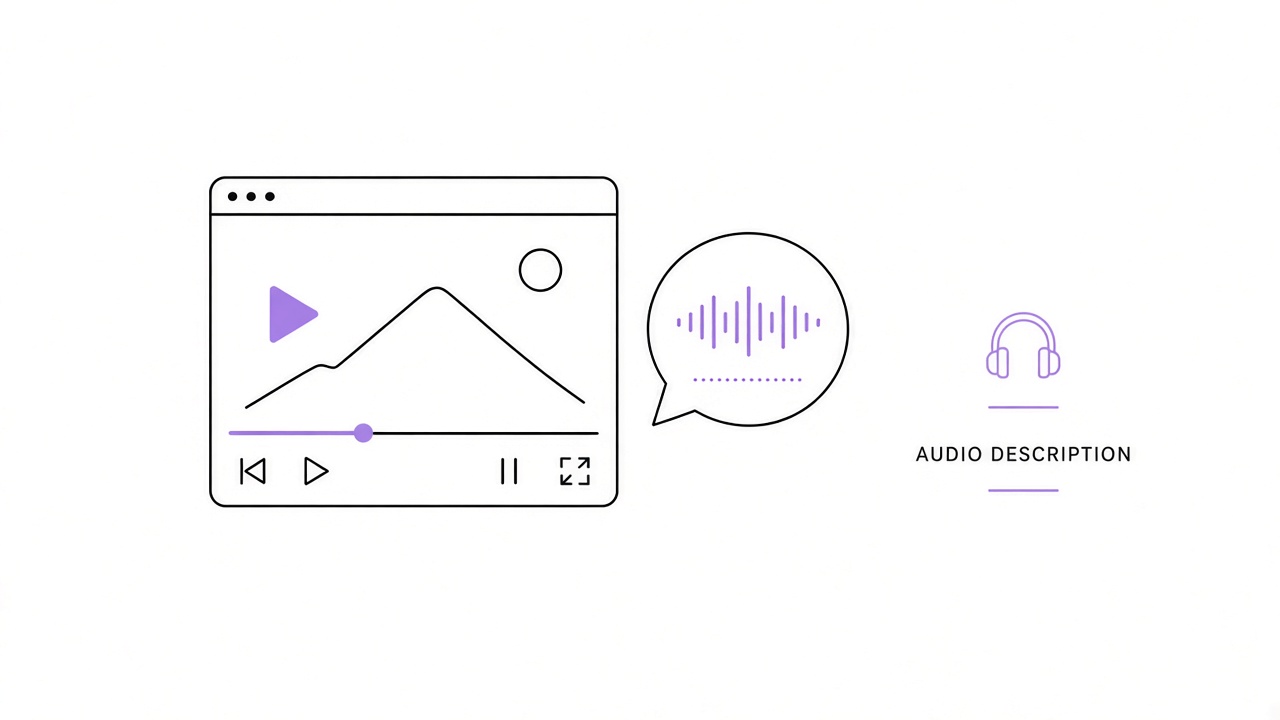
AI audio description video is the use of machine learning to generate spoken narration that explains visual content in films, television, education, and online video for blind and low-vision audiences. Traditional audio description (AD) is written by trained human describers who watch a program, identify essential visual information, and record narration mixed into silent gaps. Automated systems attempt to replicate scene understanding, script timing, and vocal delivery with algorithms instead of studio sessions.
Two AD formats dominate. Standard audio description fits lines into existing pauses, often 3 to 5 seconds long. Extended audio description pauses the video when no natural gap exists, which preserves completeness but interrupts pacing. AI pipelines must solve both timing allocation and linguistic economy: describe the stabbing motion without drowning the next line of dialogue.
| Standard or guideline | Scope | Relevance to AI AD |
|---|---|---|
| WCAG 2.1 SC 1.2.5 Audio Description (Prerecorded) | Level AA web video | Requires AD for prerecorded synchronized media |
| WCAG 2.1 SC 1.2.7 Extended Audio Description | Level AAA | Allows pausing video to fit longer description |
| DCMP description key principles | U.S. educational media | Objective, concise, synchronized, appropriate vocabulary |
| Ofcom UK broadcast guidance | Television accessibility | Quality benchmarks for voice and content selection |
| CVAA (21st Century Communications Act) | U.S. IP-delivered video | Drives AD on streaming platforms |
How the Underlying AI Pipeline Works
A typical automated AD pipeline runs scene boundary detection, shot-level object and action recognition, salience ranking, LLM-based script drafting, pause alignment, and text-to-speech synthesis, often with a human review queue before publication. Each stage introduces error modes that compound: a missed scene cut places description over dialogue; an oververbose LLM exhausts the pause window; a generic TTS voice breaks immersion in a period drama.
Scene detection and saliency
Shot boundary detectors use color histogram deltas and learned transformers to segment video into scenes. Action recognition models (SlowFast, VideoMAE, and successors) label activities like "walking," "embracing," or "pointing a gun." Saliency models rank which objects matter for narrative comprehension versus decorative background. Research systems from universities and vendors like Microsoft, Google, and Adobe publish benchmarks on TV series clips, but open-domain movies with rapid editing still challenge detectors trained on YouTube-scale data with noisy labels.
LLM narration drafting
Given structured labels ("Character A: woman, red coat, enters cafe, looks nervous"), large language models generate present-tense, third-person sentences: "Sarah steps into the crowded cafe, scanning the room." Prompt engineering enforces DCMP-style objectivity and bans interpreting emotions the visuals do not support. Chain-of-thought and critic models flag when the draft mentions a prop never visible in the frame embeddings. Length control modules truncate to fit detected pause duration based on words-per-minute speaking rate.
Timing and mixing
Forced alignment between dialogue transcripts (from ASR or production scripts) and audio waveforms locates silence windows. When gaps are too short, the pipeline either drops lower-priority visual beats or triggers extended AD mode that inserts video freeze frames. Loudness normalization and ducking lower background music so description remains intelligible, matching broadcast mixing standards.
| Stage | Common models or tools | Typical failure |
|---|---|---|
| Shot segmentation | PySceneDetect, TransNetV2 | Misses fast action cuts |
| Vision labeling | CLIP, GPT-4V-class VLMs | Hallucinates off-screen objects |
| Script generation | GPT-4, Claude, domain fine-tunes | Subjective or spoiler-heavy wording |
| Voice synthesis | Neural TTS, vendor AD voices | Robotic tone, wrong emotional register |
| Human QA | Descriptive video service reviewers | Bottleneck if treated as optional |
Netflix, YouTube, and platform approaches
Netflix maintains one of the largest human-produced AD catalogs in streaming, contracting specialist studios and training describers through style guides that AI systems try to mimic. The company has researched machine-assisted description internally but publicly emphasizes human craft for flagship originals. YouTube auto-generates captions with ASR; full AD tracks are creator-supplied or third-party, though Google has demonstrated research prototypes that pair vision models with TTS for short clips. Broadcasters like the BBC and ABC partner with accessibility vendors (Roam Media, Descriptive Video Works) who now use AI for first-draft scripts that human editors refine, a human-in-the-loop model most experts consider the near-term production standard.
Audio description quality rubric
Professional describers follow rubrics that AI evaluators attempt to encode: describe only what is essential to understand plot or instruction; use present tense; avoid interpreting character thoughts; match vocabulary to target audience (children's programming uses simpler words than forensic documentaries); never talk over dialogue unless extended AD mode is enabled; credit on-screen text by reading it when no narrator speaks it. Automated systems struggle most with the "essential only" rule, either over-describing wardrobe details or missing a silent handshake that seals a deal. Quality scoring models trained on human-rated clips still correlate modestly with blind viewer satisfaction, so production workflows treat AI scores as triage flags, not release gates.
Localization adds another layer. AD must be produced per language with culturally appropriate voice casting. Machine translation of English AD scripts into Spanish or French saves time but can misgender characters or use formal register inappropriate for teen dramas. Netflix and Disney+ fund separate AD sessions per major market for top titles; AI may assist translation memory but rarely replaces native-speaking describers for premium content.
Real Deployments and Published Evidence
Commercial deployments in 2024 and 2025 focus on assistive drafting, educational video, and corporate training rather than replacing human describers on theatrical releases. Startups offer browser uploads that return AD audio tracks within hours, targeting universities complying with Section 508 and European Accessibility Act deadlines. Quality varies: talking-head lectures score well because scenes are static; sports and animation remain weak due to motion blur and stylized characters.
Peer-reviewed papers in ACM TACCESS and INTERSPEECH report BLEU and human rating comparisons between human and machine descriptions. Human describers consistently win on narrative relevance and timing, while machines compete on cost for simple instructional footage. The VADER dataset and AD-VAT benchmarks give researchers shared metrics, but no industry-wide automated quality score replaces blind viewer panels.
W3C media accessibility task forces discuss metadata for multiple description tracks (language, extended versus standard, describer credits). AI-generated tracks will need provenance labels so viewers know whether narration was human verified, similar to caption "auto-generated" badges on YouTube.
Corporate training and e-learning adoption
Enterprise learning platforms (Cornerstone, Docebo, Articulate Rise exports) accumulate thousands of hours of compliance training with minimal AD coverage because procurement prioritized captioning first. AI-assisted pipelines ingest SCORM packages, extract slide text and on-screen bullets, and generate description for instructor gestures pointing at diagrams. Software tutorial videos benefit because cursor movement and UI highlights are structurally easier for vision models than cinematic lighting. Regulated industries (pharma, aviation) still demand human sign-off logs before learners receive certificates, so automation fits draft and QC stages rather than zero-touch publishing.
Public-sector procurement in the European Union increasingly references EN 301 549 accessibility requirements for ICT products, which align with WCAG for web content embedded in training portals. Agencies publishing historical archive footage (municipal meetings, court recordings) face backlogs measured in decades; batch AI description with spot human review is often the only financially viable path to retroactive compliance, provided viewers can report errors through feedback forms.
Limits, Risks, and Ethical Guardrails
Automated AD risks spoiler leakage, cultural misdescription, gender misidentification of characters, and legal exposure if platforms ship raw model output as compliant accessibility. Vision models trained on Western media underdescribe skin tone nuances and traditional dress. LLMs may infer relationships or motives not shown on screen, violating DCMP objectivity.
- Timing collisions: Description overlapping dialogue violates basic usability and may fail WCAG intent even when a track technically exists.
- Copyright and voice: Cloning actor voices for AD raises publicity and union issues (SAG-AFTRA negotiations).
- Employment: Blind audio description professionals fear wage pressure if studios treat AI drafts as final product.
- Liability: Educational publishers could misinform students if a diagram is misidentified.
- Consent: Living subjects in documentary footage may object to AI-generated commentary tone.
Ethical guardrails include mandatory human review for public distribution, disability-led quality rubrics, transparent labeling of AI assistance, and revenue sharing with professional describers who edit machine drafts. The American Council of the Blind and RNIB advocate for viewer choice among multiple description tracks rather than a single low-quality auto track.
Who Should Use This and Who Should Wait
Universities, corporate L and D teams, and government agencies with large archives of simple instructional video should pilot AI-first-draft plus human edit workflows now. Theatrical distributors, news organizations covering breaking events, and creators of visually dense fiction should wait for human description or invest in hybrid QA with blind consultants.
| Content type | AI readiness | Recommended workflow |
|---|---|---|
| Lecture capture, webinars | High | AI draft, light human edit |
| Product demo screencasts | Medium-high | Scripted AD from UI automation logs |
| Narrative film and TV | Low without humans | Professional describers, AI assists timing only |
| Live sports | Very low | Human live description or radio-style commentary |
Frequently Asked Questions
Does AI-generated audio description satisfy WCAG?
WCAG requires an audio description track for prerecorded video at Level AA; it does not specify human versus machine authorship. If automated description is incomplete, mistimed, or inaccurate, the video may still fail the success criterion in practice during accessibility audits.
Does YouTube auto-generate audio description?
YouTube auto-generates captions but not full audio description tracks as of current platform features. Creators upload separate AD audio or use third-party services; research prototypes exist but are not default consumer features.
Is human review still necessary?
Yes for narrative and high-stakes educational content; blind reviewers and trained describers catch errors vision models miss. Human-in-the-loop editing is the production model most broadcasters and accessibility advocates accept for quality AD.
What is the difference between standard and extended AD?
Standard AD fits narration into existing pauses; extended AD pauses the video to allow longer descriptions when dialogue is continuous. AI systems must choose which mode to apply per scene; wrong choice either drops information or frustrates sighted viewers.
How much cost can automation save?
Vendor quotes suggest 40 to 70 percent cost reduction on simple content when AI produces first drafts, but savings shrink toward zero for premium drama where human describers remain essential. Total savings depend on QA labor and revision cycles.
Can AI describe live video?
Live audio description requires sub-second latency and professional human narrators; current AI vision pipelines are too slow and unreliable for live broadcast except experimental low-stakes streams. Expect human description for Olympics and news for years to come.
Is Netflix replacing human audio describers with AI?
Netflix continues to commission human audio description for major originals and publicly positions professional describers as essential to quality. Internal research may explore machine assistance for metadata and timing, but subscriber-facing AD tracks on flagship series remain human-produced as of current public statements from accessibility teams.
Conclusion
AI audio description video automation combines scene detection, vision-language models, LLM scriptwriting, and neural TTS to scale accessibility for growing video libraries. WCAG 2.1, CVAA, and broadcast guidance set expectations that pure model output rarely meets without human editing. Netflix-scale quality still flows from trained describers; universities and trainers gain more immediate value from AI-assisted workflows. Platforms should label AI involvement, fund blind reviewer panels, and reserve human craft for visually complex storytelling while using machines to draft description for the long tail of instructional content.