The AI pilot that never ends is one of the most expensive patterns in enterprise software. A team starts a "trial," sees mixed results, and keeps the subscription because nobody wrote down what success should look like or when the decision must happen. Twelve months later finance asks why spend doubled and adoption dashboards still show sporadic logins.
An AI tool pilot exit criteria framework defines measurable success thresholds, failure triggers, and a fixed decision date before the pilot begins. This guide gives you a go/no-go template, metric categories, and governance steps so pilots produce decisions instead of drift. Shortlist candidates from AI automation and AI research categories only after your exit criteria document is drafted.
What Exit Criteria Must Define Before Day One
Exit criteria answer four questions in writing: What outcomes justify rollout? What outcomes trigger stop? Who decides? When is the decision due? If any answer is "we will see," the pilot will extend indefinitely.
Minimum exit criteria document sections:
- Pilot scope: Named workflows, teams, seat count, and duration in calendar days.
- Baseline metrics: Pre-pilot measurements on the same workflows (time, error rate, cost).
- Success thresholds: Numeric targets with acceptable confidence (for example median time reduced twenty percent on n=30 tasks).
- Failure triggers: Hard stops (security incident, data leak, quality below floor on three consecutive reviews).
- Decision roles: Sponsor, workflow owner, security reviewer, and finance approver.
- Decision date: Fixed calendar date; extensions require written exception with new thresholds.
- Rollout or sunset plan: What happens to licenses, data, and workflows on each outcome.
Publish the document where pilot participants can read it. Ambiguous criteria buried in a procurement PDF do not constrain behavior. Participants should know the kill date on day one.
Metric Categories for AI Pilots
Balance outcome metrics, quality metrics, and operational metrics. Outcome metrics prove business value. Quality metrics prove the tool is safe to scale. Operational metrics prove the team can support the tool without heroics.
| Category | Example metrics | Typical success signal |
|---|---|---|
| Outcome | Cycle time, throughput, cost per unit | Statistically meaningful improvement vs baseline |
| Quality | Revision rounds, error tags, rubric pass rate | Equal or better quality at lower time |
| Adoption | Weekly active users on target workflow | Majority of pilot seats used weekly |
| Risk | Policy violations, PII flags, audit findings | Zero critical incidents; minor issues remediated |
| Operations | Support tickets, integration uptime, SSO success | Support load within agreed threshold |
Research-heavy pilots evaluating AI research tools should add citation accuracy checks and source freshness reviews. Automation pilots using AI automation platforms should measure exception rate and mean time to recover when a step fails. Vanity metrics (total prompts sent, tokens consumed) support cost forecasting but rarely justify rollout alone.
Go, No-Go, and Extend Decision Gates
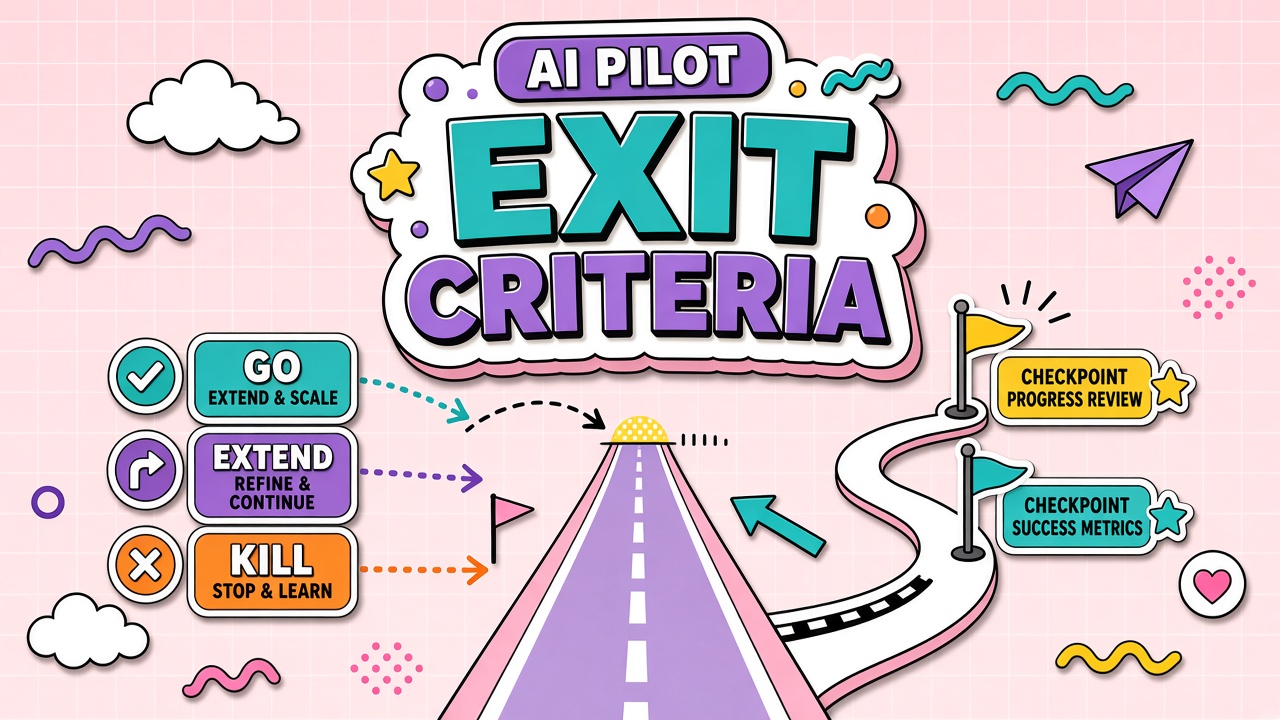
Use three explicit outcomes: go, no-go, and conditional extend. "Go" means production rollout with documented workflows and budget approval. "No-go" means license sunset, data export, and communication to participants within five business days. "Conditional extend" is allowed only when a specific blocker (integration delay, sample size too small) is named with a new decision date and unchanged success thresholds.
Decision gate checklist for the sponsor meeting:
- Review baseline vs pilot metrics on scoped workflows only.
- Confirm quality rubric results including worst-case samples.
- Review security and compliance sign-off status.
- Compare total cost of ownership vs alternatives, including seat reclamation options.
- Record decision, owners, and next actions in the steering log.
Avoid "soft go" outcomes that add seats without workflow documentation or training. Partial rollout is valid when criteria are met for one workflow but not others; name which workflows graduate and which stay in experiment mode with their own mini exit criteria.
Sample exit criteria statements
Write thresholds as testable sentences: "Median first-draft time for support macro updates decreases from eighteen minutes to twelve minutes or less across thirty audited tasks." "Rubric pass rate stays at or above ninety-two percent for four consecutive weekly batches." "Zero confirmed PII submissions to unapproved workspaces during the pilot period." Vague goals like "improve efficiency" fail every post-mortem.
Pilot Duration and Sample Size
Most workflow pilots need four to eight weeks and at least twenty to fifty completed tasks per workflow. Shorter pilots suit mature tools with low integration risk. Longer pilots suit regulated environments or workflows with monthly seasonality. Fix the end date first, then back into weekly measurement checkpoints.
Weekly checkpoint rhythm:
- Week 1: Access, training, first five tasks; confirm instrumentation works.
- Week 2: Early quality review; adjust prompts, not success thresholds.
- Week 3: Midpoint metrics vs baseline; flag blockers to sponsor.
- Week 4+: Accumulate sample size; prep decision deck one week before gate.
Changing success thresholds mid-pilot invalidates comparison unless baseline is re-measured with documented reason. Treat threshold changes as exceptional, not a standard retry loop.
Stakeholder Alignment Before the Pilot Starts
Exit criteria fail when stakeholders never agreed on what "good" means. Schedule a thirty-minute alignment meeting with finance, security, the workflow owner, and the executive sponsor. Walk through each threshold and ask: "Will you accept a no-go if we miss this number?" Record yes/no per stakeholder. Unresolved disagreements belong in the open before licenses activate, not in the decision meeting.
Finance cares about total cost of ownership and renewal commitment. Security cares about data handling and audit readiness. Operations cares about support load and integration stability. The workflow owner cares about quality and cycle time. Each stakeholder should see at least one metric they personally endorsed. Shared ownership of criteria prevents the sponsor from overriding a no-go because one department still likes the vendor demo.
Integration and Dependency Exit Criteria
AI pilots that depend on CRM, ticketing, or data warehouse connectors need integration-specific exit criteria separate from model quality. Define acceptable error rates on sync jobs, maximum manual rework minutes per batch, and fallback behavior when the API is down. A brilliant model attached to a flaky integration should fail the pilot even when draft quality scores look strong.
Integration checklist for exit criteria:
- Field mapping verified on a sample of fifty production-shaped records.
- Idempotency tested: Re-running the same job does not duplicate records.
- Rate limits documented with headroom for peak business days.
- Monitoring alerts fire to the on-call rotation, not an individual's inbox.
- Rollback tested: Legacy path can resume within four hours.
Documenting Failure Without Blame
A clean no-go is a success for governance. Capture what hypothesis failed: wrong workflow fit, integration gap, quality floor, or cost model. Archive prompts, sample outputs, and vendor responses for future shortlists. Reassign reclaimed budget explicitly so it does not evaporate into another silent trial.
Failure documentation template:
- Hypothesis and scoped workflows tested.
- Metrics vs thresholds (table format).
- Primary failure mode in one sentence.
- Secondary contributing factors.
- Recommendation for next attempt (different tool, narrower scope, more training).
- License and data sunset actions with owners and dates.
Scaling Exit Criteria Across Multiple Teams
When several teams pilot the same platform on different workflows, use a shared metric framework with workflow-specific thresholds. Security and cost criteria stay global; quality rubrics adapt per job type. Central governance reviews exit packages weekly so one team's premature rollout does not set precedent that bypasses risk controls for everyone else.
A portfolio dashboard tracking all active pilots should show decision date, status (on track, at risk, blocked), and sponsor name. At-risk pilots get office hours with the workflow owner before thresholds are missed, not after renewal invoices arrive.
Common Exit Criteria Mistakes
- No baseline: Improvement claims without pre-pilot numbers are not credible.
- Login counts as success: Activity without outcome metrics renews shelfware.
- Rubber-stamp security review: Late surprises kill rollouts after sunk cost bias sets in.
- Unlimited extensions: Every extend needs a blocker name and new date.
- Missing sunset plan: Failed pilots leave ghost subscriptions and shadow accounts.
Frequently Asked Questions
How many metrics should exit criteria include?
Three to five primary metrics plus one risk metric. More than that dilutes focus and slows decisions. Each metric should map to a stakeholder question finance or operations will actually ask.
Who can override a no-go decision?
Only the executive sponsor with written rationale and accepted risk register entry. Overrides without documentation recreate endless pilots. Workflow owners recommend; sponsors decide.
How do exit criteria work when comparing two tools in one pilot?
Run parallel tracks with identical workflows and metrics, or sequential phases with frozen criteria. Do not change rubrics between vendors mid-pilot. Browse AI automation and AI research directories to build comparable shortlists before the pilot charter is signed.
What is the shortest defensible pilot?
Two weeks for low-risk, single-workflow tests with daily volume and clear rubrics. Anything shorter rarely yields enough samples unless task volume is very high.
Do free-tier pilots need the same rigor?
Yes for data handling and quality; lighter on cost metrics. Free tiers still create shadow risk and habit formation. Write exit criteria even when the invoice is zero.
Archiving Pilot Evidence for Audits
Store scored samples, rubric sheets, and decision meeting notes in the same retention system as production workflow docs. Auditors and future buyers will ask what evidence supported rollout. A structured archive also speeds the next pilot: teams reuse thresholds instead of debating basics from scratch.
The Bottom Line
An AI tool pilot exit criteria framework forces a decision: roll out, stop, or extend with named blockers. Define success thresholds, failure triggers, roles, and a calendar decision date before anyone logs in. Measure outcomes and quality on real workflows, document no-go results without blame, and sunset licenses when criteria fail.