What is WootzApp?
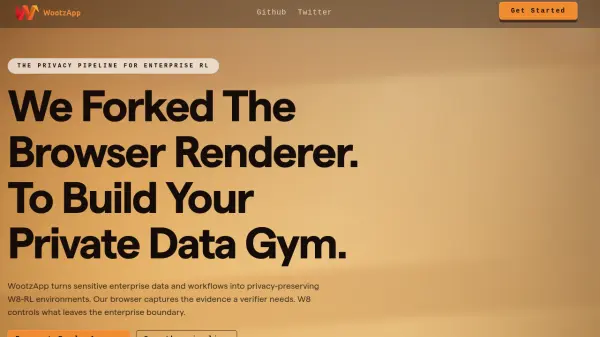
WootzApp provides a privacy pipeline for enterprise reinforcement learning (RL) by leveraging a forked browser renderer. It enables organizations to transform sensitive workflows and data into privacy-reviewed W8-RL environments. The platform captures browser-visible evidence such as screenshots, DOM state, actions, and outcomes while enforcing strict controls on what leaves the enterprise boundary.
With features like boundary mapping, snapshot capture, sanitization, and verification, WootzApp allows data owners to assess, constrain, and document sensitive systems. Each environment ships with a privacy ledger documenting retained, redacted, and delivered artifacts. This approach expands the utility of private enterprise systems for RL training without compromising data control.
Features
- Forked Browser Renderer: Captures browser-visible evidence and controls data leaving the enterprise boundary.
- Privacy Assessment: Identifies sensitive surfaces, fields, and documents before capture.
- Snapshot Capture: Records screenshots, DOM state, and actions without uncontrolled raw data movement.
- Sanitization: Constrains, redacts, or keeps sensitive fields inside controlled deployments while preserving training utility.
- Verification: Scores process and outcome separately using browser evidence, rubrics, and trajectory replay.
- Privacy Ledger: Documents retained, redacted, and delivered artifacts alongside the environment.
Use Cases
- Training RL agents on sensitive enterprise workflows like claims, ERP, or card-operations.
- Building privacy-reviewed RL environments for internal model training.
- Licensing private enterprise data as documented, replayable RL assets.
- Verifying agent behavior in browser-based tasks without exposing sensitive data.
FAQs
-
What is W8-RL?
W8-RL is a specification for privacy-preserving reinforcement learning environments that use browser evidence from a forked renderer to train models without exposing sensitive data. -
How does WootzApp protect sensitive data?
It uses boundary mapping, field constraint, redaction, and a privacy ledger to document what is retained, removed, or kept inside the deployment.