What is OpTaliX?
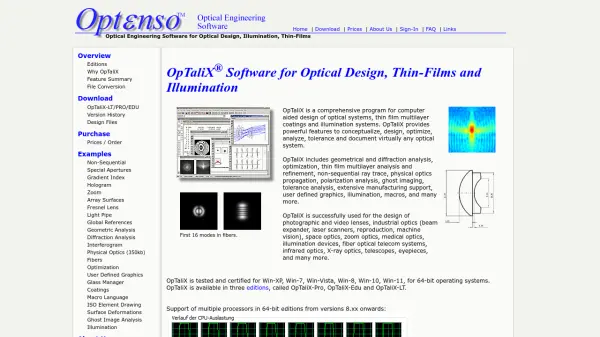
OpTaliX delivers an extensive solution for computer-aided design and analysis of optical systems, thin film coatings, and illumination projects. This advanced software supports a broad range of functionalities including geometrical and diffraction analysis, advanced optimization algorithms, sequential and non-sequential ray tracing, thin-film multilayer refinement, and tolerance analysis, among others. The platform is tailored to assist in conceptualizing, optimizing, and documenting virtually any optical or photonic system.
Designed for both industrial and research applications, OpTaliX provides full manufacturing support, user-defined graphics, polarization analysis, ghost imaging, environmental/thermal analysis, and a macro programming language. It supports multiple editions and is compatible with modern 64-bit Windows systems, making it suitable for fields such as photography, medical optics, fiber-optic telecom, aerospace, infrared/X-ray optics, and numerous other optical engineering domains.
Features
- Geometrical and Diffraction Analysis: Evaluate optical system performance with robust modeling algorithms.
- Advanced Optimization Algorithms: Accurately optimize optical designs using exact constraint handling.
- Sequential and Non-Sequential Ray Tracing: Simulate light propagation through complex optical paths.
- Thin-Film Multilayer Analysis: Analyze and refine multilayer coating designs.
- Macro Language Support: Automate tasks and customize analyses with scripting capabilities.
- Tolerance Analysis: Assess system performance sensitivities to manufacturing variations.
- Polarization and Illumination Analysis: Investigate the effects of light polarization and illumination distribution.
- Environmental/Thermal Analysis: Simulate optical system behavior under different thermal and environmental conditions.
- User-Defined Graphics: Customize visualizations for reporting and presentation.
- Manufacturing Support: Access extensive glass and lens catalogs and generate ISO-compliant element drawings.
Use Cases
- Design of photographic and video lenses for consumer and industrial applications.
- Development and optimization of fiber-optic telecommunications components.
- Engineering of medical optical devices and imaging systems.
- Simulation and analysis of zoom lenses, telescopes, and eyepieces.
- Design and evaluation of illumination systems for lighting applications.
- Research and development of infrared and X-ray optical systems.
- Optimization and prototyping of thin-film multilayer coatings for enhanced performance.
- Manufacturing support for lens and optical component production.