What is OpenOps?
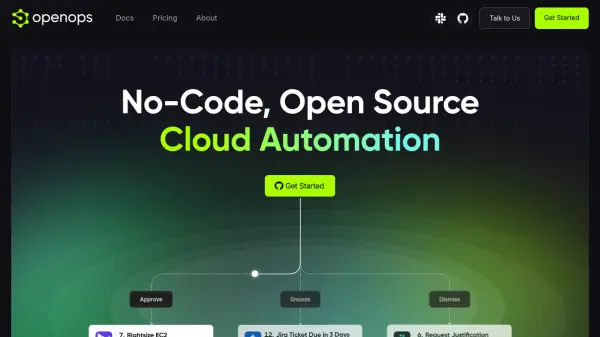
OpenOps is a no-code, open-source cloud automation solution designed to streamline and optimize financial operations (FinOps) across multiple cloud environments. The platform utilizes AI-powered capabilities and offers an extensive catalog of ready-made and customizable workflow templates, enabling organizations to automate anomaly detection, cost allocation, forecasting, and policy enforcement with minimal manual intervention.
OpenOps integrates seamlessly with popular cloud providers, DevOps tools, and business management applications, facilitating granular control, efficient collaboration, and continuous improvement in cost efficiency. Advanced security measures, including ISO-27001 certification, SOC2 compliance, and GDPR adherence, ensure robust protection of organizational data while enabling safe and scalable automation. Suitable for teams seeking flexibility, rapid deployment, and deep customizability in their cloud financial management practices.
Features
- No-Code Automation: Accessible workflow creation and customization without coding expertise.
- AI Copilot: Advanced AI-driven assistance for workflow recommendations and optimizations.
- Pre-Packaged Templates: Ready-made, best-practice workflows for common FinOps scenarios.
- Multi-Cloud Integration: Seamless support for public cloud providers, cost visibility tools, and DevOps platforms.
- Human-in-the-Loop: Feedback, approvals, and collaboration embedded within automated workflows.
- Security and Compliance: ISO-27001 certification, SOC2 compliance, GDPR adherence, and transparent permission management.
- Anomaly Detection: Real-time alerts for unusual cost spikes and resource usage.
- Customizable Governance: Enforcement of cloud policies such as tagging and resource types.
- Analytics Dashboards: Centralized cost, usage, and performance visualization for collaborative financial management.
- Self-Hosted and SaaS Options: Free open-source and fully-managed cloud versions available.
Use Cases
- Automated detection and remediation of cloud cost anomalies.
- Allocate and track cloud spending across multiple business units and projects.
- Forecast and optimize multi-cloud resource expenses based on historical data.
- Streamline approval workflows for resource rightsizing and conversions to savings plans.
- Centralize financial, usage, and performance management across engineering and finance teams.
- Enforce organization-wide cloud policy governance and tagging standards.
- Enhance collaboration and feedback loops between FinOps, engineering, and finance staff.
- Integrate with third-party tools for unified analytics and project management.
FAQs
-
Why is OpenOps the answer to my organization’s FinOps challenges?
OpenOps bridges the gap between existing cloud service provider tools and custom-built automation by delivering customizable, AI-powered, and human-in-the-loop automation for financial operations, making it efficient and collaborative for finance and engineering teams. -
Do I need to build everything from scratch with OpenOps?
No, OpenOps provides a comprehensive catalog of ready-to-use, customizable workflow templates to streamline FinOps practices without starting from scratch. -
Does OpenOps integrate with existing cloud infrastructure and cost management tools?
Yes, OpenOps integrates seamlessly with a wide array of tools, including AWS Cost Explorer, CloudHealth, Anodot, Zesty, ServiceNow, Slack, Microsoft Teams, Jira, Asana, and more, to enhance automation and fit easily into existing ecosystems. -
What level of access does OpenOps need to my cloud environment?
OpenOps adheres to your cloud’s permission model, offering customizable access levels. It can provide insights and recommendations with read-only access and execute actions such as rightsizing with write access, all while following strict security policies.