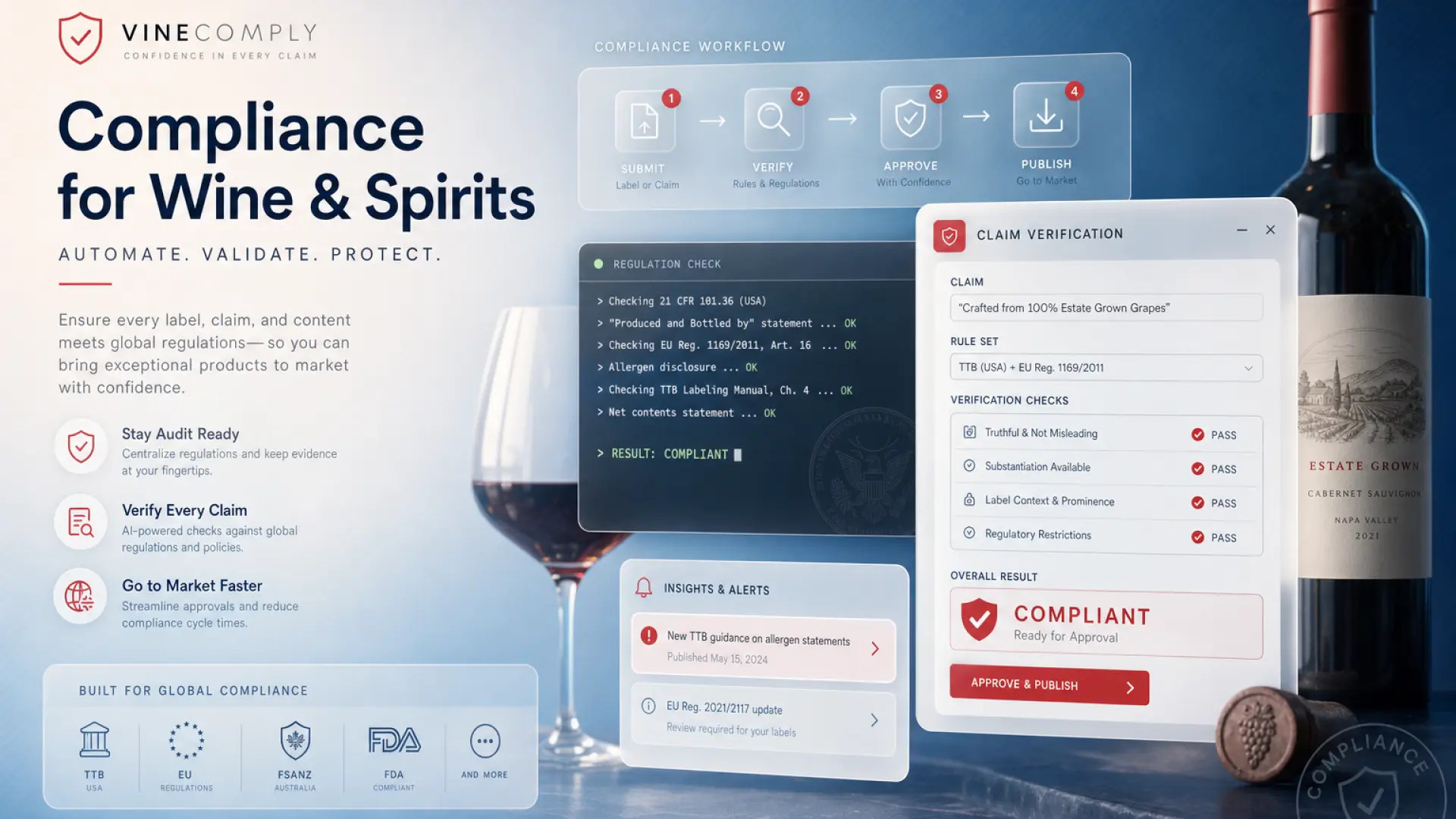
AI wine spirits labeling compliance workflows help producers draft front and back label copy, marketing claims, and export translations faster. Regulators including the US TTB, EU member states, and provincial liquor boards treat approved label text as legal documents. AI drafts accelerate iteration; compliance review remains mandatory before print.
This guide covers label element checklists by market, health and origin claim restrictions, translation and export workflows, version control for approved copy, and FAQ topics. Pair AI writing assistant tools with AI productivity workflows that enforce regulatory checkpoints, not skip them.
Label Element Checklist by Market
Each destination market mandates specific mandatory statements, font sizes, allergen disclosures, and alcohol by volume presentation. AI templates should encode market-specific field lists so drafts fail validation when required elements are missing.
| Market | Typical mandatory elements | AI draft caution |
|---|---|---|
| United States (TTB) | Brand name, class/type, ABV, net contents, sulfite declaration | Do not invent COLA numbers or health claims |
| European Union | Energy values, importer, lot coding, language rules | Verify PDO/PGI terms match certified boundaries |
| Canada (LCBO/provincial) | Bilingual requirements, VQA or regional marks | Check provincial sticker add-ons separately |
| Asia-Pacific exports | Local language, distributor, import permits | Translation must match approved English master |
- Build AI prompt libraries per SKU with locked mandatory fields.
- Run automated diff against last approved COLA or equivalent filing.
- Route creative varietal stories separately from legal mandatory text blocks.
- Archive rejected AI drafts to avoid accidental reuse in production art files.
Health and Origin Claim Restrictions
Health-related statements, implied therapeutic benefits, and unverified geographic origin terms trigger TTB and international enforcement actions. AI marketing tone often drifts toward prohibited superlatives unless constrained by compliance playbooks.
- Block prompts that suggest health, weight loss, or anti-aging benefits from alcohol.
- Validate appellation and vintage claims against vineyard records and certificates.
- Review influencer briefs generated by AI for off-label health language.
- Separate organic, biodynamic, and sustainability claims with third-party proof links.
- Escalate novel ingredient statements to regulatory counsel before filing.
Translation and Export Markets
Machine translation accelerates multilingual label drafts, but legal meaning must match the approved source language line for line. Idiomatic marketing copy in one language may become a prohibited claim when translated literally.
- Maintain translation memory tied to approved COLA master text.
- Require human bilingual reviewer sign-off for export markets.
- Track RTL layout and character expansion effects on label artwork.
- Align distributor-specific addendum text with central compliance repository.
- Version each market bundle independently to avoid cross-shipment errors.
Version Control for Approved Copy
Approved label copy behaves like source code: tagged releases, change logs, and rollback paths prevent obsolete claims from reaching printers. AI iteration speed makes undisciplined file naming a common failure mode in fast-moving beverage portfolios.
- Store gold-master text in PLM or DAM with immutable approval timestamps.
- Link AI draft threads to SKU, market, and COLA reference IDs.
- Notify production when mandatory text changes after art approval.
- Audit print runs against latest approved string hashes before bottling.
- Retire AI prompts tied to superseded regulatory interpretations.
Regulatory Checkpoint List for Label Workflows
Every AI-generated label draft should pass a fixed checkpoint sequence before artwork reaches prepress. Checkpoints mirror TTB and export market filing order so creative teams cannot skip compliance because an AI draft "looked final."
- Creative brief locked with SKU, market, and prior COLA reference.
- AI draft generated from mandatory field template only.
- Compliance officer verifies claims, appellation, and allergen statements.
- Legal reviews health, origin, and comparative superiority language.
- Final string hash matched against approved repository before print authorization.
Frequently Asked Questions
How does AI fit direct-to-consumer shipping label workflows?
DTC channels add state-specific shipping labels, volume limits, and recipient age verification copy beyond standard COLA text. AI can assemble checklists per destination state, but compliance must verify rules before each campaign launch.
Can AI draft influencer and social content for alcohol brands?
TTB and FTC disclosure rules apply to influencer posts regardless of who drafted the caption. AI-generated posts need human review for responsible drinking language, audience age targeting, and required sponsorship tags.
Should AI write COLA submission cover letters?
AI can summarize formula and label changes for internal worksheets, but formal TTB submissions require accurate legal descriptions matching lab analysis. Never submit AI-invented ingredient statements without chemist verification.
What about cannabis beverage crossover products?
Cannabis-infused beverages fall under separate state agencies with distinct labeling regimes from TTB alcohol rules. Maintain separate AI prompt libraries and approval chains for each product class.