What is LMCache?
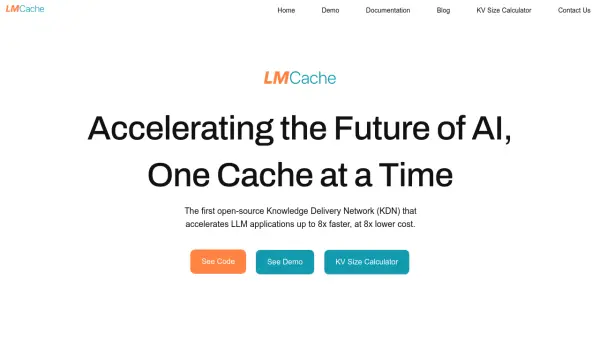
LMCache offers a significant advancement for Large Language Model (LLM) applications by functioning as an open-source Knowledge Delivery Network (KDN). It is engineered to dramatically boost the performance of these AI systems, promising up to an 8-fold increase in speed while concurrently reducing operational costs by a similar factor. This is achieved through innovative techniques in managing and delivering knowledge, specifically targeting the bottlenecks often encountered in LLM interactions.
The system enhances user experience by enabling prompt caching, which allows for rapid retrieval of long conversational histories, thereby ensuring fast and uninterrupted interactions with AI chatbots and document processing tools. Furthermore, LMCache improves the speed and accuracy of Retrieval-Augmented Generation (RAG) queries. It dynamically combines stored Key-Value (KV) caches from various text chunks, a feature particularly beneficial for enterprise search engines and AI-driven document processing, leading to significantly faster response times and more efficient AI operations.
Features
- Prompt Caching: Enable fast, uninterrupted interactions by caching long conversational histories for quick retrieval.
- Fast RAG: Enhance the speed and accuracy of RAG queries by dynamically combining stored KV caches from various text chunks.
- Scalability: Scales effortlessly, eliminating the need for complex GPU request routing.
- Cost Efficiency: Novel compression techniques reduce the cost of storing and delivering KV caches.
- Speed: Unique streaming and decompression methods minimize latency, ensuring fast responses.
- Cross-Platform: Seamless integration with popular LLM serving engines like vLLM and TGI.
- Quality Enhancement: Improves the quality of LLM inferences through offline content upgrades.
Use Cases
- Accelerating AI chatbots for faster user interactions.
- Speeding up document processing tools by caching prompts.
- Enhancing enterprise search engines with high-speed RAG queries.
- Improving AI-based document processing through dynamic KV cache fusion.
- Reducing operational costs for serving LLM applications.
- Optimizing LLM performance in environments using vLLM or TGI.