What is Keshif?
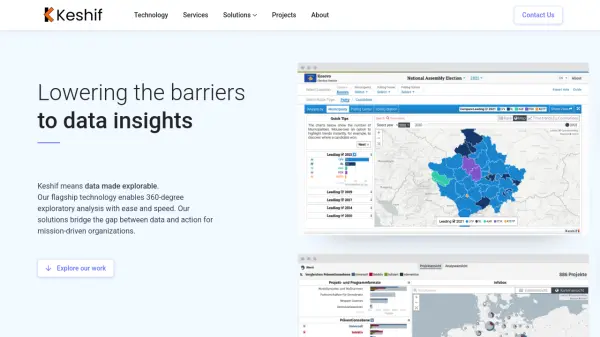
Keshif leverages artificial intelligence to lower barriers to data insights by enabling 360-degree exploratory analysis with ease and speed. The platform bridges the gap between data and action for mission-driven organizations, converting rows and columns of tables and databases into rich, interactive, explorative charts and dashboards.
It automates best practices in visualization, allowing users to express analytics goals and have data visualized intelligently. The technology supports cross-dimensional filtering, comparisons, and aggregations, unifying and simplifying common tasks so users can focus on data goals rather than control options. With fully synchronized, dynamically updated charts and dashboards in real time, Keshif facilitates rapid interactive answers at the speed of thought.
Features
- Automated Visualization: Express analytics goals to have data visualized with best practices automatically
- Interactive Dashboards: Access rich, synchronized dashboards that update dynamically in real time
- Cross-Dimensional Analysis: Analyze data with filtering, comparisons, and aggregations across dimensions
- Extensible Architecture: Built on modern web standards to ingest rich data and present custom visualizations
- Simplified Analytics Process: Unifies and simplifies common tasks to focus on data goals
Use Cases
- Analyzing survey data to understand public opinion trends
- Exploring incident data to discover patterns in who, what, when, where, and how
- Visualizing election results for insights into voter behavior
- Monitoring indicators over time, locations, and dimensions
- Managing knowledge by collecting, organizing, and exploring data for actionable insights
FAQs
-
What types of data can Keshif analyze?
Keshif can analyze various datasets including surveys, incidents, election results, indicators, and knowledge management data, adapting across different types and sizes. -
Does Keshif offer services beyond the platform?
Yes, Keshif provides full-scope services such as visual data analytics and dashboarding, data preparation, data collection, data strategy, and web design and development. -
Which sectors does Keshif typically work with?
Keshif works with mission-driven organizations in sectors like monitoring, evaluation & learning, economy, finance & trade, health, democracy & governance, defense, and stabilization & transition.