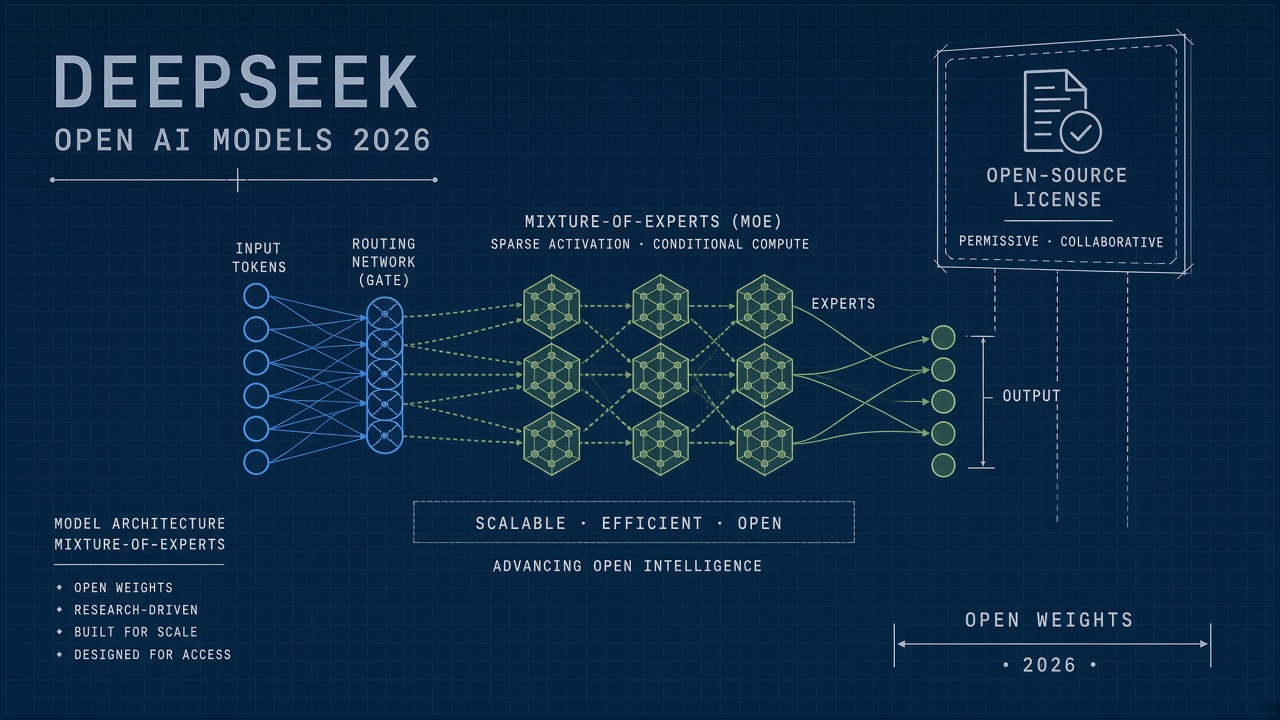
DeepSeek's 2026 open-weight lineup centers on the V4 family: V4-Pro at 1.6 trillion total parameters (49 billion active) and V4-Flash at 284 billion total (13 billion active). Both models ship with one-million-token context, MIT-licensed weights on Hugging Face, and API endpoints that support OpenAI-compatible and Anthropic-compatible formats. The deepseek open model 2026 release replaced the V3 and R1 API aliases for new deployments, though legacy model names still route to V4 variants during a transition window.
This analysis covers what changed in the latest releases, how benchmark claims compare to closed frontier models, license and export considerations for enterprise teams, self-hosting versus API tradeoffs, and a security review checklist for teams evaluating AI code and agent workloads on DeepSeek. Figures below come from DeepSeek launch materials and Hugging Face model cards; validate on your own workloads before production commitments.
Latest DeepSeek Releases in 2026
DeepSeek V4-Pro and V4-Flash are Mixture-of-Experts language models with 1M default context, dual thinking and non-thinking modes, and open weights under the MIT License. DeepSeek announced V4 in July 2026 with immediate API availability and Hugging Face downloads for both base and instruction-tuned variants.
V4-Flash targets teams that need fast, economical inference for agents, chat, and AI code assistance. V4-Pro targets workloads where reasoning depth and benchmark parity with closed frontier models matter more than per-token cost. DeepSeek also shipped V4.1 Flash with native multimodal support in late summer 2026, retiring earlier V4 Flash Vision experimental endpoints while keeping compatibility aliases.
| Model | Total params | Active params | Context | License |
|---|---|---|---|---|
| DeepSeek-V4-Flash | 284B | 13B | 1M tokens | MIT |
| DeepSeek-V4-Pro | 1.6T | 49B | 1M tokens | MIT |
| DeepSeek-V4.1 Flash | Updated Flash tier | 13B active (MoE) | 1M tokens | MIT |
API model names are deepseek-v4-flash and deepseek-v4-pro at
https://api.deepseek.com. Legacy aliases deepseek-chat and
deepseek-reasoner route to V4 Flash thinking and non-thinking modes during the
deprecation window. Teams building on
open-source AI stacks
should pin explicit V4 model IDs in production configs to avoid surprise routing changes.
Benchmark and Capability Shifts
DeepSeek V4 claims frontier-class reasoning on agent and software engineering benchmarks while cutting long-context compute cost through DeepSeek Sparse Attention and token-wise compression. DeepSeek positions V4-Pro as competitive with top closed models on coding and math suites, while V4-Flash matches Pro on simpler agent tasks at lower latency.
On the API side, DeepSeek reports strong scores on SWE-bench Verified (66.0), SWE-bench Multilingual (54.5), and Terminal-bench (31.3) for the V3.1 generation that preceded full V4 rollout. V4 technical materials emphasize improved agent tool use, faster thinking-mode responses versus R1-0528, and hybrid reasoning that lets a single model switch between thinking and non-thinking modes without separate endpoints.
The architectural headline is affordable million-token context. DeepSeek Sparse Attention (DSA) reduces memory and compute for long prompts, which matters for legal review, repository-wide code analysis, and log ingestion workflows. vLLM and SGLang added V4 support with expert parallelism and custom attention backends, making self-hosted long-context serving more practical than prior open-weight generations.
License and Export Considerations
DeepSeek V4 weights use the MIT License, which permits commercial use, modification, fine-tuning, and distillation without copyleft obligations. That makes V4 one of the most permissive frontier-scale open releases in 2026, but enterprise legal review should still cover export control, data residency, and vendor concentration risk.
Chinese-origin AI models face heightened scrutiny in U.S. and EU procurement. Some enterprises restrict training data that touches regulated workloads from routing through China-hosted APIs. Self-hosting MIT weights on infrastructure you control can address data residency concerns, but does not eliminate geopolitical review if your organization bans certain model provenances outright.
- Confirm whether your industry (defense, finance, healthcare) restricts models trained or hosted in specific jurisdictions.
- Document the MIT License terms and retain Hugging Face commit hashes for audit trails.
- Review whether fine-tuned derivatives inherit any third-party dataset restrictions from your training corpus.
- Evaluate BIS export rules if you redistribute weights or offer inference as a service across borders.
Self-Host vs API Tradeoffs
V4-Flash is the practical self-host target; V4-Pro requires a large multi-GPU cluster with expert parallelism, while the API offers predictable per-token economics at scale. DeepSeek API pricing for V4-Flash starts around $0.14 per million input tokens (cache miss) and $0.28 per million output tokens at standard rates, with peak and off-peak tiers that double or halve costs depending on UTC hour.
| Deployment path | Best for | Tradeoff |
|---|---|---|
| DeepSeek API | Fast pilots, variable load, no GPU ops team | Data leaves your network; vendor routing changes |
| Self-host V4-Flash | Private code repos, air-gapped eval, cost at scale | Requires Neuron/GPU capacity and MLOps staff |
| Self-host V4-Pro | Maximum open-weight quality without API limits | Very high hardware cost; long-context memory pressure |
For teams comparing open-source AI hosting options, V4-Flash on vLLM with 8+ high-memory GPUs is a common starting point. Cache-aware API usage (prompt caching, repeated system prompts) can beat naive self-host TCO for bursty workloads under 50 million tokens per month.
Security Review Checklist
Before production deployment, security teams should review model provenance, prompt injection surfaces, tool execution boundaries, and logging for sensitive data in long contexts. Open weights reduce vendor lock-in but increase your responsibility for secure inference endpoints.
- Run static and dynamic red-team tests on agent tool loops that call external APIs.
- Enforce network egress policies on self-hosted inference nodes.
- Disable thinking-mode outputs in logs if chain-of-thought may contain user PII.
- Pin model checksums and scan container images for supply-chain tampering.
- Document incident response if a jailbreak or data exfiltration path is discovered in production.
- Re-evaluate quarterly as DeepSeek ships V4.1 Pro and retires legacy API aliases.
Frequently Asked Questions
What replaced DeepSeek V3 and R1 in 2026?
DeepSeek V4-Pro and V4-Flash replaced V3 and R1 for new API deployments. Legacy model names
deepseek-chat and deepseek-reasoner temporarily route to V4 Flash
variants. Pin explicit V4 model IDs before the final retirement deadline.
Can I use DeepSeek V4 commercially?
Yes. MIT License permits commercial use, modification, and distillation. Your legal team may still impose geopolitical or sector-specific restrictions independent of the license text.
How much GPU memory does self-hosting V4-Flash need?
Requirements vary by quantization and context length. vLLM deployment guides recommend multi-GPU clusters with expert parallelism for full FP8/FP4 mixed precision. Start with vendor recipes and scale tests on your target prompt distribution.
Does DeepSeek V4 support tool calling?
Yes. Both API models support JSON tool calls, FIM completion in non-thinking mode, and agent workflows. Validate tool schemas against your production connectors before rollout.
How does V4-Flash compare to closed APIs on cost?
DeepSeek API pricing undercuts many frontier closed models on per-token basis, especially with cache hits and off-peak rates. Total cost depends on output length, thinking mode usage, and whether self-hosting amortizes hardware over your token volume.