What is Ivy?
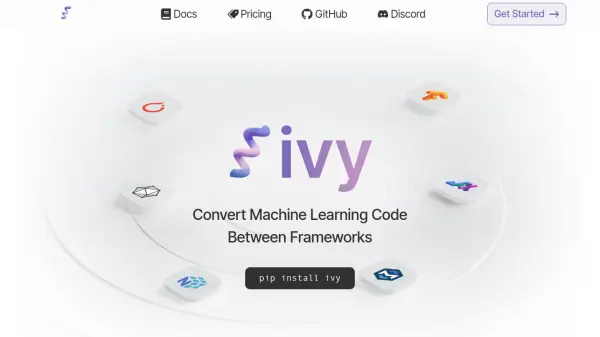
Ivy facilitates the conversion of machine learning code across different deep learning frameworks. It employs a source-code to source-code transpilation method, allowing developers to seamlessly translate models between popular platforms such as PyTorch, TensorFlow, JAX, and NumPy. This approach ensures that the converted models retain their original functionality and structure, making them easily modifiable post-conversion.
The tool simplifies the often complex process of framework migration into a single line of code. Ivy aims to unify the deep learning ecosystem by providing cross-compatibility, allowing libraries and models initially developed in one framework to be utilized in others, thus enhancing flexibility and development choices for machine learning practitioners.
Features
- Framework Transpilation: Convert deep learning models between PyTorch, TensorFlow, JAX, and NumPy.
- One-Line Conversion: Execute framework conversions with a single line of code.
- Source-to-Source Conversion: Retains original model functionality and structure for easy modification after conversion.
- Cross-Compatibility: Unifies frameworks, enabling models and libraries to work across different platforms.
- Integrated Libraries Support: Enables multi-framework support for libraries that integrate Ivy.
Use Cases
- Migrating existing machine learning models from one framework to another (e.g., PyTorch to TensorFlow).
- Utilizing models developed in a specific framework within a different framework's ecosystem.
- Enabling libraries to support multiple deep learning frameworks simultaneously.
- Standardizing codebases that involve multiple ML frameworks.
- Facilitating collaboration among teams using different ML frameworks.