What is Dokku?
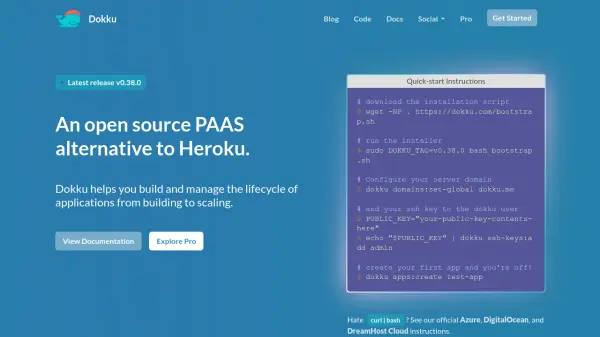
Dokku is an open source Platform as a Service (PaaS) that provides a Heroku-like experience for deploying and managing applications. Powered by Docker, it can be installed on any hardware, allowing users to own their PaaS without vendor lock-in. Once set up, Heroku-compatible applications can be pushed via Git, built using Heroku buildpacks, and run in isolated containers. Dokku supports application lifecycle management from building to scaling, making it a lightweight and extensible alternative for single-host deployments.
Features
- Heroku Compatibility: Deploy Heroku-compatible applications via Git with support for Heroku buildpacks.
- Docker-Powered: Runs applications in isolated Docker containers for consistency and portability.
- Extensible via Plugins: Customize Dokku with plugins written in any language to add features.
- Lifecycle Management: Manages the entire application lifecycle from building to scaling.
- No Vendor Lock-in: Install on any hardware, including inexpensive cloud providers, and own your PaaS.
Use Cases
- Deploying web applications on a personal server
- Hosting side projects or prototypes with low cost
- Learning and experimenting with containerized deployments
- Replacing Heroku for single-host applications
- Testing and staging Heroku-compatible apps before production deployment
FAQs
-
What is Dokku used for?
Dokku is an open source Platform as a Service (PaaS) that allows you to build and manage the lifecycle of applications, from building to scaling, similar to Heroku but self-hosted. -
How do I install Dokku?
Dokku can be installed via a bootstrap script: download it and run with sudo, specifying the desired release tag. Detailed instructions are available on the official documentation. -
Can Dokku run on any hardware?
Yes, Dokku is powered by Docker and can be installed on any hardware, including inexpensive cloud providers, providing a no-vendor-lock-in PaaS solution. -
Does Dokku support plugins?
Yes, Dokku is extensible and customizable via plugins. Plugins can be written in any language and shared online to add features beyond the core functionality. -
Is Dokku compatible with Heroku?
Yes, Dokku supports Heroku-compatible applications. You can push apps via Git and they will build using Heroku buildpacks, then run in isolated containers.