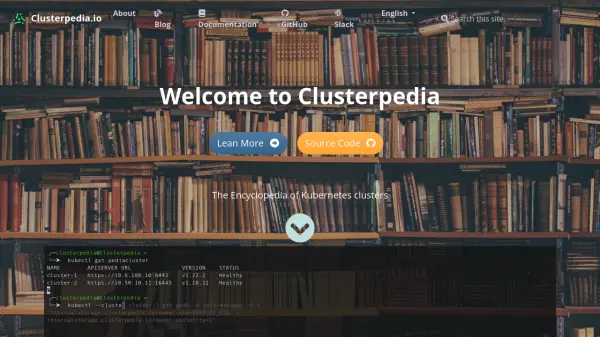
What is Clusterpedia?
Clusterpedia is a Cloud Native Computing Foundation sandbox project that synchronizes resources with multiple Kubernetes clusters and provides enhanced search capabilities. It supports searching for multi-cluster resources by type (e.g., Pod, Deployment) and combining multiple resources into Collection Resources. Compatible with Kubernetes OpenAPI, Clusterpedia works with existing tools like kubectl and client-go without additional frameworks.
Clusterpedia supports complex search conditions beyond Label Selector, including specifying multiple clusters and namespaces, using powerful Field Selectors to filter resources by any field, querying descendant resources via parent or ancestor Owner, sorting by multiple resource fields, and supporting pagination with remaining items count.
Features
- Multi-cluster Resource Synchronization: Synchronize resources from multiple Kubernetes clusters for unified search.
- Extensive Resource Support: Search for multi-cluster resources by type (Pod, Deployment) and create Collection Resources.
- Custom Resource Search: Ability to search for custom Kubernetes resources.
- Kubernetes OpenAPI Compatibility: Works with kubectl and client-go without extra tools.
- Complex Search Conditions: Supports Label Selector, Field Selector, ancestor Owner queries, multi-field sorting, and pagination.
Use Cases
- Unified search across multiple Kubernetes clusters.
- Troubleshooting by filtering resources across clusters using Field Selectors.
- Resource dependency analysis using ancestor Owner queries.
- Inventory management with paginated multi-cluster resource listings.
FAQs
-
Does Clusterpedia support searching custom resources?
Yes, Clusterpedia can search for custom Kubernetes resources. -
Can I use kubectl with Clusterpedia?
Yes, Clusterpedia is compatible with Kubernetes OpenAPI, so you can use kubectl and client-go. -
Is Clusterpedia free to use?
Yes, Clusterpedia is an open-source project and free to use.