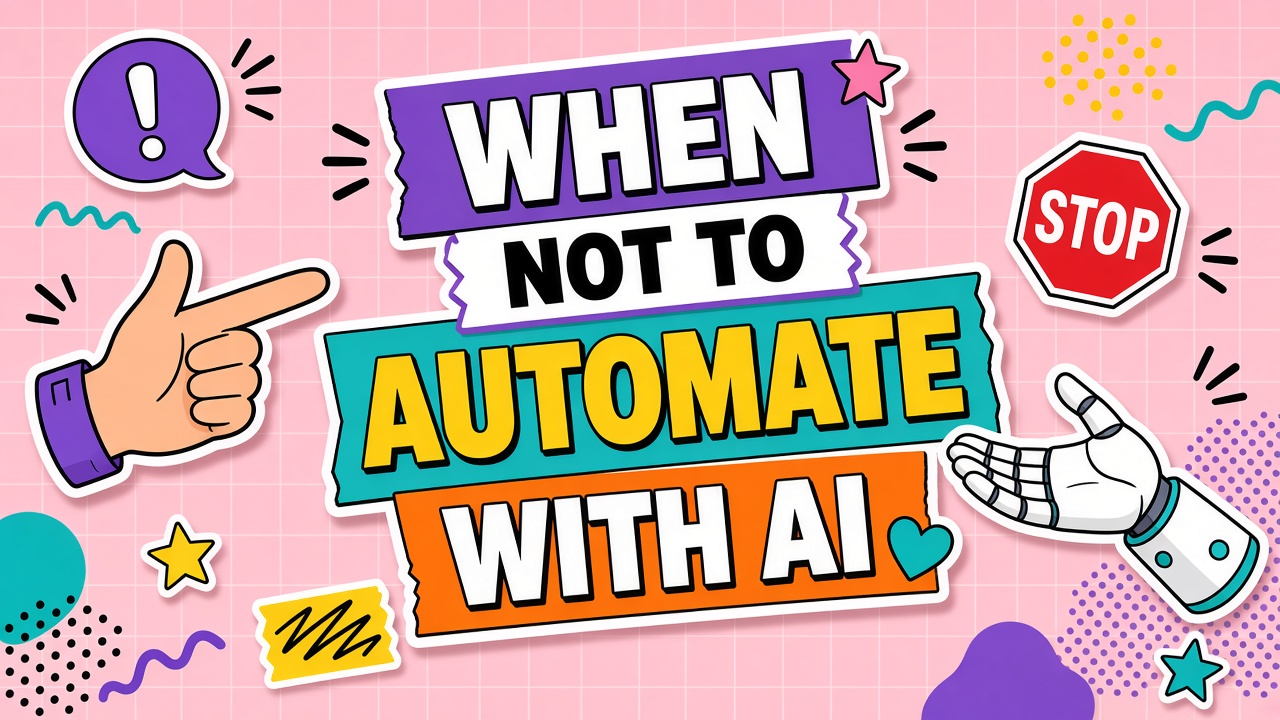
Automation pressure is real. Leaders see a demo and ask why a whole team still does work manually. The better question is whether the task tolerates probabilistic output, reversible errors, and no named human accountable for the decision.
Knowing when not to use AI automation protects customers, employees, and your brand. This guide lists categories where automation fails, ethical and legal boundaries, and gray areas that need human escalation. Pair it with AI productivity tools for tasks that do fit automation, and AI writing tools only where human review remains mandatory.
Categories Where AI Automation Fails
AI automation fails when the cost of a wrong answer exceeds the cost of manual work, when accountability must be traceable to a person, or when the input signal is too sparse for reliable inference.
| Category | Why automate fails | Human alternative |
|---|---|---|
| Final legal or medical decisions | Liability, licensing, patient safety | AI drafts; licensed professional decides |
| Performance termination or discipline | Bias risk, legal exposure, dignity | Manager with HR; AI may summarize facts only |
| Security incident response | Wrong action amplifies breach | Runbooks with human approval gates |
| Negotiation with strategic partners | Relationship and non-text context matter | AI prep briefs; humans negotiate |
| Novel creative direction (brand-defining) | Originality and taste are human calls | AI explores variants; creative lead chooses |
Ethical and Legal Boundaries
Regulators and courts increasingly ask who decided, not which model generated text. Automating decisions in credit, housing, hiring, or healthcare screening without human review may violate sector rules even when the model is accurate on average.
- Disclosure: Customer-facing automation may require telling users AI was involved.
- Data minimization: Do not automate flows that force unnecessary sensitive uploads.
- Appeal path: Automated rejections need a human reconsideration route.
High-Stakes Judgment Calls
High-stakes means harm is hard to undo: account bans, refunds denied, safety recalls, public statements during a crisis. AI can summarize options; a named approver must pick one.
Relationship-Sensitive Communication
Apologies to upset customers, layoff notices, condolence messages, and executive replies to board members carry tone risk that models miss. Use AI for internal drafts only, with a human rewriting voice and checking facts.
Creative Originality Requirements
Campaign concepts, trademark-sensitive naming, and flagship product positioning need human authorship for both legal and brand reasons. AI is useful for mood boards and rough copy, not for signing off the final direction without human creative ownership.
Frequently Asked Questions
What about gray areas where AI helps but should not decide?
Use a two-step rule: AI produces draft or score; human with domain authority approves before anything external ships. Log both steps for audit.
When should teams escalate from AI to a human?
Escalate when confidence is low, stakes are high, the user disputes the output, or policy marks the workflow as human-only. Build escalation into the workflow, not as an afterthought in Slack.
Is internal automation lower risk than customer-facing?
Internal use reduces reputational risk but not legal risk if decisions affect employees or regulated data. Treat internal HR and finance automation with the same gates as customer flows when outcomes are binding.