Two coding assistants run the same model size. One streams answers word by word with noticeable pauses. The other feels instant, as if tokens arrive in bursts. The difference is often not a bigger GPU but an inference trick called speculative decoding, also known as draft-and-verify decoding.
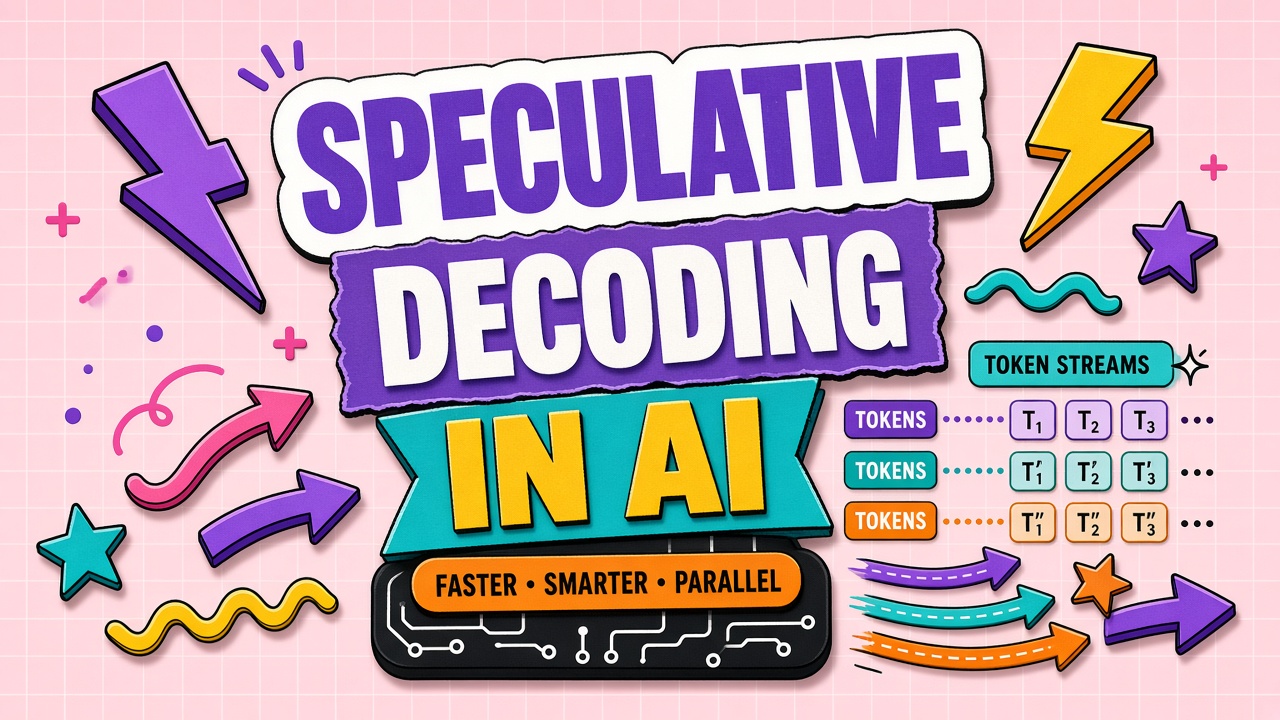
Speculative decoding speeds up text generation by pairing a small, fast draft model with a larger target model. The draft proposes several tokens at once; the target model verifies them in parallel and accepts the longest matching prefix. Users of AI image generators and AI design tools notice similar latency wins wherever providers optimize inference behind the scenes, even when marketing focuses on model quality instead of decoding mechanics.
Draft-and-Verify Decoding in Plain Language
Standard autoregressive decoding generates one token, feeds it back, generates the next, and repeats. Each step waits on the full target model. Speculative decoding adds a cheaper draft model that guesses the next few tokens quickly. The target model then evaluates those guesses in a single forward pass. Matching tokens are accepted in bulk; the first mismatch triggers a correction and the cycle restarts.
When draft and target models agree often, you see multi-token leaps with the quality of the larger model. When they disagree frequently, speedup vanishes and overhead can even slow generation slightly.
The technique was described in research literature before widespread production deployment. Inference frameworks adopted it because GPU utilization improved: the target model processes batches of candidate tokens instead of idling between single-token steps. Acceptance rate is the key metric. If the draft model agrees with the target on four of five proposed tokens, you effectively generate four tokens for roughly the cost of one target forward pass plus one cheap draft pass.
The acceptance loop in four steps
- Draft proposes: A small, fast model generates K candidate tokens given the current context.
- Target verifies: The large model computes probabilities for those K positions in one pass.
- Accept or reject: Matching prefixes are committed. On first mismatch, reject from that token onward.
- Repeat: The loop continues until the response completes or a stop condition triggers.
Why Latency Matters for Interactive AI Tools
Perceived intelligence correlates with responsiveness in chat, autocomplete, and agent UIs. Delays above a few hundred milliseconds break conversational flow in interfaces where users expect near-real-time feedback. Speculative decoding targets time-to-first-token and inter-token delay without requiring users to switch to a smaller, lower-quality model for every request.
Interactive tools live or die on perceived responsiveness. Chat assistants, design copilots, and real-time prompt editors all depend on how quickly visible output arrives. A latency reduction that does not change benchmark scores on a leaderboard can still determine whether a designer keeps a tool open all afternoon or switches tabs. Speculative decoding attacks the serial bottleneck in autoregressive inference by reorganizing work so users wait less between visible updates.
- Chat assistants: Faster streaming keeps users engaged during long explanations.
- Code completion: Inline suggestions must appear before the developer types the next character.
- Agent loops: Multi-step tool use multiplies latency; shaving milliseconds per token compounds across steps.
- Design sidebars: Short label rewrites and layout suggestions need snappy token delivery.
- Voice and realtime pipelines: Lower latency per chunk keeps conversation natural.
| Workflow | Latency sensitivity | Typical user expectation |
|---|---|---|
| Live chat assistance | High | Streaming starts within 1 to 2 seconds |
| Design prompt iteration | High | Rapid tweak-and-regenerate cycles |
| Batch content generation | Moderate | Total job time matters more than per-token feel |
| Overnight report pipelines | Low | Throughput and cost dominate UX |
Where Users Notice Speed Gains
Gains appear wherever providers run paired models on capable hardware and prompts follow predictable patterns. Coding assistants benefit because code syntax is repetitive. Customer support macros and templated replies show similar draft acceptance rates. Open-ended creative writing with rare vocabulary sees smaller wins because draft models mispredict more often.
Speculative decoding helps most when draft and target models agree often. That alignment is highest on repetitive, template-like text: code completion, UI copy variants, structured JSON, and follow-up edits that stay on distribution. Gains are smaller on highly creative or rare-token outputs where the draft model diverges early and acceptance rates drop. First-token cold starts (model loading, queue time) are not solved by speculative decoding; users still wait on infrastructure before any tokens stream.
Scenarios with smaller gains
- Long-form unique prose: Draft mismatch rises; acceptance batches shrink.
- Multimodal image generation: Different bottlenecks may dominate the full render path.
- Low-resource languages: Draft models may weakly track target distributions.
- Very short replies: Setup overhead eats savings on one-sentence answers.
| Use case | Typical speedup | Why |
|---|---|---|
| Code autocomplete | High | Repetitive syntax, strong draft-target alignment |
| FAQ chatbots | Moderate to high | Common phrasing patterns |
| Creative fiction | Low | Unpredictable token sequences |
| Multilingual mixed prompts | Variable | Draft model may weakly match target on low-resource languages |
Latency in Design and Image Tool Workflows
AI design copilots mix text generation with canvas operations. Prompt refinement, layout suggestions, and component label rewrites are autoregressive text tasks where speculative decoding can shorten the gap between typing and seeing suggestions. The image render itself often runs through diffusion or other pipelines where different optimizations apply, but the surrounding conversational layer still benefits from faster token streaming.
Image generators that offer chat-style prompt editing (describe changes in natural language before regenerating) expose speculative gains in the text leg of the workflow. Users iterating on "make the sky warmer" and "add more contrast" notice responsiveness in the assistant panel even when each full render still takes several seconds. Providers rarely label this as speculative decoding in product copy; benchmark time-to-first-token on prompt-assist features separately from full image generation time.
Compare speculative decoding AI benefits indirectly by running identical prompt-edit sessions across tools and measuring how quickly suggested rewrites appear.
Vendors rarely advertise speculative decoding on marketing pages. Phrases like "optimized inference," "fast mode," or latency-focused tier names sometimes map to similar serving stacks. When evaluating image tools, separate measurements for prompt-assist latency vs full render time. A fast chat sidebar paired with a slow diffusion backend is common and not a contradiction.
Limits: Model Pairing, Hardware, and Quality
Speculative decoding is not a universal turbo button. Effectiveness depends on how well the draft model tracks the target distribution, batch size limits on your inference stack, and whether verification runs on the same GPU cluster without queue contention.
- Model pairing: Draft models are often distilled variants of the target. Mismatched families reduce acceptance rates.
- Hardware dependency: Parallel verification needs memory bandwidth. CPU-only deployments may see minimal benefit.
- Quality tradeoffs: Correctly implemented speculative decoding preserves target-model output distribution. Bugs in acceptance logic can introduce subtle quality drift.
- Short outputs: Fixed setup cost means very short replies may not benefit.
Draft and target alignment in practice
Cloud providers that ship matched draft checkpoints (often labeled as speculative partners in server configs) achieve higher acceptance than arbitrary pairings. Self-hosted teams should consult their inference server documentation for supported model pairs. Running a 7B draft against a 70B target from different training runs may underperform compared to vendor-tuned pairs distilled from the same data mix.
Output quality equivalence
Correct speculative decoding preserves the target model's output distribution. Implementation bugs, approximate verification, or vendor "fast modes" that actually swap to a smaller model do not. Ask whether fast tiers change the model weights or only the inference path. A cheaper model is not speculative decoding; it is a different product tier with different capability ceilings.
Frequently Asked Questions
Does faster decoding always mean lower API cost?
Not necessarily. You may pay the same per token while experiencing better UX. Some providers pass efficiency savings through lower latency tiers rather than reduced per-token pricing. Check whether billing counts draft-model tokens separately. Speculative decoding can lower latency while using similar or higher total compute because two models run per step. Managed APIs may price per token regardless of internal optimizations.
Should API integrators configure speculative decoding?
Usually no. Cloud APIs hide decoding strategy behind latency SLAs. Self-hosted deployments using vLLM, TensorRT-LLM, or similar stacks can enable speculative decoding in server configuration. Document which model pairs your ops team supports.
Can users tell when speculative decoding is active?
Rarely. Streaming may arrive in small bursts instead of perfectly even token spacing. There is no user-facing toggle on most consumer products.
Why not just use the draft model alone?
Draft models trade quality for speed. Speculative decoding gives you target-model accuracy with draft-model latency when acceptance rates are high. For tasks requiring maximum reasoning depth, users still choose the full target model tier explicitly.
Does speculative decoding speed up diffusion image models?
Classic speculative decoding targets autoregressive token generation. Image diffusion uses iterative denoising steps, which vendors optimize through distilled schedulers, fewer steps, or hardware-specific kernels. Some multimodal stacks include autoregressive components where draft-and-verify applies, but "fast image mode" usually refers to step reduction, not text-style speculative decoding.
How should teams measure latency improvements?
Track time to first token, tokens per second at steady state, and end-to-end time for fixed output lengths. Measure at p50 and p95 under production load. Demo-tier accounts on quiet servers mislead compared to peak-hour behavior in shared API pools.
Can you enable speculative decoding when self-hosting?
Open-source inference servers such as vLLM and TensorRT-LLM expose speculative decoding options for compatible model pairs. Configuration requires matched draft checkpoints, tuning speculation length, and sufficient GPU memory. Managed APIs abstract this away but offer less control over acceptance thresholds and model pairing.
Speed You Can Feel in Daily Work
Hardware quality matters as much as algorithm choice. Speculative decoding needs enough GPU memory to host draft and target models concurrently, plus bandwidth for parallel verification passes. Under-provisioned inference clusters see queue contention that wipes out decoding gains during peak hours.
Speculative decoding AI optimizations matter most when your team lives inside interactive tools all day. A few hundred milliseconds per token compounds across long sessions, agent loops, and pair-programming workflows. Treat vendor latency claims as hypotheses to validate on your prompts, region, and time of day.
Speculative decoding speeds up token generation by batching verification with a draft model, preserving target quality when implemented correctly. For AI image generator and AI design buyers, latency shapes iteration loops more than benchmark leaderboards. Ask vendors whether fast modes change models or inference paths, measure time-to-first-token on your workloads, and remember that creative outputs with low draft acceptance see smaller gains. Speed is a systems property: model pairing, hardware, and queue depth matter as much as the algorithm name. When comparing tools on EliteAI.tools, read latency documentation alongside model size claims. A smaller model with speculative serving can feel faster than a larger model on unoptimized infrastructure, even when benchmark scores favor the bigger checkpoint.