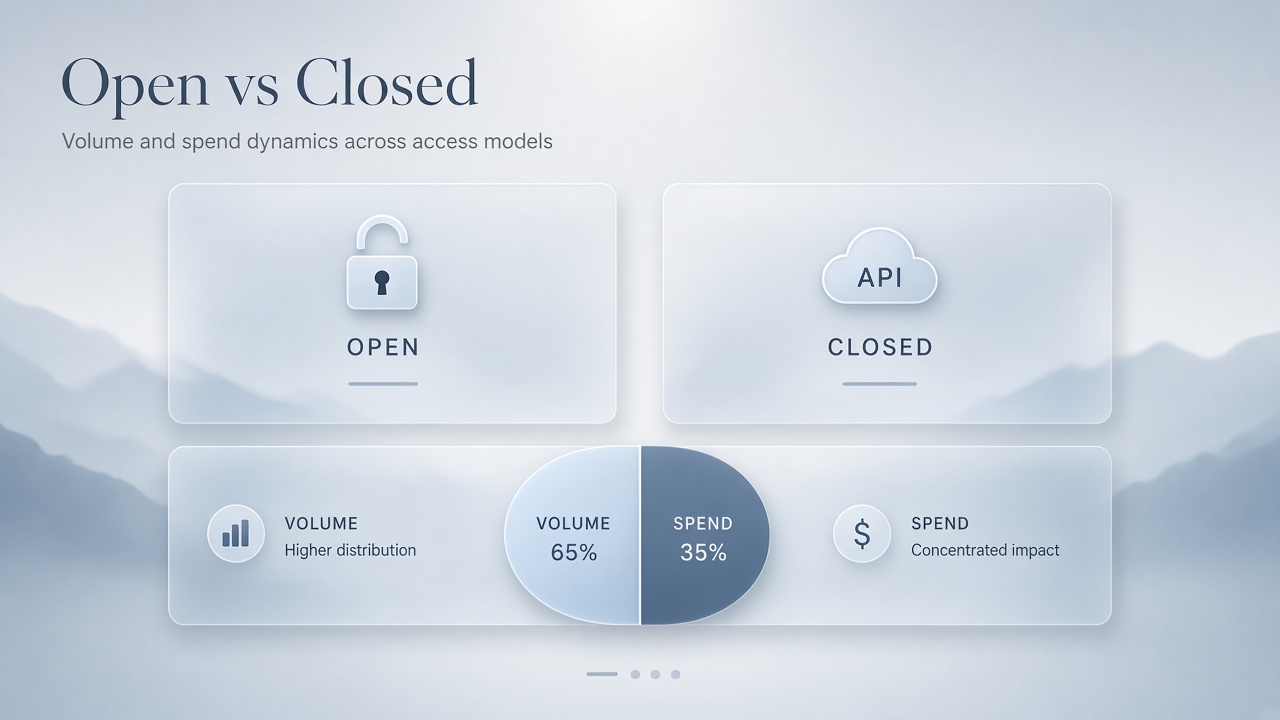
"Open models are winning" and "closed models dominate" can both be true in the same quarter. It depends whether you measure tokens processed, dollars spent, developer mindshare, or regulated enterprise contracts. August 2026 gateway data showed open-weight models at a record fraction of production traffic while Anthropic and OpenAI still collected most revenue. Buyers need both numbers on the same slide.
This analysis of open weight vs closed models 2026 summarizes usage and revenue signals, self-hosting growth drivers, reasons enterprises still pick closed APIs, and security/compliance factors shaping hybrid routing. Explore deployment options via open-source AI tools and AI code platforms that now default to model-agnostic harnesses.
Usage and Revenue Signals in 2026
On Vercel's AI Gateway, open-weight models rose from about 11% of token volume in April 2026 to 29% in June and a record 62% on August 22, while capturing under 9% of spend in recent months. Anthropic closed models accounted for roughly 61-65% of gateway spend over the same period. The split is routing strategy, not market confusion: cheap open models handle volume; closed frontiers handle high-stakes tasks.
| Metric | Open-weight signal | Closed API signal |
|---|---|---|
| Token volume (Vercel Gateway) | Up to ~62% (Aug 22) | ~38% same day |
| Spend share (Vercel Gateway) | Under 9% (Aug) | Anthropic ~61-65% |
| Enterprise adoption | ~1 in 8 customers run open-weight in prod (Jun) | Majority still default to closed APIs |
| OpenRouter study (MIT co-authored) | ~20% of tokens; ~4% of revenue | ~80% tokens; ~96% revenue |
Earlier OpenRouter research cited by MIT Sloan found open models cost about 87% less per million tokens on average while closed models captured nearly all platform revenue. Optimal reallocation to superior open alternatives could cut spending more than 70% in theory, but production traffic still favored closed models during the study window. The open source llm market share story is therefore bifurcated: volume is shifting faster than wallet share.
DeepSeek and Chinese Open Weights
DeepSeek alone reached about 22.6% of Vercel gateway token volume in June, nearly matching Google's share. Chinese-built open models were a large subset of open traffic but not identical to the overall open-weight category. Conflating the two overstates or understates geopolitical supply-chain risk depending on the audience.
Self-Hosting Growth Drivers in 2026
Teams adopt open weights when inference cost, data residency, customization, and vendor risk outweigh the convenience of a closed API. 2026 drivers include:
- Price wars on closed mid-tiers still leave high-volume routing expensive compared with self-hosted Llama, Qwen, or DeepSeek weights.
- Model-agnostic agent harnesses (MCP, IDE plugins, gateway routers) make switching a configuration change.
- Inference providers multiply hosting options without operating bare-metal GPU clusters.
- OpenAI's reduced fine-tuning availability pushes enterprises to open weights for domain adapters.
- EU and sector regulators reward auditable on-prem deployments for sensitive workloads.
Hugging Face download trends and contributor programs (such as Meta Muse tiers) signal developer momentum even when revenue stays with closed APIs. Watch tokens, customers, and inference provider coverage together.
When Enterprises Pick Closed APIs
Closed frontier APIs still win when error cost is high, capabilities are multimodal and agentic, legal indemnification matters, or teams lack GPU operations staff. Typical closed-API workloads in 2026:
- Customer-facing agents with brand risk and strict latency SLAs.
- Long-horizon coding agents using vendor-integrated computer use and browsing.
- Regulated document analysis where vendor SOC 2, HIPAA BAA, or EU data packages are pre-negotiated.
- Early-stage teams optimizing time-to-market over unit cost at modest scale.
Enterprise buyers often run a closed API vs open weights portfolio: closed models for customer-facing and compliance-heavy paths, open models for batch summarization, embedding, and internal tools. That hybrid pattern matches gateway economics where open traffic exploded but spend did not flip.
Security and Compliance Factors
Open weights add control; closed APIs add vendor accountability. Neither removes security engineering. Self-hosting demands patch management for CUDA stacks, model weight integrity checks, and network isolation. Closed APIs demand data processing agreements, prompt logging policies, and exit planning when pricing shifts.
| Factor | Open-weight tilt | Closed API tilt |
|---|---|---|
| Data residency | Full on-prem control | Regional endpoints + ZDR options |
| Patch velocity | Your ops team owns CVE response | Vendor ships security updates |
| Capability frontier | Lags on agents/multimodal peaks | First access to flagship features |
| License audit | Must track weight licenses per deployment | Terms of service govern use |
For enterprise model choice 2026, security reviews should score each workload independently. A gateway dashboard showing 62% open tokens does not automatically justify moving customer PII to self-hosted weights without matching controls.
Frequently Asked Questions
Are open-weight models winning in 2026?
They are winning a large and growing share of production token volume on major gateways, but closed APIs still capture most revenue and many high-stakes workloads.
How can open models be 62% of tokens but under 9% of spend?
Open-weight inference prices average far less per token. Teams route bulk, low-risk traffic to cheap open models while reserving expensive closed frontiers for critical tasks.
What share of enterprises use open weights in production?
Vercel reported roughly one in eight enterprise AI Gateway customers running at least one open-weight model in production as of June 2026, with adoption still early relative to token share growth.
Should my company pick open or closed models?
Most large organizations should plan hybrid routing: closed APIs where capability and compliance packages matter, open weights where cost and control dominate.
Does DeepSeek represent all open-weight growth?
No. DeepSeek is a major contributor, but Qwen, Llama-family, Kimi, and other open models also appear in gateway and OpenRouter statistics. Treat Chinese open weights as a subset, not the whole category.
Which metrics should I track quarterly?
Token share by model family, spend share, production customer adoption, inference provider coverage, and workload types successfully moved to open weights without quality regression.