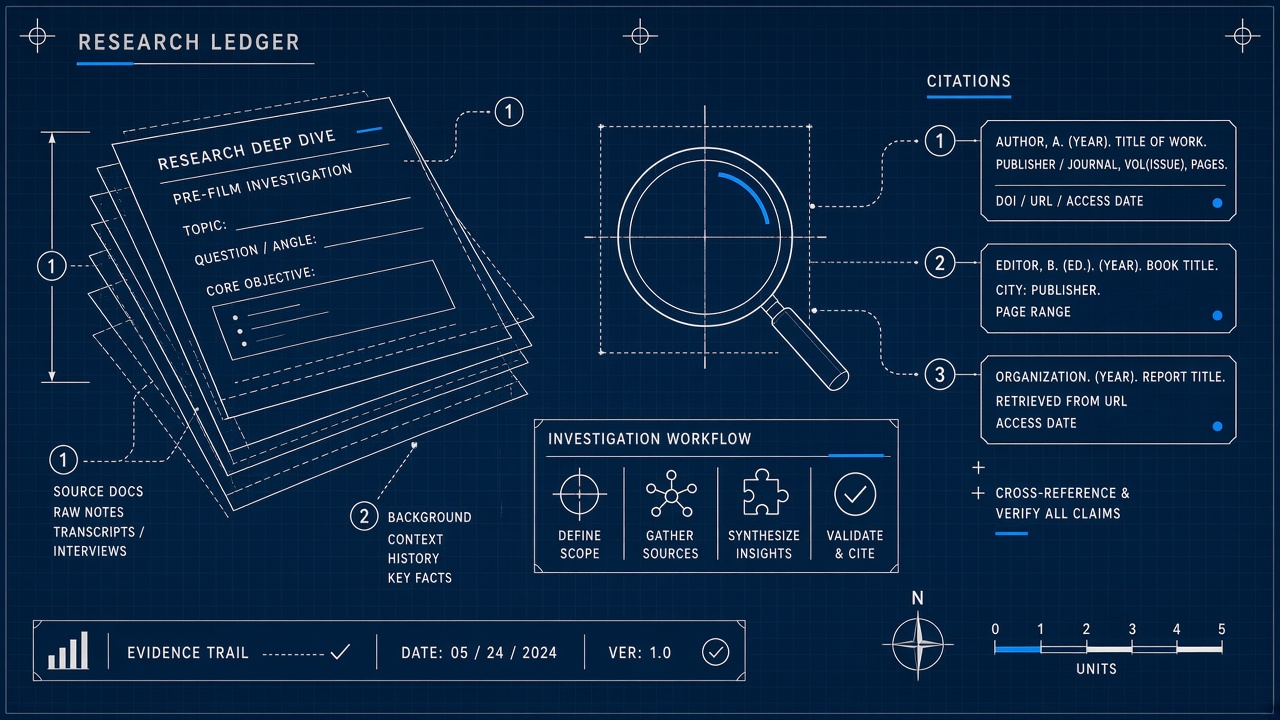
Explainer videos fail when the script repeats blog summaries without primary sources, or when a confident tone hides gaps you discover only after comments cite contradicting studies. An ai workflow creator research pipeline defines the research question and scope, gathers tier-1 sources and primary documents, synthesizes findings with explicit uncertainty flags, builds a film-ready outline with citation placeholders, and documents a post-publish correction workflow. AI accelerates summarization and gap spotting; you verify claims, choose what to film, and own corrections when new evidence appears.
This guide fits documentary-style YouTubers, science communicators, finance educators, and journalists building creator businesses. Pair research with AI code tools when you automate source bibliographies and AI chatbot tools for structured Q&A against your source packet, never as a substitute for reading primary documents on high-stakes topics.
Define Research Question and Scope
State one research question, audience knowledge level, runtime target, and explicit out-of-scope topics before collecting sources so the deep dive stays filmable and defensible. Vague topics ("AI in healthcare") sprawl; scoped questions ("How FDA regulates AI diagnostic tools in 2026") produce outline-ready structure.
- Research question in one sentence: what should the viewer understand or decide?
- Audience: beginner, practitioner, or mixed (affects jargon budget).
- Runtime: 8, 15, or 25 minutes sets depth cap on sub-questions.
- Out of scope list: adjacent controversies you will mention but not resolve.
- Success criteria: 3 to 5 takeaways the description will promise.
| Scope element | Example (tech explainer) | Why it matters |
|---|---|---|
| Core question | How vector databases differ from traditional SQL for RAG | Drives section headers |
| Audience | Developers new to embeddings | Limits math depth on camera |
| Out of scope | Full fine-tuning tutorial | Prevents runtime bloat |
| Takeaway count | Four decision criteria for tool choice | Matches thumbnail promise |
Gather Tier-1 Sources and Primary Docs
Collect tier-1 sources (peer-reviewed papers, official regulator pages, company primary documentation, court filings, standards bodies) before secondary blogs and social threads enter the packet. The ai workflow creator research quality floor is source hierarchy, not word count.
- Tier 1: .gov, standards org, journal DOI, SEC filing, official product docs.
- Tier 2: reputable trade press, established textbooks, conference proceedings.
- Tier 3: blogs, forums, tweets (lead generation only, verify elsewhere).
- Save PDFs, archive URLs (Wayback or local copy), note access date.
- Minimum source count scales with claim risk: 3 for opinion, 8 plus for medical or legal.
| Source type | Use on camera | Citation in description |
|---|---|---|
| Peer-reviewed study | Summarize finding, show title slide | DOI link required |
| Regulator guidance | Quote short compliant excerpt | Official page URL |
| Vendor whitepaper | Label as vendor claim | Link plus conflict note if sponsored |
| Anonymous forum post | Do not cite as fact | Exclude from bibliography |
Source Packet Structure
Build one folder or doc per video with source ID, title, tier, 3-bullet summary you wrote after reading, and quotes with page numbers for script placeholders. AI summaries attach to source IDs so you can trace any drafted line back to a document you opened.
AI Synthesis With Explicit Uncertainty Flags
Run AI synthesis only on your source packet and require uncertainty flags on conflicting studies, missing data, vendor marketing language, and preprint status before any claim enters the outline. Prompt for "high confidence," "mixed evidence," and "unknown" labels per bullet.
- Input: numbered source list with tier tags, not open web browse for final synthesis.
- Ask for agreement and disagreement tables across sources.
- Flag preprints and retracted papers explicitly.
- Reject synthesis that cites sources not in your packet.
- Human read: does the synthesis match your reading of the abstract or executive summary?
| Confidence flag | On-camera language | Example |
|---|---|---|
| High | State directly with citation | Multiple tier-1 sources agree |
| Mixed | Present both sides, note debate | Conflicting clinical trials |
| Low / unknown | Omit or say evidence is limited | Single small preprint |
Outline Script With Citation Placeholders
Convert synthesis into a timed outline where every factual beat includes a citation placeholder [S3], a confidence flag, and a visual plan (talking head, diagram, quote card) before you write full prose. Filming from a verified outline reduces mid-shoot rewrites when you cannot find the source for a stat you almost said.
- Hook: question plus stakes (no citations needed if clearly opinion).
- Section blocks: 2 to 4 minutes each with one main claim per block.
- Insert [S#] after each verifiable sentence in outline notes.
- Mark B-roll or slide for each citation (paper title, chart, regulator logo).
- Conclusion: restate takeaways without adding new uncited facts.
| Outline field | Purpose | Filled by |
|---|---|---|
| Timestamp target | Pacing control | Creator |
| Claim + [S#] | Traceability | Research lead |
| Confidence flag | Tone calibration | AI draft, human confirm |
| Visual note | Edit and shoot prep | Creator or producer |
Expand outline to full script only after citation pass: search script for numbers, dates, and superlatives; each needs a [S#] or rewrite as opinion.
Description Bibliography and On-Screen Citations
Publish a numbered bibliography in the video description matching [S#] placeholders from production, and show key source titles on screen when the claim is contested or easy to misquote. Viewers and commenters use description links as the authority anchor for your deep dive.
- Export bibliography from source packet; same order as [S#] keys.
- Include access date for pages that change frequently.
- Pin a comment pointing to sources section for long descriptions.
- Chapters align to sections so fact-checkers can jump to claims.
Post-Publish Correction Workflow
When viewers or experts flag errors, run a correction workflow: verify against tier-1 sources, pin or edit description, add on-screen correction card or follow-up short, and log the change in your source packet. Silent fixes without disclosure erode trust on research channels.
- Intake: comment, email, or expert DM with specific claim challenged.
- Verify: re-read cited source; check for newer publication.
- Severity: typo vs material misrepresentation vs harmful health claim.
- Action: description errata, pinned comment, re-upload with correction card, or full follow-up video.
- Archive: note correction date in source packet for future reference.
| Error severity | Minimum response | Timeline |
|---|---|---|
| Minor typo or date | Description fix plus pinned note | 48 hours |
| Wrong stat, right topic | Correction card in video or community post | 72 hours |
| Material factual error | Follow-up video or re-upload | ASAP, prioritize |
Collaboration With Fact-Checkers
Invite domain experts to review outline bullets flagged "mixed" before filming; credit them in description when they contribute substantively. AI cannot replace expert review on regulated topics; it can format questions for faster expert replies.
Research Deadline and Scope Guardrails
Set a hard research stop time relative to publish date so synthesis does not expand indefinitely; when new sources appear after the stop, queue them for a follow-up video instead of delaying the current outline. Scope guardrails prevent perfectionism from blocking your upload calendar while keeping the on-camera claims within the packet you actually verified.
- Research stop: 72 hours before record date for weekly channels.
- Freeze source packet version number on outline approval.
- Post-publish sources feed the correction workflow or sequel topic list.
- Track hours spent per video to calibrate future scope questions.
Frequently Asked Questions
How many sources does a 15-minute deep dive need?
Plan 6 to 12 tier-1 or tier-2 sources for a typical explainer, more when each section makes independent factual claims. Quality and traceability beat raw count; three strong papers beat twenty blog links.
How do I stop AI from inventing citations?
Restrict synthesis to your uploaded source packet, require source IDs on every bullet, and reject any [S#] that does not exist in your bibliography. Never ask the model to "find sources" without you opening each one.
How should I separate opinion from researched fact on camera?
Use explicit framing ("In my experience," "The literature suggests") and reserve definitive language for high-confidence tier-1 claims you show on screen. Outline flags help you rehearse tone before recording.
How long should research take versus filming?
Many research-heavy creators spend 2 to 4 hours of source work per 1 minute of final runtime for new topics; familiar beats reuse packet sections. Scope definition prevents research expanding past filming deadlines.
Research Once, Film With Citations Ready
A practical ai workflow creator research practice scopes the question, gathers tier-1 sources, synthesizes with uncertainty flags, builds cited outlines, and corrects in public when evidence changes. AI speeds reading and gap analysis; your source discipline defines credibility. Run the scope table on your next video idea before you open a draft script.