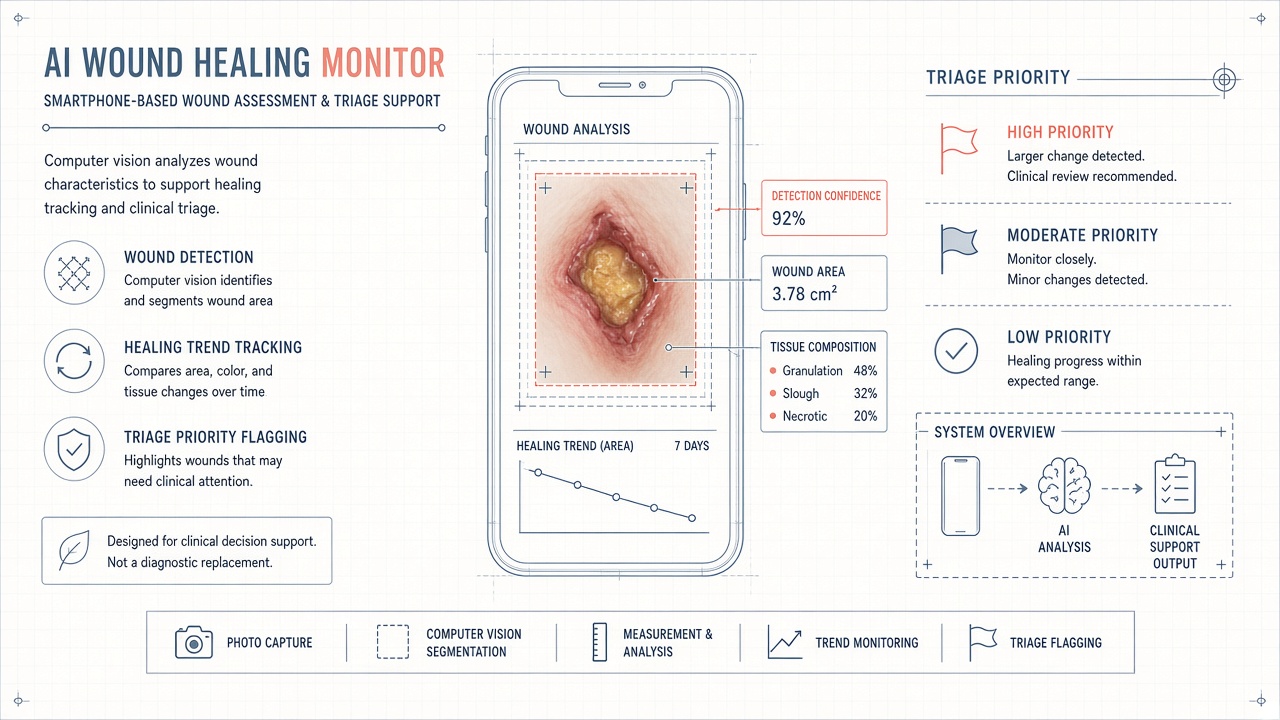
A cardiac surgery patient photographs her sternotomy incision on day twelve at home. Redness spreads along the lower edge, but she hesitates to call the clinic because the nurse line is busy. Meanwhile, the wound care team receives dozens of daily images from remote monitoring patients and cannot review every upload before complications worsen. Wound healing AI monitoring applies computer vision to smartphone photographs, flagging redness, gaping, fluid, discoloration, or retained sutures so clinicians triage urgent cases first. These systems augment, not replace, physical examination and culture-guided antibiotic decisions.
Surgical program directors evaluating post-discharge pathways and community health nurses managing diabetic foot ulcers should understand sensitivity across skin tones, regulatory classification, and how AI chatbot wound care advice differs from validated image classifiers. More digital health explainers sit on the EliteAI.tools blog index.
What Wound Healing AI Monitoring Means in Plain Language
Wound healing AI monitoring refers to software that analyzes photographs of acute or chronic wounds to detect signs of delayed healing, infection, or dehiscence, then routes high-risk images to clinicians for timely review. Patients or caregivers capture images with standard smartphone cameras under guidance on lighting, distance, and wound exposure. Algorithms trained on labeled clinical image libraries classify visual features associated with complications. Outputs range from binary urgency flags to segmented wound areas with area measurements over time.
The clinical problem is twofold: surgical site infections and chronic wound deterioration often present first at home, and scaling human review of every submitted image creates operational bottlenecks. AI prioritization aims to preserve early detection benefits of remote monitoring without overwhelming staff. Accuracy must be evaluated against specialist nurses, not only against historical labels, because inter-rater disagreement on wound photography is substantial.
| Visual signal | Clinical concern | AI detection role |
|---|---|---|
| Erythema / redness | Early cellulitis or SSI | Priority flag for nurse callback |
| Wound gaping | Dehiscence risk | Urgent surgical review queue |
| Exudate / fluid | Infection or seroma | Feature-specific sensitivity tracking |
| Discoloration | Ischemia or necrosis | Escalation when combined with other flags |
How the Underlying AI Pipeline Works
Smartphone wound AI pipelines ingest patient photographs through a secure portal, normalize lighting and orientation, run object detection or segmentation models, and output triage scores integrated into clinician dashboards. The UK WISDOM program (Wound Imaging Software and Digital platfOrM) illustrates a production architecture: the Isla digital wound monitoring platform receives post-operative images, an artificial intelligence module built with You Only Look Once (YOLO) object detection models scores red-flag features, and flagged cases surface at the top of nurse review queues.
WISDOM AI development and validation
The WISDOM AI development study, published in PLOS One (2024, doi:10.1371/journal.pone.0315384), compiled a training set of 37,974 unique patient images and a test set of 3,634 images between September 2023 and March 2024. Clinical nurse specialists annotated wound features requiring priority review. The YOLO-based algorithm was evaluated for sensitivity, specificity, positive predictive value, and negative predictive value against specialist ratings, with explicit subgroup analysis across light and dark skin tones. Overall sensitivity for priority-review features reached approximately 89%, though performance for individual features such as redness and gaping varied, with reduced detection in darker skin tones for some signals. Intra-rater reliability testing on a 355-image subset assessed model consistency against repeated human review.
Image capture standardization
Patient-facing apps instruct users on distance, angle, and lighting to reduce glare and shadow artifacts that confuse classifiers. Some platforms include color reference cards for white-balance correction. Without capture guidance, day-to-day lighting variation dominates signal and false positives increase. Preprocessing may crop wound regions, apply histogram equalization cautiously, and reject blurry frames before inference. Segmentation models isolate wound beds from surrounding skin to measure area change longitudinally, supporting healing trajectory charts in chronic ulcer programs.
Clinical workflow integration
After inference, rules engines combine AI scores with patient-reported symptoms, vital signs, and days post-operation to assign review priority. Non-flagged images may receive delayed batch review or automated reassurance messages with explicit instructions to seek emergency care for fever or rapid spread. Integration with electronic health records logs AI outputs as supplemental data; the attending surgeon retains authority for treatment decisions. Audit trails document which model version scored each image for medicolegal traceability.
| Pipeline stage | Technology | Failure mode |
|---|---|---|
| Capture | Smartphone app guidance | Poor lighting, partial wound view |
| Detection | YOLO / CNN classifiers | Skin tone performance gaps |
| Triage | Rules + clinician dashboard | Alert fatigue if thresholds too low |
| Follow-up | EHR documentation, callbacks | False reassurance on negative AI |
Real Deployments and Published Evidence
The WISDOM randomized feasibility trial (ISRCTN16900119, NCT06475703) enrolled 120 cardiac surgery patients across two UK centers with diverse ethnic and geographic representation to compare AI-enabled digital monitoring plus standard care against standard care alone. Sponsored by Guy's and St Thomas' NHS Foundation Trust with NIHR funding, the trial assessed safety, acceptability, feasibility, and health economic endpoints through surveys, interviews, and medical record review through 60 days post-surgery. MHRA approval (CI/2024/0004/GB) and ethics approval (24/NS0005) preceded deployment. The AI module flags images for up to 30 days post-operatively while all participants receive standard wound follow-up.
Parallel programs address diabetic foot ulcers and abdominal surgical sites. Healthy.io and similar vendors run randomized trials on mobile wound measurement for chronic ulcers. RedScar and related tools focus on surgical-site infection detection after abdominal surgery in smaller cohorts. Evidence maturity varies: development studies report sensitivity and specificity; definitive outcome trials measuring infection rates, reoperation, and mortality remain ongoing for many platforms.
Health economic arguments center on nurse time saved per flagged true positive and avoided readmissions when complications are caught early. Feasibility studies like WISDOM establish progression criteria before larger effectiveness trials commit NHS resources at national scale.
Limits, Risks, and Ethical Guardrails
Wound image AI can miss infections in darker skin tones, generate false positives from benign bruising, and create liability if patients interpret a negative AI result as clearance to ignore worsening symptoms. The WISDOM AI study explicitly reported reduced sensitivity for some features in darker skin tones, underscoring the need for diverse training data and subgroup monitoring in production. Algorithms trained predominantly on sternotomy or abdominal wounds may not generalize to burns, pressure injuries, or pediatric cases.
- Digital divide: Elderly patients or those without smartphones may be excluded from remote monitoring benefits.
- Privacy: Wound photographs are identifiable health data requiring encryption and consent.
- Automation bias: Nurses may under-review non-flagged images that still show subtle deterioration.
- Regulatory status: Some modules hold MHRA or FDA clearance as medical devices; others remain care-pathway software with varying oversight.
- False reassurance: High negative predictive value does not eliminate rare missed infections.
Who Should Use This and Who Should Wait
Cardiac surgery programs, high-volume general surgery services, and wound care clinics with remote monitoring infrastructure should pilot AI triage after validating performance on their patient demographics. Home health agencies without nurse callback capacity should not deploy prioritization without staffing to act on alerts. Patients should continue seeking urgent in-person care for systemic infection signs regardless of app feedback.
| Stakeholder | Recommendation | Guardrail |
|---|---|---|
| Cardiac surgery service | Join feasibility or post-feasibility trials | Monitor skin tone subgroup metrics |
| Wound care nurse team | Use AI as triage queue, not sole reviewer | Retain spot-check of non-flagged images |
| Patients | Submit daily photos per protocol | Call clinic for fever or rapid spread |
| Health system legal | Verify device classification and contracts | Document model version per image |
Frequently Asked Questions
Can smartphone AI replace in-person wound checks?
No. AI prioritizes which remote images need urgent human review; physical examination, cultures, and clinical judgment remain necessary for diagnosis and treatment.
What sensitivity did the WISDOM AI study report?
The PLOS One WISDOM AI development study reported approximately 89% overall sensitivity for priority-review wound features on 3,634 test images, with feature-specific and skin-tone subgroup variation requiring local validation.
Does surgical wound AI work for diabetic foot ulcers?
Different wound etiologies need separate training data; sternotomy models should not be assumed valid for neuropathic foot ulcers without transfer studies.
| Wound type | Evidence maturity | Typical AI output |
|---|---|---|
| Post-cardiac sternotomy | WISDOM feasibility trial completed | Red-flag triage queue |
| Abdominal surgical site | Smaller SSI detection studies | Infection probability score |
| Diabetic foot ulcer | Randomized monitoring trials ongoing | Area measurement over time |
How should hospitals address skin tone performance gaps?
Collect diverse training images, report subgroup metrics transparently, lower automation trust in underperforming subgroups, and maintain manual review pathways until equity benchmarks are met.
Is wound AI a regulated medical device?
Modules that diagnose or triage clinical conditions may require MHRA, FDA, or EU MDR clearance depending on intended use claims; care coordination software faces lighter oversight but still needs clinical safety cases.
Will daily photography burden patients?
Feasibility trials measure acceptability; cardiac surgery cohorts in WISDOM include caregiver-assisted capture when patients lack smartphones or dexterity.
Conclusion
Wound healing AI monitoring turns patient smartphone photographs into prioritized clinician review queues through computer vision pipelines validated in programs like WISDOM, where YOLO models trained on tens of thousands of images flag surgical complications with useful but imperfect sensitivity. Real-world feasibility trials in UK cardiac surgery demonstrate operational integration, while skin tone equity and definitive infection outcome data remain active research fronts. Services that pair AI triage with staffed callback protocols and clear patient safety netting can scale remote wound surveillance; those expecting algorithms to replace nurses or in-person exams will underestimate residual risk.