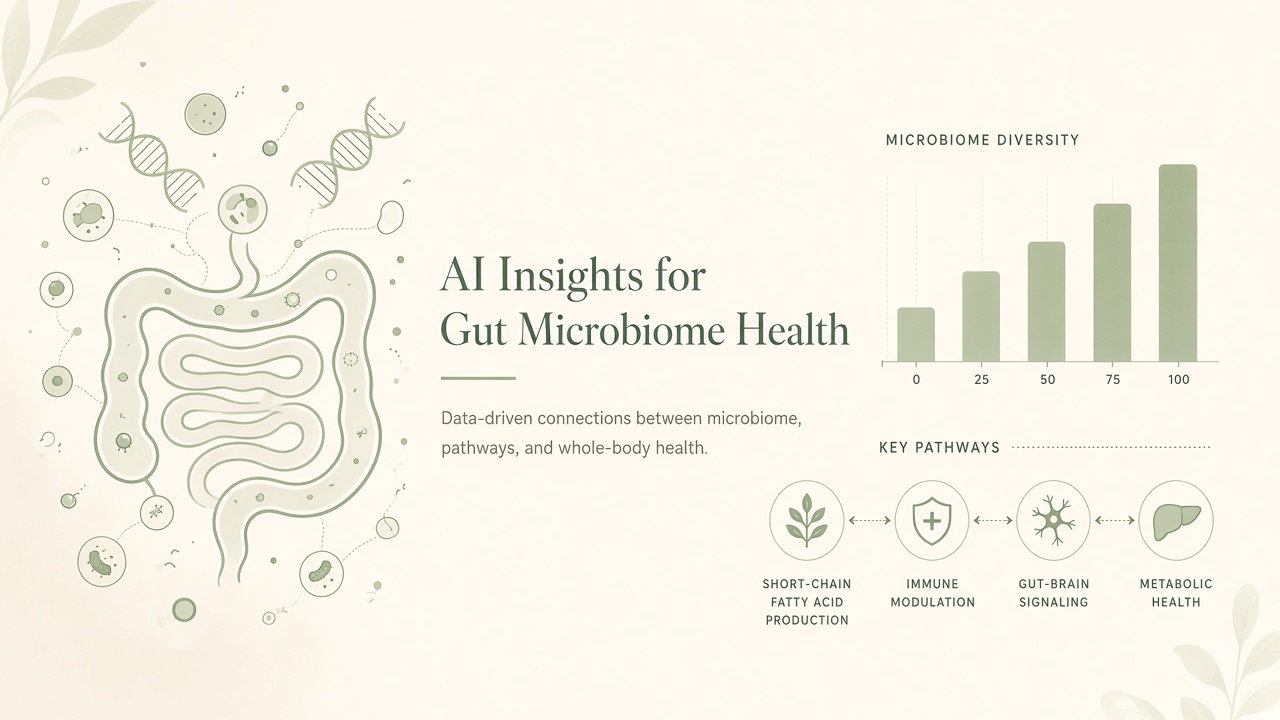
A gastroenterologist reviews stool metagenomics from a patient with refractory ulcerative colitis. Hundreds of taxa shift after biologic therapy, but which changes predict remission versus flare? Manual interpretation of 16S amplicon tables and pathway abundance scores cannot scale to every clinic visit. AI microbiome analysis gut health pipelines integrate shotgun sequencing, metabolomics, and host clinical metadata to rank disease-associated microbial modules, predict treatment response, and surface interpretable biomarker rules. These systems support hypothesis generation and trial enrollment; they do not replace colonoscopy, histology, or therapeutic decisions made by licensed clinicians.
Nutrition researchers comparing dietary interventions and hospital informatics teams building precision medicine dashboards should understand batch effects, compositional statistics, and when a AI chatbot summary of microbiome papers is insufficient without validated model outputs. Additional medical AI explainers appear on the EliteAI.tools blog index.
What AI Microbiome Analysis Gut Health Means in Plain Language
AI microbiome analysis gut health refers to computational workflows that classify host disease status, predict clinical outcomes, or recommend interventions by learning patterns from gut microbial DNA, RNA, proteins, metabolites, and linked host data. The human gut harbors trillions of microorganisms whose collective genes exceed the human genome in functional diversity. Dysbiosis, a persistent imbalance in community structure or function, associates with inflammatory bowel disease (IBD), type 2 diabetes, colorectal cancer, cardiovascular risk, and neurological conditions, though association does not prove causation.
Early microbiome studies relied on 16S rRNA gene surveys that identify bacteria at genus level but miss viruses, fungi, and strain-level variation. Shotgun metagenomics sequences all DNA in a sample, enabling taxonomic profiling, metagenome-assembled genomes, and functional pathway reconstruction. AI layers transform these high-dimensional tables into patient-level predictions: which individuals harbor cancer-linked microbial signatures, which IBD subtype responds to a specific biologic, or which metabolite modules correlate with short-chain fatty acid production and immune tone.
| Data layer | What it measures | AI role |
|---|---|---|
| Shotgun metagenomics | Taxa, genes, pathways | Disease classification, biomarker discovery |
| Metabolomics | Bile acids, SCFAs, TMAO | Joint modeling with taxa (MMETHANE) |
| Host clinical data | Labs, medications, diet logs | Outcome prediction, treatment stratification |
| Longitudinal sampling | Pre/post intervention time series | Response forecasting, stability metrics |
Why multi-omics integration matters
Taxonomic abundance alone often fails to explain host phenotype because identical species can express different gene repertoires under diet, antibiotic, or inflammation pressure. Metatranscriptomics and metaproteomics capture activity; metabolomics links microbial metabolism to host signaling. A 2025 review in United European Gastroenterology literature on IBD emphasizes that converging genomics, epigenomics, transcriptomics, and metagenomics through AI orchestration is the path toward patient-specific characterization rather than single-assay snapshots. Fit-for-purpose study design matters: metagenomics suffices when community structure carries the signal; full multi-omics integration justifies its cost when mechanistic pathways or treatment response prediction is the goal.
How the Underlying AI Pipeline Works
Production-grade gut microbiome AI stacks preprocess compositional sequencing data, engineer phylogenetic and chemical features, train supervised classifiers or interpretable rule learners, and validate on held-out cohorts with explicit correction for batch and geography. Raw FASTQ files pass through quality control, host read depletion, taxonomic profiling (MetaPhlAn, Kraken), and functional annotation (HUMAnN). Machine learning models then consume abundance matrices, often after centered log-ratio or other compositional transforms that address the sum-to-one constraint of relative abundances.
MMETHANE and interpretable rule learning
MMETHANE (Microbes and METabolites to Host Analysis Engine), published in Microbiome (2025, doi:10.1186/s40168-025-02270-z), predicts binary host status from paired microbial composition and metabolomics measurements. The model incorporates phylogenetic distance among taxa and chemical structure similarity among metabolites, performing adaptive dimensionality reduction that respects biological relationships. Unlike opaque black-box classifiers, MMETHANE outputs human-readable rules explaining which microbial and metabolite clusters drive predictions. Across six paired datasets, MMETHANE matched or beat conventional machine learning on 80% of comparisons and uncovered biologically meaningful microbe-metabolite links in IBD case studies. Interpretability supports clinician trust and regulatory conversations where feature importance must be auditable.
AR-CDT Net for large-scale disease classification
AR-CDT Net, described in BMC Bioinformatics (2025), combines multi-scale deformable convolutions with channel-wise dynamic Tanh activations to classify host disease states from microbiome profiles. Evaluated on more than 8,000 samples spanning eight phenotypes including healthy controls, type 2 diabetes, IBD, colorectal cancer, and multiple sclerosis, the framework outperformed nine representative baselines on most within-cohort tasks. In cross-dataset generalization, training on the imbalanced primary cohort and testing on external type 2 diabetes data achieved area under the curve (AUC) 0.7921, suggesting transferable signals rather than site-specific artifacts. SHAP-based interpretation disentangles disease-specific signatures from shared dysbiotic backgrounds among clinically distinct conditions.
Multi-omics integration frameworks
Tools such as MOFA+, DIABLO, and MintTea fuse metagenomic, metabolomic, and host omics tensors to discover latent factors that co-vary across modalities. Network analyses map microbial interaction graphs influencing bile acid transformation, trimethylamine N-oxide production, and short-chain fatty acid-mediated immune regulation. Standardized workflows address quality control, assembly, binning, annotation, and visualization so multi-center studies remain reproducible. Without harmonized DNA extraction kits, storage protocols, and bioinformatics pipelines, batch effects dominate signal and AI models memorize site identifiers instead of biology.
| Stage | Input | Output |
|---|---|---|
| QC and profiling | Stool FASTQ, metadata | Taxon and pathway abundance tables |
| Feature engineering | Compositional transforms, phylogeny | Model-ready matrices |
| Training | Labeled cohort splits | Classifier or rule set |
| Validation | External geographic cohorts | AUC, calibration, SHAP reports |
Typical research and clinical translation workflow
- Define clinical question and minimum effect size; preregister analysis plan.
- Collect standardized stool samples with diet and medication metadata at defined time points.
- Run shotgun metagenomics and optional metabolomics on an accredited laboratory pipeline.
- Apply compositional preprocessing and batch correction across sequencing runs.
- Train interpretable or deep models with nested cross-validation; hold out entire sites for external validation.
- Report performance with confidence intervals; publish feature rules or SHAP summaries for review.
- Prospectively test biomarker panels in interventional trials before clinical claims.
Real Deployments and Published Evidence
Microbiome AI today operates primarily in research consortia, biobank-linked cohort studies, and pharmaceutical trial stratification rather than routine primary care diagnostics. National IBD multi-omics initiatives and cancer microbiome programs link stool profiling to treatment response prediction. AR-CDT Net's 8,000-sample benchmark and MMETHANE's IBD case studies demonstrate that paired metabolite-genus models outperform taxa-only baselines when sample sizes allow joint measurement. Consumer direct-to-consumer kits market diversity scores, but clinical actionability of those scores without prospective outcome validation remains limited.
Pharmaceutical sponsors increasingly embed microbiome endpoints in phase 2 trials for immunotherapy and metabolic disease, using AI to identify responders before randomization. Academic groups publish open-source packages (MMETHANE, HUMAnN, QIIME 2 plugins) that hospitals can deploy on private clusters to keep genomic data inside firewalls. Regulatory pathways for microbiome-based diagnostics follow laboratory-developed test frameworks in the United States and in vitro diagnostic regulation in the European Union when claims exceed research use.
Nature Communications multi-omics reviews (2026) catalog fit-for-purpose strategies across host-associated and environmental microbiomes, reinforcing that layer counting without aligned biological questions wastes sequencing budget. Successful translation studies share longitudinal sampling, multi-site harmonization, and pre-specified primary endpoints tied to host outcomes rather than taxon shifts alone.
Limits, Risks, and Ethical Guardrails
Gut microbiome AI faces compositional statistics pitfalls, geographic and dietary confounding, antibiotic washout variability, and causal ambiguity that limit direct therapeutic recommendations from association models. Models trained on Western high-fiber or low-fiber cohorts often fail on underrepresented populations. Stool samples snapshot luminal contents, not mucosal communities that drive IBD pathology. Probiotic and fecal microbiota transplantation interventions show heterogeneous outcomes; AI predictions must be validated in randomized trials before guideline adoption.
- Privacy: Metagenomes can sometimes re-identify individuals from rare strain combinations; consent must cover data sharing.
- Overinterpretation: Correlation between taxa and disease does not establish mechanistic causality.
- Batch effects: Site-specific lab protocols can dominate classifiers unless explicitly corrected.
- Clinical harm: Patients may pursue unproven diets or supplements based on consumer AI reports.
- Equity: Under-sampled ancestries and rural diets reduce model fairness.
Ethical deployment requires transparent uncertainty reporting, clinician-mediated result delivery, and refusal to market diagnostic certainty without analytical and clinical validity studies. IRB oversight applies when identifiable samples feed commercial model training.
Who Should Use This and Who Should Wait
Academic gastroenterology labs, pharmaceutical biomarker teams, and multi-omics consortia with bioinformatics infrastructure should adopt validated pipelines for stratification and mechanism discovery. Primary care clinicians should not order ad hoc microbiome AI panels outside approved protocols. Wellness startups should wait for prospective outcome data before making disease prevention claims.
| Stakeholder | Recommendation | Guardrail |
|---|---|---|
| Research hospital | Deploy MMETHANE-style interpretable models | External cohort validation required |
| Pharma trial team | Stratify enrollment with multi-omics AI | Pre-specify endpoints in protocol |
| Primary care | Refer to trials; avoid consumer kits for diagnosis | No treatment changes from DTC scores alone |
| Patients | Participate in consented research registries | Understand research vs clinical grade |
Frequently Asked Questions
Can AI microbiome analysis diagnose IBD from stool alone?
No. IBD diagnosis requires clinical evaluation, endoscopy, and histology; microbiome AI may support subtype stratification or treatment response research but does not replace gold-standard workup.
How does 16S amplicon sequencing compare to shotgun metagenomics for AI?
16S is cheaper and faster but resolves bacteria at coarse taxonomic levels; shotgun metagenomics enables strain-level and functional features that improve complex disease classifiers when sample depth is adequate.
| Method | Cost profile | Best AI use case |
|---|---|---|
| 16S amplicon | Lower per sample | Large epidemiology screens |
| Shotgun metagenomics | Higher sequencing depth | Multi-disease classification (AR-CDT Net) |
| Metagenomics + metabolomics | Highest lab burden | Interpretable rules (MMETHANE) |
Why choose interpretable models like MMETHANE?
Regulators, clinicians, and journal reviewers increasingly demand explainable features linking microbes and metabolites to outcomes; rule-based outputs support audit trails that pure deep nets lack without post-hoc SHAP analysis.
Does diet ruin microbiome AI predictions?
Recent meals, fiber intake, and fasting state shift taxa within hours to days; longitudinal sampling and dietary logging reduce but do not eliminate confounding in single time-point classifiers.
Can AI predict fecal transplant success?
Research models correlate donor-recipient community compatibility with remission rates in small cohorts, but prospective randomized validation is incomplete for clinical deployment.
Are microbiome AI tests FDA-cleared?
Most research pipelines are not marketed as standalone diagnostics; commercial tests that make clinical claims must follow LDT or IVD pathways with analytical and clinical validity evidence.
Conclusion
AI microbiome analysis gut health transforms shotgun metagenomics, metabolomics, and host metadata into stratification models, interpretable rules, and trial enrichment signals through pipelines exemplified by MMETHANE and AR-CDT Net. Published evidence supports research-grade disease classification and multi-omics mechanism discovery, while causal therapy guidance awaits prospective interventional validation. Teams with harmonized sampling, external cohort replication, and clinician oversight can extract actionable hypotheses; others should treat microbiome AI as an emerging science, not a replacement for endoscopic and histologic standards of care.