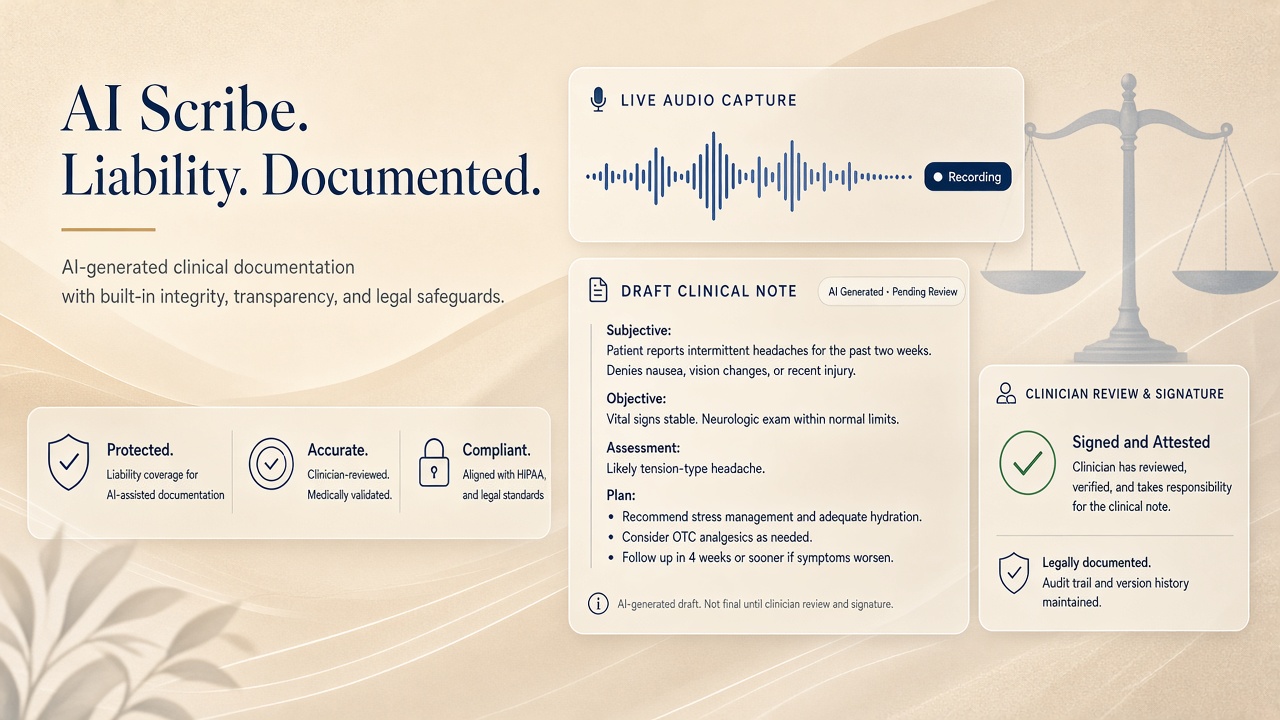
A family physician finishes a fifteen-minute visit, glances at the AI-generated note, and signs it during the next patient's hallway wait. The scribe attributed a penicillin allergy the patient denied and omitted the shared decision discussion about statin risks. Months later, a malpractice deposition asks who wrote the documentation and whether the clinician verified every line. AI medical scribe liability sits at the intersection of ambient clinical documentation, malpractice law, HIPAA security, and regulatory gaps where most scribes are marketed as administrative tools rather than FDA-reviewed medical devices. The clinician who signs the chart remains the author for legal purposes even when a large language model drafted the text.
Hospital compliance officers, medical staff leaders, and ambulatory practices rolling out ambient documentation should define review workflows before deployment, not after the first board complaint. Clinicians comparing AI chatbot charting advice to vendor demos need independent safety testing data. More clinical AI governance articles appear on the EliteAI.tools blog index.
What AI Medical Scribe Liability Means in Plain Language
AI medical scribe liability refers to the legal and professional responsibility for errors, omissions, and misrepresentations in clinical documentation produced or assisted by ambient artificial intelligence that listens to patient encounters and drafts electronic health record notes. Ambient digital scribe (ADS) products record audio, transcribe speech, and summarize content into history, exam, assessment, and plan sections. Vendors including major health systems adopters such as Kaiser Permanente (2024 enterprise rollout) market HIPAA-eligible services that reduce "pajama time" documentation. When the draft is wrong, courts and licensing boards look to the signing clinician, the employing institution, and potentially the vendor under negligence, corporate liability, or product liability theories.
Unlike computer-assisted physician order entry with hard stops, scribe outputs are narrative prose where a single hallucinated diagnosis or missing contraindication can alter downstream care. Documentation also supports billing compliance; upcoding or missing medical necessity language triggers payer audits independent of malpractice exposure.
| Documentation element | Common AI error | Liability hook |
|---|---|---|
| Allergies and medications | Hallucinated or misheard entries | Patient safety event |
| Assessment diagnoses | Unsupported conditions added | Misdiagnosis downstream |
| Clinical reasoning | Omitted unless verbally stated | Board discipline for poor records |
| Consent discussions | Summarized inaccurately or skipped | Informed consent challenge |
How the Underlying AI Pipeline Works
Ambient scribe pipelines capture encounter audio with patient consent, perform speech-to-text, segment speakers, apply large language model summarization into EHR templates, and push drafts to the clinician inbox for review and attestation. Enterprise deployments integrate via application programming interfaces into Epic, Cerner, or other records. Some systems highlight low-confidence sentences or link summary bullets to transcript timestamps. Version control and audit trails should record model version, edit distance between draft and signed note, and time from encounter end to signature.
JMIR ambient scribe error frequency study
A 2025 Journal of Medical Internet Research instrument validation study (e64993) evaluated two popular commercial ambient digital scribe products in a simulated clinical setting to quantify documentation errors systematically. The authors emphasize that error-prone ADS technology can have serious patient safety consequences and that health care facilities currently bear the burden of independent testing because vendor algorithms are proprietary and continuously updated. The European Union Artificial Intelligence Act, effective August 2024, requires developers of high-risk AI systems to evaluate safety, but many United States scribes remain outside FDA medical device pathways when classified as administrative documentation aids.
JCO Oncology Practice liability analysis
Gerke, Simon, and Roman's 2025 JCO Oncology Practice analysis examines tort liability for clinicians, hospitals, and manufacturers when AI-generated patient information is inaccurate, with particular attention to oncology where specialized terminology raises error rates. AI transcription tools are generally not regulated as medical devices under the United States Federal Food, Drug, and Cosmetic Act unless marketed with diagnostic claims, leaving FDA oversight limited and responsibility distributed across professional ethics, hospital credentialing, and vendor contracts.
npj Digital Medicine risk taxonomy
A 2025 npj Digital Medicine perspective outlines uncharted risks including unclear liability when algorithm-driven documentation errors harm patients, regulatory gaps treating scribes as HIPAA-eligible services rather than evaluated devices, and equity concerns for patients with limited English proficiency or accents that speech models transcribe poorly. Professional bodies such as the Royal Australian College of Surgeons have called for civil liability framework updates clarifying accountability when AI participates in clinical care.
| Control layer | Implementation | Liability function |
|---|---|---|
| Patient consent | Recording disclosure, opt-out path | Privacy and trust defense |
| Clinician review | Mandatory before signature | Standard-of-care documentation duty |
| Vendor contract | Indemnification, SLA, BAA | Allocates corporate risk |
| Audit trail | Model version, edit log | Discovery evidence in litigation |
Recommended institutional governance workflow
- Complete HIPAA security risk assessment for audio storage and cloud inference locations.
- Obtain informed consent or jurisdiction-appropriate recording notice for patients.
- Pilot scribe on representative specialties; measure error taxonomy locally (JMIR methodology).
- Train clinicians on proofreading, dictating clinical reasoning aloud, and refusing auto-sign.
- Define mandatory review time blocks; prohibit hallway one-tap attestation policies.
- Monitor near-miss reports, medication discrepancy rates, and billing audit findings quarterly.
- Re-validate after every vendor model update with documented sign-off.
Real Deployments and Published Evidence
Large integrated delivery networks and venture-backed ambient AI vendors deployed scribes to thousands of clinicians in 2024-2025, citing documentation time savings while independent safety evidence remains limited to simulated evaluations and facility-specific pilots. Kaiser Permanente's 2024 ambient documentation rollout exemplifies enterprise scale. Mayo Clinic Proceedings Digital Health and npj Digital Medicine literature document barriers to scaling across diverse settings: accent bias, specialty vocabulary, emergency department noise, and unclear accountability structures.
Time-motion studies pre-dating generative AI showed physicians spending nearly two hours on EHR work per hour of direct patient care; ambient scribes target that imbalance. Published outcome data on burnout reduction and note quality improvement exist in vendor-sponsored and early adopter reports, but peer-reviewed randomized trials linking scribe use to malpractice claim rates are not yet mature. MICA insurance guidance and state medical society advisories increasingly warn that documentation errors weaken malpractice defenses even when clinical care was appropriate.
Limits, Risks, and Ethical Guardrails
AI medical scribes introduce hallucinations, automation bias toward uncritical signing, cybersecurity exposure of recorded encounters, and transparency failures when patients are unaware conversations are processed in cloud infrastructure. The "ambient" branding can mislead patients who do not realize passive recording occurs. Licensing boards may discipline physicians for attestations they did not reasonably verify. Hospitals face corporate negligence theories if default workflows encourage speed over review.
- HIPAA Security Rule: APIs linking scribes to EHRs expand attack surface; breaches expose audio and drafts.
- Billing fraud: AI-inflated evaluation and management levels trigger False Claims Act exposure.
- Equity: Speech recognition performance varies by accent and language, risking poorer records for marginalized patients.
- Vendor opacity: Proprietary model updates change error profiles without notice.
- Regulatory gap: Lack of FDA clearance means no standardized premarket safety threshold.
Who Should Use This and Who Should Wait
Ambulatory practices with compliance bandwidth, documented review policies, and local error benchmarking should adopt ambient scribes with phased specialty rollouts. High-acuity settings without quiet recording conditions, clinicians unwilling to add review time, and organizations lacking BAAs and indemnification clauses should wait. No clinician should enable scribes without understanding they remain the legally responsible author.
| Stakeholder | Recommendation | Guardrail |
|---|---|---|
| Attending physician | Proofread every section before sign | Dictate reasoning for complex decisions |
| Hospital compliance | Require local ADS safety evaluation | Track model version per note |
| Vendor | Provide transparency on updates | Contractual indemnification clarity |
| Patient | Ask whether encounter is recorded | Request correction of chart errors promptly |
Frequently Asked Questions
Who is liable if an AI scribe documents the wrong allergy?
The signing clinician bears primary professional responsibility; hospitals may share corporate liability; vendors face exposure only if contracts or product liability theories apply, and FDA oversight is limited for administrative scribes.
Are ambient AI scribes FDA-cleared medical devices?
Most are marketed as HIPAA-eligible documentation tools outside current FDA medical device enforcement for autonomous diagnosis; classification may change if vendors make clinical decision claims.
What did the 2025 JMIR ADS study conclude?
JMIR researchers found frequent documentation errors across two commercial ambient scribes in simulation and argued facilities must independently evaluate safety because vendor algorithms are opaque and continuously updated.
| Risk category | Example | Mitigation |
|---|---|---|
| Clinical safety | Wrong medication list | Line-by-line medication reconciliation |
| Malpractice defense | Missing clinical reasoning | Verbally state rationale during visit |
| Privacy | Cloud audio breach | Encryption, BAA, access logging |
| Billing | AI-embellished E/M level | Compliance review of coded notes |
What is automation bias with scribes?
Clinicians may trust fluent AI prose and sign without verification; institutional policy should treat drafts as unverified until human proofreading completes.
Must patients consent to ambient recording?
State wiretapping and hospital policy vary; transparent disclosure before recording is standard ethical practice and supports privacy defenses.
Can licensing boards discipline for AI note errors?
Yes. Boards evaluate whether the physician met documentation standards regardless of drafting tool; unreadable or inaccurate charts weaken defenses in complaints.
Conclusion
AI medical scribe liability centers on the enduring duty of the attesting clinician to ensure accurate, complete, readable documentation even when ambient large language models draft the prose. JMIR safety studies, JCO Oncology Practice tort analyses, and npj Digital Medicine ethics reviews converge on mandatory local validation, patient transparency, audit trails, and refusal to auto-sign. Enterprise rollouts at major health systems demonstrate feasibility and time savings, but regulatory gaps and proprietary model churn shift safety burden to hospitals and physicians. Practices that budget review time, re-validate after updates, and negotiate vendor accountability can capture documentation efficiency without surrendering medicolegal defenses; those that treat AI notes as finished charts invite patient harm and malpractice exposure.