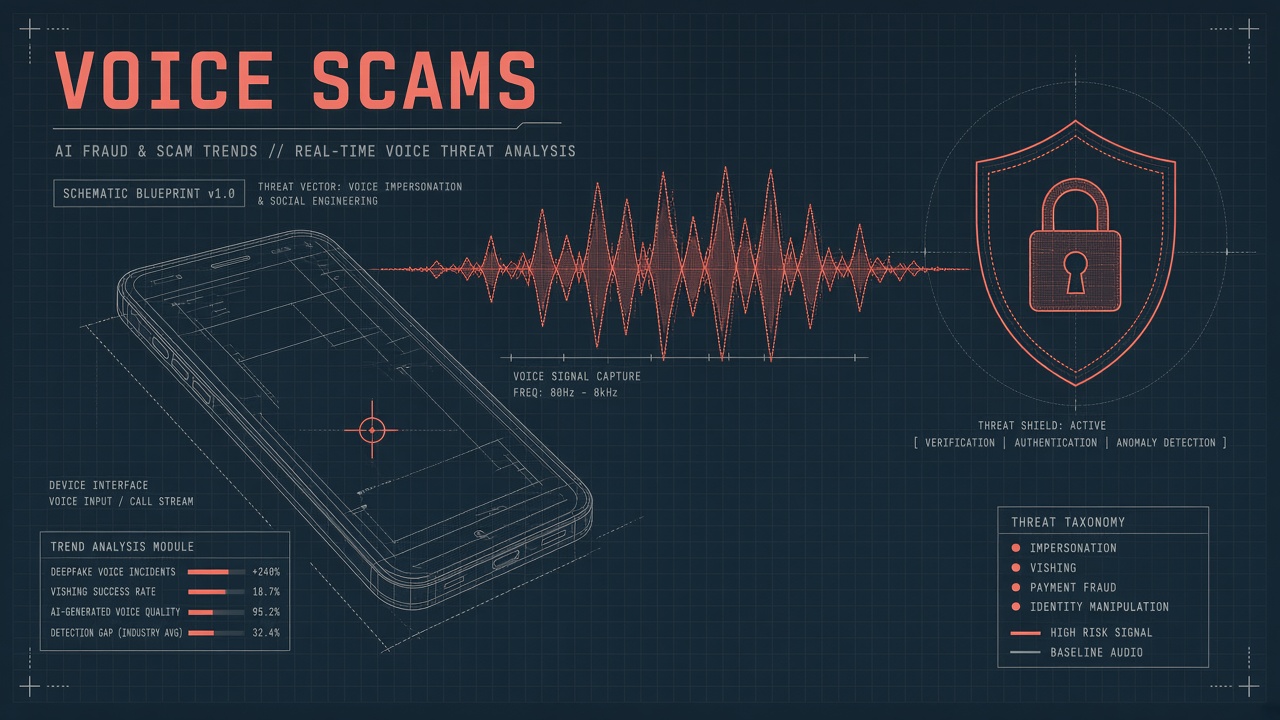
Criminals treated generative AI as standard fraud infrastructure in 2025 and 2026. The FBI Internet Crime Complaint Center added its first dedicated artificial intelligence section in the 2025 annual report, recording 22,364 complaints citing AI tools in the commission of fraud and $893.3 million in reported losses. Voice cloning reinforced wire-transfer scams. Deepfake video appeared in fake job interviews. Chat agents scaled personalized phishing at volumes manual crime rings could not match. The FTC continued imposter scam enforcement, with reported losses exceeding $3.5 billion in 2025 across all methods, many now AI-assisted.
AI fraud trends in 2026 demand defenses that treat voice, video, and chat authenticity as untrusted until verified out-of-band. Security teams should update business email compromise playbooks, employee training, and customer warnings for synthetic media. Review AI chatbot deployments for agent abuse paths and compare detection tooling via AI security resources before rolling autonomous agents to customer-facing channels.
Top Scam Types in 2026
AI-enabled fraud clusters into investment schemes, executive impersonation, romance and confidence fraud, employment scams, and government imposter messages, with generative tools improving believability at each stage. The FBI attributed $632 million in AI-linked losses to investment fraud alone, $30 million to business email compromise, $19 million to confidence and romance scams, and more than $5 million to voice-cloned family distress calls.
| Scam type | AI role | Detection signal |
|---|---|---|
| Crypto investment fraud | Chat personas, fake dashboards, localized scripts | Unregistered platforms; urgency to move off mainstream apps |
| Business email compromise | Executive-tone emails plus cloned voice callbacks | Payment detail changes without verified callback |
| Family distress (grandparent) | Voice cloning from social clips | Caller refuses family code word; demands wire or crypto |
| Romance and pig butchering | Long-con chat scripts; synthetic profile photos | Investment pivot after weeks of trust building |
| Fake employment | Deepfake video interviews; voice spoofing | Equipment purchase requests before start date |
| Government imposter (tolls, taxes) | Mass-generated SMS and email with local details | Threats of immediate arrest; payment via gift cards or crypto |
FTC May 2026 consumer alerts noted government imposter reports up 40%, partly driven by fake toll collection messages spoofing EZ-Pass, SunPass, FasTrak, and TxTag programs. Romance scam reported losses rose 22% to $1.48 billion in FTC data, with AI lowering the cost of sustaining believable personas.
Voice and Video Deepfake Cases
Voice cloning moved from novelty demos to standard fraud layering because a familiar voice overrides email skepticism. Attackers scrape short clips from social media or earnings calls, synthesize urgent requests, and pair them with spoofed caller ID. The FBI documented employment interview deepfakes costing victims roughly $13 million in 2025, a figure likely undercounted because victims do not always identify AI involvement.
Representative 2025 and 2026 incident patterns include:
- CEO wire fraud: Email requesting urgent transfer, followed by a cloned voice confirming the instruction on a callback number controlled by attackers.
- Family emergency: Call claiming a relative was arrested or hospitalized, pressuring immediate payment before verification.
- Vendor impersonation: Video calls with lip-synced deepfakes of known suppliers during invoice redirection scams.
- Remote hiring fraud: Synthetic interviewers collecting identity documents and bank details from job seekers.
The FTC awarded prizes in its Voice Cloning Challenge to detection prototypes measuring liveness scores, watermarking audio, and authenticating human speech. Commercial deepfake detection vendors expanded real-time phone screening in 2026, but no single tool catches every clone. Organizations should assume audio and video proof is forgeable.
Agent-Assisted Social Engineering
Autonomous AI agents enable persistent, personalized phishing at scale when attackers connect chat models to email inboxes, CRM exports, or scraped social graphs. Unlike template spam, agent-driven campaigns adapt tone to each target, reference recent posts, and maintain multi-week conversations before requesting credentials or payments.
Enterprise risk teams report new abuse paths:
- Helpdesk agents hijacked: Prompt injection causing customer support bots to leak policies or approve refunds.
- Sales agent impersonation: Fake chat widgets mimicking brand tone to harvest payment cards.
- Internal copilot misuse: Compromised employee accounts using authorized AI tools to draft convincing spear-phishing internally.
- Multilingual scaling: Instant translation lets single crime groups target dozens of countries without native speakers.
Defenders deploying AI chatbots should enforce authentication before sensitive actions, log agent tool calls, and rate-limit outbound links. Compare guardrail vendors through AI security tools.
Bank and Telco Countermeasures
Financial institutions and carriers responded with stepped-up authentication, scam labeling, and regulatory collaboration in 2026. Payments industry analysts urged banks to treat voice verification as insufficient when clones defeat known-voice callbacks. Multi-factor authentication, behavioral biometrics, and transaction anomaly models expanded, though criminals adapted with live "coach" scams guiding victims through approvals.
Countermeasure themes:
- Out-of-band verification: Confirm wire changes via pre-registered numbers, not numbers in the email or call.
- Hold periods: Delay high-value first-time payees when risk scores spike.
- Scam labels: Carriers flag suspected AI robocalls; banks push in-app warnings for crypto purchases following romance scam patterns.
- Information sharing: FBI IC3 and FinCEN advisories on AI fraud typologies for SAR filing.
The FTC proposed expanding Telemarketing Sales Rule coverage to AI-enabled scam calls and pursued impersonation fraud bans. Telcos face continuing pressure to block spoofed caller ID without catching legitimate business calls.
Consumer and Employee Training
Training must shift from "look for bad grammar" to "never trust unsolicited audio, video, or chat for money movement." Effective 2026 programs include family code words, manager callback protocols, and explicit permission to hang up and re-contact via known channels.
Recommended practices:
- Publish internal policy: no payment changes based on email or voice alone.
- Run tabletop exercises with simulated cloned executive calls.
- Teach consumers to pause, verify through a separate device, and report at ReportFraud.ftc.gov or ic3.gov.
- Warn job seekers never to pay for equipment or training before verified employment.
- Update security awareness monthly; AI scam scripts evolve faster than annual training cycles.
Attribution gaps mean many victims never label AI in complaints, so internal fraud teams should assume synthetic media in any impersonation case until ruled out.
Frequently Asked Questions
How much did AI fraud cost in 2025?
The FBI IC3 recorded $893.3 million in reported losses across 22,364 complaints citing AI use. Actual losses are likely higher due to underreporting and victims unaware of AI involvement.
Can my bank detect voice clones?
Some banks deploy liveness detection and behavioral signals, but no system is foolproof. Customers should treat urgent voice requests as suspicious and verify through independent channels.
Are AI chatbots on company websites risky?
Poorly secured bots can leak data or be impersonated externally. Use branded domains, CAPTCHA, authenticated sessions for account actions, and monitor for typosquat widgets.
What should I do if I sent money to a scammer?
Contact your bank or payment provider immediately, file reports with IC3 and the FTC, and preserve messages and call logs. Recovery is difficult but early reporting improves odds for wire recalls.
Do deepfake detection tools work for enterprises?
Enterprise tools can flag many synthetic clips in controlled channels, but attackers test against public detectors. Combine tooling with process controls such as callback verification and payment delays.