Food processors face recall costs, regulatory shutdowns, and consumer trust losses when Salmonella, Escherichia coli, or Staphylococcus aureus slip through spot-check culturing that samples less than one percent of production volume. Traditional microbiology remains the legal gold standard but returns results hours to days after product has already shipped from fast lines. Food safety contamination detection AI applies hyperspectral imaging (HSI), convolutional neural networks, and hybrid optimizers to screen surfaces and products for pathogen indicators in near real time on research and pilot lines.
Quality assurance managers, meat inspection agencies, and vision system integrators all ask the same question: can a camera replace culture plates on the plant floor? Product teams exploring AI chatbot interfaces for food safety workflows should ground answers in peer-reviewed accuracy and external validation drops documented in systematic reviews, not vendor-only demo lines. More explainers live on the EliteAI.tools blog index.
What Food Safety Contamination Detection AI Means in Plain Language
Food safety contamination detection AI is the use of spectral imaging, machine learning classifiers, and sensor fusion to detect bacterial contamination or proxy signatures on food surfaces faster than traditional plating, supporting sortation and hold decisions while culture methods confirm positives. Detection is not regulatory release by itself: most jurisdictions still require approved microbiological methods for official compliance even when AI flags suspect units for diversion.
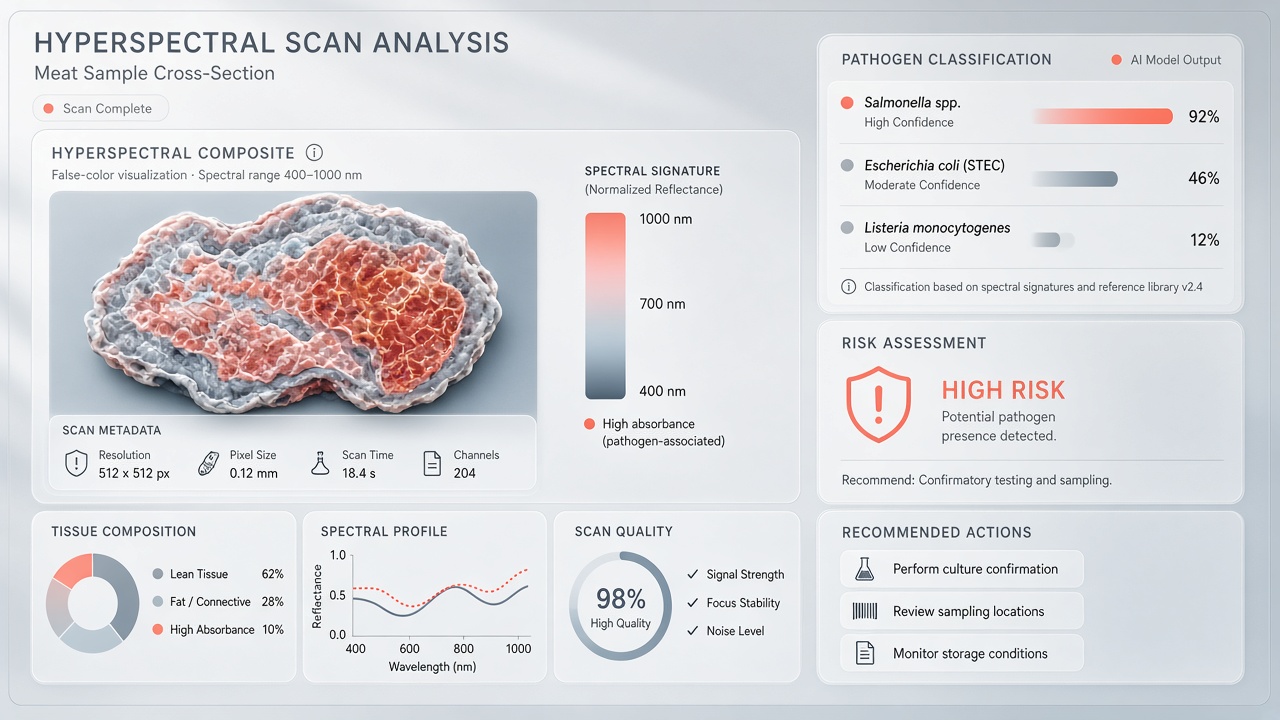
Shortwave infrared hyperspectral imaging (SWIR-HSI) captures chemical contrast between clean muscle tissue and contaminated regions where metabolic byproducts or water binding shift reflectance. Deep networks including backpropagation neural networks (BPNN), particle swarm optimized CNN-SVM hybrids (PSO-CNN-SVM), and plain convolutional stacks classify pixels or patches into pathogen-present versus absent labels calibrated on lab-inoculated samples.
| Pathogen or matrix | Sensor approach | Reported performance (study conditions) |
|---|---|---|
| E. coli, Salmonella, Staph on mutton | SWIR-HSI plus deep classifiers | High accuracy on inoculated lab samples |
| E. coli on pork | PSO-CNN-SVM hybrid | 87.5% classification in published trial |
| Mixed pathogens | HSI plus BPNN | 97.63% on controlled HSI dataset |
| General food AI screening | Multiple modalities in literature | External validation often 78 to 82% |
How the Contamination Detection Pipeline Works
A food safety AI screening pipeline calibrates spectral or RGB cameras on the line, captures images of each unit or batch segment, preprocesses reflectance cubes, runs trained classifiers or anomaly detectors, diverts flagged product to hold lanes, and routes positives to culture confirmation and root-cause investigation. Line speed, wash water, marination, and packaging film glare dominate whether research accuracy survives production.
SWIR-HSI for E. coli, Salmonella, and Staph on mutton
SWIR-HSI studies on mutton surfaces inoculated with Escherichia coli, Salmonella, and Staphylococcus aureus demonstrate that shortwave infrared reflectance combined with deep learning separates contaminated from clean regions in controlled trials. SWIR bands respond to moisture and organic film differences associated with bacterial lawns at concentrations relevant to spoilage research, though industrial thresholds for recall differ by jurisdiction and product class. Mutton matrix results do not automatically transfer to poultry skin or ready-to-eat leafy greens without new labels.
PSO-CNN-SVM on pork E. coli detection
Particle swarm optimized CNN-SVM hybrids for pork surface E. coli detection report 87.5 percent classification accuracy in published experiments combining convolutional feature extraction with support vector machine decision boundaries tuned by PSO search. Hybrid stacks aim to reduce false positives versus linear classifiers on high-dimensional spectral data. Eighty-seven point five percent accuracy under lab inoculation leaves economically meaningful false negative rates if deployed without culture confirmation on positives and negatives sampled statistically.
BPNN mixed pathogen HSI classification
Backpropagation neural networks on hyperspectral imaging datasets with mixed pathogen classes report 97.63 percent classification accuracy in controlled HSI experiments distinguishing multiple bacterial contaminants on food surfaces. High accuracy on curated cubes reflects homogeneous lighting and known inoculation levels; plant floors introduce conveyor vibration, temperature drift, and biofilm backgrounds not present in bench studies.
Systematic review: internal versus external validation gap
A systematic review synthesizing 152 food safety AI studies documents a recurring pattern: internal validation accuracies near 95 percent often fall to roughly 78 to 82 percent when models face external datasets with different instruments, operators, or product lots. The gap is the central risk for procurement teams evaluating vendor claims based on in-house benchmarks alone. External validation should use independently collected batches, blinded operators, and pathogens at legally relevant concentration ranges.
Human-in-the-loop HACCP integration
Hazard Analysis Critical Control Point (HACCP) plans must designate critical limits, corrective actions, and verification steps. AI screening fits best as a CCP monitoring tool when false negative rates are bounded by parallel random culture sampling and when diverted product has traceable lot codes. Quality teams log model version, threshold, and diverted volume each shift for audit readiness under FDA Food Safety Modernization Act preventive controls and analogous EU hygiene rules.
- Define target pathogen, matrix, and action limits with food safety officer and regulator input.
- Collect labeled HSI or RGB datasets across shifts, suppliers, and sanitation states.
- Train classifiers; report internal metrics and mandatory external validation on held-out plants or days.
- Integrate divert hardware and culture confirmation workflow for flagged units.
- Monitor false negative rate via stratified culture sampling even when AI reads negative.
- Retrain when new marinades, packaging films, or line speeds change optical conditions.
Published Evidence and Industry Pilots
Hyperspectral and deep learning food safety studies report strong accuracy on inoculated samples, but the 152-study systematic review shows external validation typically drops performance from about 95 percent to 78 to 82 percent. SWIR-HSI mutton trials for E. coli, Salmonella, and Staph establish feasibility for spectral separation in research settings. PSO-CNN-SVM pork E. coli at 87.5 percent and BPNN mixed pathogen HSI at 97.63 percent illustrate method diversity, not interchangeable plant-ready products.
Pilot line deployments in red meat and poultry plants remain limited compared with optical sorters for foreign material. Integrators bundle cameras with GPU servers and HACCP documentation templates, but buyers should contractually require external validation on their SKUs before replacing culture frequency entirely.
Regulatory agencies publish guidance encouraging new technology while retaining culture as adjudicator. Processors should frame AI as enhanced vigilance with defined divert and confirm protocols, not as elimination of microbiological verification sampling required by customers and law.
Recall and traceability context
When AI diverts product, lot traceability systems must link spectral logs to batch codes for investigation if culture later confirms pathogens downstream. Blockchain marketing does not replace physical segregation on the line. Insurance and retailer audits increasingly ask whether vision systems were validated on the exact SKU and shift pattern in production contracts.
External validation protocol design
The systematic review of 152 food safety AI studies implies procurement teams should contract blinded external validation before production reliance: independent operators, new product lots, and pathogens at regulatory detection thresholds not represented in training cubes. Internal accuracy near 95 percent that falls to 78 to 82 percent externally means hold-and-test protocols must sample both AI-flagged and AI-cleared units. PSO-CNN-SVM at 87.5 percent on pork E. coli and BPNN at 97.63 percent on mixed pathogen HSI are starting benchmarks, not release criteria without plant-specific replication.
Leafy greens and ready-to-eat product context
SWIR-HSI mutton trials for E. coli, Salmonella, and Staph demonstrate spectral separation on red meat surfaces; leafy greens and ready-to-eat salads present different moisture, chlorophyll interference, and wash-line blur that invalidate direct transfer. Processors evaluating hyperspectral lines for mixed SKUs should budget matrix-specific label campaigns and external validation per product class, not assume one BPNN architecture generalizes from mutton to romaine without performance drops similar to the published external validation gap.
Limits, Risks, and Ethical Guardrails
Models trained on lab inoculation may miss naturally occurring biofilms, bacteriophage interactions, or pathogens below optical detection limits on high-speed lines. Ninety-seven point six three percent accuracy on HSI cubes does not imply ninety-seven percent recall protection for consumers if external validation lands near eighty percent.
- Matrix transfer: Mutton models fail on pork fat bloom without retraining.
- Line speed blur: Motion reduces spectral fidelity; shutter and lighting must match training.
- False negatives: External validation in the high seventies to low eighties still misses contaminated units.
- Regulatory acceptance: Culture remains official method in most jurisdictions.
- Worker impact: Automated divert increases rework labor; plan staffing before deployment.
Ethical guardrails require publishing external validation protocols, maintaining culture sampling independent of AI negatives, notifying regulators when AI replaces sampling frequency, protecting worker safety around divert mechanisms, and avoiding marketing that implies zero risk because a line installs cameras.
Small processors without capital for HSI may still benefit from lower-cost RGB anomaly detection for foreign material while relying on third-party labs for pathogens. Equity concerns arise if only large plants afford AI while small suppliers face disproportionate audit blame when supply chains mix lots.
FSMA preventive controls integration
FDA Food Safety Modernization Act preventive controls require hazard analysis and verification of control measures. AI screening fits as a monitoring record when plants document corrective actions for diverted lots and periodic culture verification that bounds false negatives. SWIR-HSI mutton pathogen research and PSO-CNN-SVM pork trials inform hazard analysis for similar matrices but do not satisfy verification unless replicated on the production line at target throughput.
Who Should Use This and Who Should Wait
Mid-size and large meat processors with HACCP capacity, GPU maintenance staff, and willingness to run external validation on their SKUs should pilot SWIR-HSI or PSO-CNN-SVM stacks with culture confirmation now. Ready-to-eat brands without divert infrastructure and plants relying on co-packer labs should wait until turnkey validated systems exist for their matrix.
| Audience | Recommendation | Caveat |
|---|---|---|
| Red meat processing QA team | Pilot SWIR-HSI for E. coli, Salmonella, Staph screening on mutton or similar SKUs | Confirm with culture; expect matrix-specific training |
| Pork plant pathogen control | Evaluate PSO-CNN-SVM; demand external validation above 87.5% lab baseline | Systematic review shows external drop to 78 to 82% |
| Multi-pathogen research consortium | Benchmark BPNN and CNN variants on shared HSI corpus | 97.63% is internal; blind external sets mandatory |
| Small co-packer without line CAPEX | Wait; continue lab culture and third-party testing | HSI hardware and validation cost remain high |
Frequently Asked Questions
Why does accuracy drop from 95 percent to 78 to 82 percent externally?
The systematic review of 152 studies finds models overfit instrument settings, lighting, and batch idiosyncrasies in internal splits; new plants and SKUs expose domain shift. Contract external validation before production reliance.
What did SWIR-HSI show for mutton pathogens?
Published SWIR-HSI work separates E. coli, Salmonella, and Staph contaminated mutton regions from clean tissue in controlled trials using deep classifiers. Results support research pilots, not automatic regulatory substitution for culture on all SKUs.
Is 87.5 percent enough for pork E. coli screening?
PSO-CNN-SVM reported 87.5 percent classification on pork E. coli experiments; combined with culture confirmation on flagged units and random sampling on negatives, the rate may support sortation but not standalone release. Model economics depend on recall cost versus divert volume.
How strong is 97.63 percent BPNN mixed pathogen accuracy?
It reflects controlled HSI dataset classification among mixed pathogens in the cited study, likely under uniform lab conditions. Treat as upper bound until blind external plant validation reproduces high eighties or better with acceptable false negatives.
Will regulators accept AI instead of culture?
Most food safety authorities retain culture or PCR as official methods; AI typically qualifies as monitoring that triggers hold and confirm workflows. Engage your inspector and customer quality agreements before changing sampling plans.
Can HSI keep up with full production speed?
Research systems often run below commercial line speeds; motion blur and insufficient integration time degrade spectra unless lighting and shutters are engineered for throughput. Pilot at target speed before capital commitment.
Does mutton HSI research apply to pork lines?
SWIR-HSI separation of E. coli, Salmonella, and Staph on mutton informs feasibility but PSO-CNN-SVM pork results at 87.5 percent require separate external validation on your fat bloom and line geometry. Treat each matrix as a new validation campaign.
Must culture sampling continue after AI deployment?
Yes. The 152-study systematic review shows external validation gaps; stratified culture of both flagged and cleared units remains necessary to bound false negatives regulators and retailers expect. AI reduces time-to-hold, not time-to-zero risk.
Conclusion
Food safety contamination detection AI accelerates pathogen screening with SWIR-HSI separating E. coli, Salmonella, and Staph on mutton in research trials, PSO-CNN-SVM reaching 87.5 percent on pork E. coli, BPNN hitting 97.63 percent on mixed pathogen HSI datasets, and a systematic review of 152 studies warning that external validation often pulls accuracy from about 95 percent down to 78 to 82 percent. FSMA preventive controls, culture verification, and matrix-specific validation keep divert-and-confirm workflows audit-ready. Use spectral AI to flag suspect units faster, validate externally on your line, and never ship product on model green light alone without the microbiological proof your regulators and customers require.