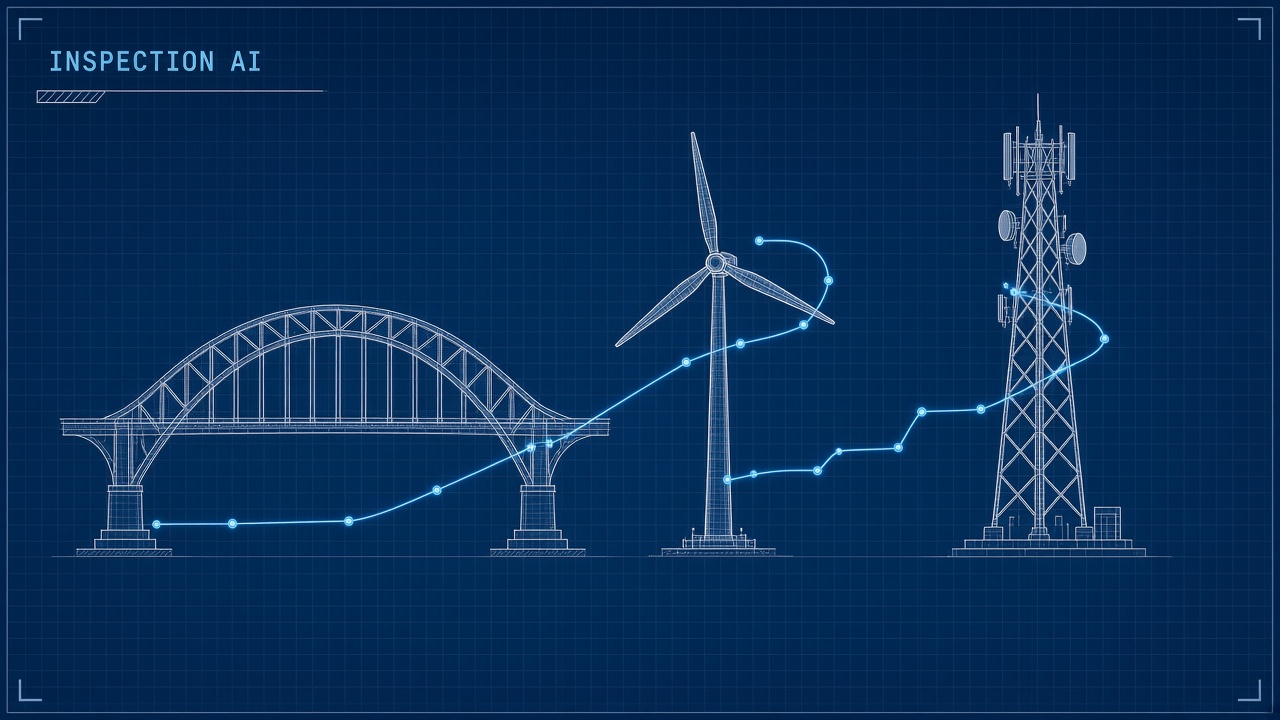
AI drone infrastructure inspection replaces rope-access and manual climb surveys with UAV photogrammetry, LiDAR corridors, and machine learning defect detectors that flag cracks, corrosion, spalling, and blade anomalies for human confirmation. A 2025 bridge inspection framework validated on Belgium's Merendreebrug achieved 3.2 cm photogrammetric accuracy versus terrestrial laser scans, generated safe underdeck flight routes within 0.67 m RMSE, and produced a verified damage report in under 4.25 hours after expert review of AI candidates. Wind operator Boralex cut defect review time 61% with 95% classification accuracy using SkyVisor AI. Infrastructure owners evaluating AI research on computer vision or building AI research infrastructure for asset monitoring should plan for human-in-the-loop validation, BVLOS regulatory evolution, and digital twin integration from day one.
Manual Inspection Cost and Risk
Manual bridge, turbine, and tower inspections expose workers to fall hazards, weather delays, and subjective note-taking while costing thousands per asset in labor, rigging, and lane closures. Bridge underdeck surveys traditionally require bucket trucks, snooper cranes, or climbers harnessed to steel. Wind turbine blade walks demand certified technicians on ropes 80+ meters above ground. Cell tower climbs carry RF exposure and structural load risks. Each method limits how often owners can inspect, letting small cracks propagate into costly repairs.
Manual reports vary by inspector experience. Photo coverage gaps leave undetected spalling on hidden gussets or trailing-edge blade erosion. Regulatory mandates (FHWA bridge intervals, OEM blade warranty inspections) drive demand but budgets cap frequency. Drones promise repeatable imagery, georeferenced models, and safer standoff distance from traffic and energized lines.
Cost models must include data processing, not just flight hours. A $2,000 pilot day is cheap if analysts spend weeks reviewing 10,000 images manually. AI defect suggestion collapses review queues when tuned for recall with spatial clustering, accepting false positives upstream of human sign-off.
Wind blade inspections at utility scale may cover thousands of turbines per season. Fleet scheduling software batches sites by weather windows and pilot certification regions. AI preprocessing that triages only anomalous blade segments for human review keeps analyst headcount flat as turbine counts grow.
Liability remains with the asset owner. AI assists prioritization; engineers certify maintenance actions. Contracts should define whether vendors guarantee detection rates per defect class or merely provide software tooling.
Automated Flight Planning Workflows
Modern inspection pipelines generate collision-aware flight paths from 3D models or GIS assets, then execute repeatable autonomous missions with RTK GPS and obstacle sensing. Bridge workflows map deck soffits, piers, and bearings with offset cameras maintaining constant standoff distance. Underdeck flights face GPS multipath and magnetic interference; planners use structure-from-motion priors and visual odometry backups.
Dock-based autonomy scales cadence without pilot travel. HOCHTIEF's A1 Rhine Bridge rebuild uses a DJI Dock 2 on site with weekly BVLOS surveys piloted remotely from Madrid (~1,600 km away) via Skyports, feeding DroneDeploy reality capture for 2D maps, topography, and 3D models the construction team references against design.
Wind turbine inspections orbit hub height with blade tracking paths: leading edge, pressure side, suction side, trailing edge segments captured at defined overlap for photogrammetry stitching. Cell towers use cylindrical or helical patterns around guy wires and mounts, respecting minimum distances from antennas.
Utility corridor missions increasingly use fixed-wing VTOL aircraft. A May 2026 Censys Sentaero 6 proof-of-concept in Ohio flew TV540 LiDAR plus 45 MP RGB across transmission and distribution lines for vegetation encroachment and asset modeling under BVLOS constraints, demonstrating corridor-scale workflows beyond single-structure orbits.
Crack and Corrosion Detection Models
Defect detectors are typically convolutional or transformer vision models trained on labeled cracks, spalls, rust blooms, delaminations, and hot spots, then post-processed to cluster duplicate detections on 3D meshes. The Merendreebrug pipeline optimized for recall, producing 16,822 initial detections grouped into 66 damage candidates; human reviewers confirmed 24 defects in 4.25 hours via a graphical interface mapping predictions onto the photogrammetric model with dimensions and severity metadata.
Wind blade AI (Boralex case study) preprocesses images with segmentation, runs custom defect detectors, and post-processes with flight-context metadata (distance, angle, lighting) to tune false positive rates. Reported results: 742 anomalies analyzed, 95% classification accuracy, 8 minutes average per inspection analysis, 61% time reduction versus manual review.
Defect taxonomy matters for model design. Bridges: longitudinal deck cracks, map cracking, efflorescence, rebar exposure, bearing rotation indicators. Turbines: leading-edge erosion, lightning strikes, adhesive voids, tip damage. Towers: rust on mounts, bolt looseness proxies, coax connector corrosion. Each class needs balanced training data across paint colors, soiling, and sun angle.
| Asset type | Common AI targets | Typical sensor |
|---|---|---|
| Bridges | Cracks, spalling, corrosion, delamination | RGB photogrammetry, optional TLS fusion |
| Wind turbines | Blade erosion, lightning, adhesive gaps | High-res RGB, thermal optional |
| Cell towers | Rust, structural deformation, loose hardware | RGB zoom, LiDAR for guy wires |
| Utility corridors | Vegetation encroachment, conductor sag | LiDAR + RGB fusion |
Digital Twin Updates from Scan Data
Each inspection flight should feed BIM, GIS, or asset management digital twins with dated meshes, defect pins, and measurement trends rather than orphaned photo folders. Photogrammetric models align to design coordinates when ground control points or RTK trajectories are accurate within centimeters. Engineers overlay as-built versus as-designed on bridge rebuilds (HOCHTIEF Rhine case) to catch rebar placement drift before concrete pours.
Defect histories stored on the twin enable change detection: crack length growth between 2025 and 2026 surveys triggers maintenance tickets automatically when thresholds exceed codes. Wind fleets correlate blade erosion rates with annual energy production loss models.
Integration APIs export GeoJSON defect layers, IFC snippets for BIM tools, and PDF reports for regulators. Without twin linkage, AI detections remain slideshows. Owners should require CMMS integration (Maximo, SAP PM) in procurement specs.
LiDAR plus RGB fusion improves conductor and vegetation modeling where RGB alone misjudges depth. Corridor-scale twins aggregate miles of right-of-way, not single structures, supporting vegetation management budgets.
Change detection between inspection epochs highlights new crack growth faster than side-by-side photo review. Aligning meshes with ICP registration before differencing reduces false alarms from slight viewpoint shifts between flights.
BVLOS Regulation Trends
Beyond visual line of sight (BVLOS) rules are shifting from case-by-case FAA waivers toward standardized frameworks, enabling docked drones and long corridor flights without a pilot on every rooftop. U.S. Part 107 requires remote pilot certification for commercial ops; BVLOS historically needed individual waivers. FAA Notice JO 7200.20 (effective September 30, 2025) streamlines vertical structure inspections with expanded operating parameters. Proposed Part 108 NPRM (August 7, 2025) aims to replace waiver patchwork with scalable BVLOS rules, with finalization expected 2026-2027.
European operators already run remote-piloted dock missions across borders (Madrid pilot flying Germany). Utility BVLOS proofs in Ohio demonstrate fixed-wing endurance for 158-mile-class ambitions when launch logistics and airspace coordination mature.
Compliance checklist: detect-and-avoid, command link redundancy, geo-fencing, remote ID, cybersecurity for dock stations, and insurance endorsements. Tower inspections near airports need additional coordination. Railway ROW inspections face trespass and electrification hazards beyond FAA scope alone.
Until Part 108 finalizes, budget legal review for each BVLOS expansion. Dock deployments amortize pilot travel but concentrate regulatory risk at the dock site.
Thermal infrared adds value for electrical infrastructure: loose connectors, transformer hotspots, and PV module defects show temperature anomalies RGB misses. Fusion models that register thermal frames to RGB meshes reduce duplicate review when inspectors toggle layers in the digital twin viewer.
Railway and highway bridge programs under federal stewardship increasingly accept UAV supplements to hands-on inspection but rarely waive hands-on entirely for fracture-critical members. AI should prioritize ranking which spans need scaffolding next cycle, not claim 100% replacement of structural engineers on site.
Vendor selection criteria should include export formats (LAS, OBJ, COG GeoTIFF), API rate limits for enterprise CMMS integration, and retraining tooling when your fleet paints bridges green instead of gray. Models trained only on concrete spalling underperform on painted steel cell towers without domain adaptation.
Insurance underwriters increasingly ask for dated orthomosaics proving inspection cadence after weather events. AI workflows that timestamp every defect pin and flight metadata simplify claims when hurricanes or ice storms trigger emergency reassessments across hundreds of structures in one week.
Cell tower co-location adds RF complexity: flight planners must respect exclusion zones around active antennas while still imaging mount hardware. Machine learning models trained on tower portfolios learn to ignore intentional equipment versus unintended rust, reducing false positives that manual reviewers currently filter.
Frequently Asked Questions
Who is liable for missed defects?
Asset owners retain engineering responsibility for structural safety. AI vendors typically disclaim warranties beyond software performance metrics. Contracts should specify human review requirements and detection rate benchmarks per defect class, not absolute guarantees.
Do I need LiDAR or is RGB enough?
RGB photogrammetry suffices for many bridge and blade surface defect workflows when overlap and GSD are controlled. LiDAR adds value for vegetation encroachment, conductor geometry, and low-texture surfaces where photogrammetry struggles.
Can drones inspect railways?
Technically yes for trackbed, bridges, and catenary masts, but railway operators impose strict ROW access, electrification clearances, and FRA coordination beyond standard Part 107 planning. Expect bespoke safety cases.
How accurate are AI crack measurements?
Merendreebrug reported 3.2 cm mean distance error on the overall model versus TLS, enabling useful trending but not replacing caliper verification on critical fractures. Always validate measurement pipelines on ground truth before code compliance claims.
What is human-in-the-loop review?
AI proposes defect candidates; trained inspectors confirm, reject, or reclassify before maintenance actions. High-recall models with clustering reduce review time while keeping engineers accountable for final reports.
Can I fly BVLOS without a waiver today?
In the U.S., most BVLOS still requires approved pathways or waivers until Part 108 finalizes. Dock vendors bundle compliance packages; verify status with aviation counsel before scaling beyond VLOS orbits.
Where should I learn more about drone inspection AI?
Review ISPRS bridge inspection papers, operator case studies (Boralex, HOCHTIEF), and FAA Part 108 progress. Broader vision ML context appears under AI research and AI research search.