Low Earth orbit hosts more than ten thousand operational satellites and hundreds of thousands of trackable debris fragments, with collision velocities exceeding 10 kilometers per second. A centimeter-scale object can disable a spacecraft; a cascade of collisions could trigger Kessler syndrome, where debris generation outpaces natural decay. Traditional orbit determination from sparse radar and optical passes struggles when uncertainty ellipsoids overlap days before closest approach. Machine learning now fuses high-volume observations, propagates covariances faster than legacy filters, and ranks conjunction alerts so human operators focus on the riskiest events. SpaceX Stargaze ingests roughly 30,000 star trackers capturing on the order of 30 million satellite transits per day. Slingshot Aerospace applies ML to high-covariance conjunctions up to five days ahead. SCRAP uses LightGBM and XGBoost on conjunction features. Researchers explore Masked PPO reinforcement learning for debris removal mission planning. Readers following AI research for aerospace safety or browsing popular AI tools for anomaly detection should understand how tracking pipelines convert photons and radar returns into maneuver decisions.
Kessler Syndrome and LEO Crowding
Donald Kessler's 1978 hypothesis warned that dense debris fields could become self-sustaining: each collision creates fragments that cause further collisions, making some orbits unusable for generations. Megaconstellations for broadband, Earth observation, and military sensing increased launch cadence throughout the 2020s. Anti-satellite tests and accidental breakups added trackable clouds. The U.S. Space Surveillance Network and commercial providers catalog objects down to roughly 10 centimeters in LEO, but smaller untrackable debris still poses lethal risk. Operators receive conjunction data messages when predicted miss distances fall below thresholds, yet false alarm rates strain mission teams that must weigh fuel cost against catastrophic loss.
AI does not remove debris by itself in most deployments, but better tracking and risk ranking reduce unnecessary maneuvers while catching high-risk overlaps earlier. Autonomous collision avoidance on board satellites, still rare in production, depends on accurate short-horizon predictions from fused sensor networks. International debris mitigation guidelines encourage post-mission disposal, yet compliance varies. Tracking AI makes non-compliance visible by associating uncatalogued objects with launch events.
Radar, Optical, and Onboard Sensor Fusion
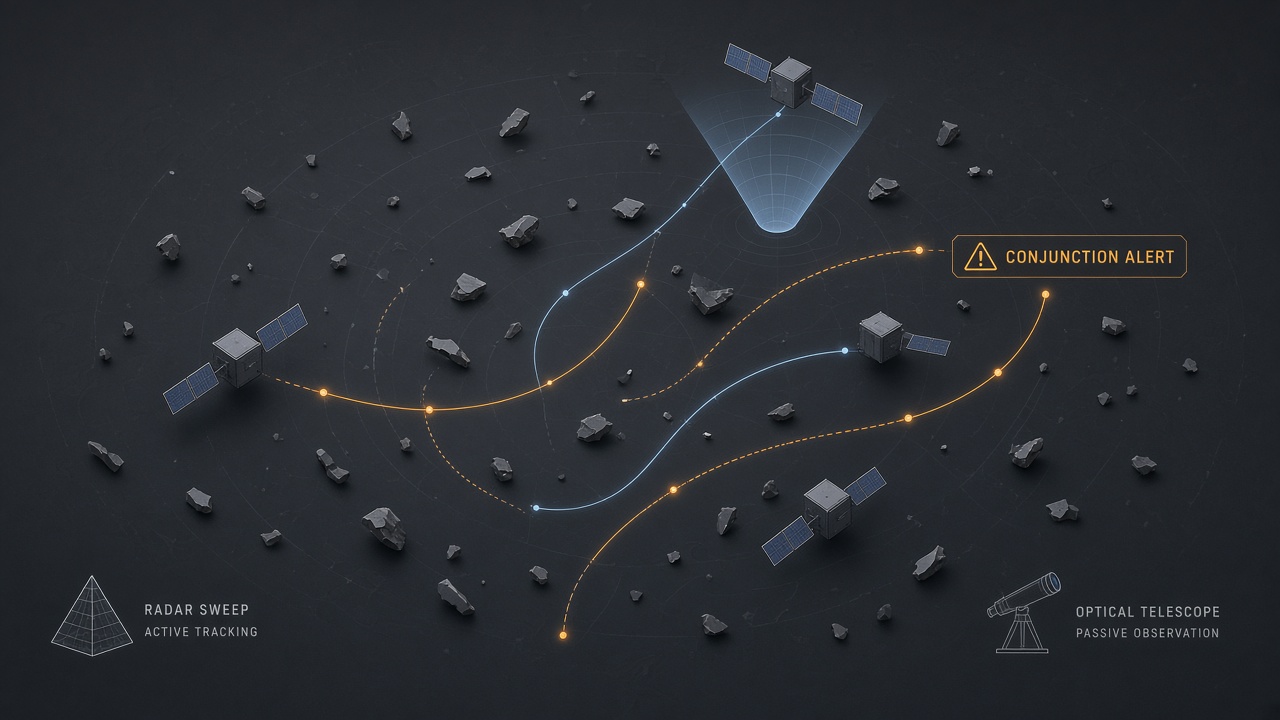
Ground-based phased-array radars provide range and range-rate; optical telescopes add angular precision; onboard star trackers on deployed constellations contribute opportunistic observations when other satellites cross the field of view. SpaceX Stargaze repurposes star tracker hardware across the Starlink fleet, building a distributed optical network that records roughly 30 million transits daily. Those measurements feed orbit refinement pipelines that update state vectors more frequently than twice-per-day radar passes alone. Sensor fusion models learn which observations to trust under weather, terminator lighting, and attitude constraints.
| Sensor type | Strength | ML fusion role |
|---|---|---|
| Ground radar | All-weather range data | Kalman updates, outlier rejection |
| Optical tracking | Fine angle, geostationary watch | Association across passes |
| Onboard star trackers | High cadence, distributed | Stargaze-style transit cataloging |
| Space surveillance catalogs | Historical ephemerides | Feature inputs for risk models |
Gradient-Boosted Collision Risk Models
SCRAP and related systems engineer tabular features from conjunction summaries (miss distance, relative velocity, covariance volume, time to closest approach) and train gradient-boosted trees such as LightGBM and XGBoost to rank event severity. Tree models handle heterogeneous inputs well, train quickly on millions of historical conjunction data messages, and expose feature importance for operator trust. They complement physics propagators rather than replacing orbital mechanics: numerical integration still produces baseline trajectories; ML re-scores which pairs deserve analyst attention when catalog uncertainty inflates collision probability estimates.
Slingshot Aerospace focuses on high-covariance conjunctions where linearized uncertainty assumptions break down, using ML to extend reliable warning windows to about five days for selected geometries. Early warning gives operators more launch-window flexibility and reduces emergency maneuvers that interrupt payload operations. Validation compares predicted miss distance distributions to post-event radar confirmation, tuning probability calibration so a 1-in-10,000 reported risk approximates observed frequency across fleets.
Orbit Determination and Conjunction Alerts
Orbit determination fuses sequential measurements into state estimates and covariance matrices; conjunction screening propagates those states forward to find close approaches between a protected asset and catalog objects. AI improves association (matching uncorrelated tracks to catalog IDs), learns systematic biases in radar sites, and denoises optical astrometry affected by atmospheric seeing. When two objects' uncertainty ellipsoids overlap, the pipeline computes collision probability using forward Monte Carlo or analytical approximations. Operators receive alerts ranked by ML-adjusted risk, not raw miss distance alone.
Autonomous avoidance maneuvers remain policy-sensitive: international norms require operators to notify counterparts and document fuel expenditure. Some missions pre-authorize automated burns below a probability threshold after extensive simulation. AI space debris tracking inputs must be explainable enough for insurance and regulatory review after near-miss events.
Debris Removal and Future RL Planning
Active debris removal missions plan rendezvous with tumbling objects; reinforcement learning approaches such as Masked PPO explore fuel-efficient capture trajectories under partial observability. These are research-stage compared to operational conjunction screening, but they share sensor fusion and uncertainty propagation machinery. A successful removal mission reduces future conjunction count, benefiting all operators. Policy makers weigh removal cost against launch insurance savings and orbit sustainability metrics.
Commercial space situational awareness vendors compete on catalog freshness, API latency, and calibrated risk scores. Open data from U.S. Space Command supplements commercial feeds. Teams publishing in AI research conferences benchmark orbit prediction error on standardized datasets while redacting operator-identifying ephemerides. The field moves toward federated learning across operators without sharing proprietary maneuver plans.
Catalog maintenance is continuous: new launches add objects, atmospheric drag lowers orbits, and deliberate or accidental breakups inject fragments. Orbit determination must associate uncorrelated tracks observed minutes apart with the same physical object despite gaps. Machine learning classifiers score association hypotheses using brightness, radar cross section trends, and maneuver detection signatures. When operators execute planned burns, propagators update within hours; undeclared maneuvers by third parties can invalidate conjunction messages until fresh observations arrive.
Collision probability mathematics assumes Gaussian uncertainty in position and velocity, which breaks down when covariances are elongated or correlated across axes. Slingshot-style ML targets these high-covariance cases up to five days before closest approach, giving mission planners time to adjust observation schedules or pre-position ground stations for tracking passes. Five-day horizons still sit inside many mission planning cycles, unlike two-week strategic launch windows, making the extra lead materially useful for constellation managers scheduling batch maneuvers across dozens of satellites.
Space situational awareness APIs expose CDM streams to commercial customers under service agreements. SCRAP-style gradient boosting runs efficiently on tabular features extracted from those messages, enabling on-premise deployment for operators who cannot upload proprietary ephemerides to third-party clouds. Feature stores cache historical conjunction outcomes (miss distance confirmed post-event) to retrain models quarterly as debris populations evolve. Anti-satellite tests create step changes in fragment counts that models must detect quickly through anomaly monitors on catalog growth rate.
Masked PPO reinforcement learning for debris removal explores capture trajectories under fuel and safety constraints, distinct from conjunction screening but sharing orbit propagators. A successful capture reduces future conjunction counts for all operators, a positive externality motivating international funding debates. Until removal scales, maneuvering remains the primary mitigation. AI ranking ensures fuel is spent on true high-risk events rather than noisy alerts driven by pessimistic covariance inflation.
Kessler syndrome remains a tail-risk scenario rather than an scheduled date, but insurers and regulators track object density trends. Transparency from Stargaze-scale optical networks may improve catalog completeness for objects too small for routine radar but large enough to disable a satellite. Combining AI space debris tracking with design standards for demise on reentry and post-mission disposal compliance forms a layered safety strategy no single algorithm solves alone.
Frequently Asked Questions
How small an object can we track?
Ground systems track LEO objects roughly 10 centimeters and larger depending on altitude and radar power. Smaller debris remains lethal but invisible to catalog screening; missions use Whipple shielding and accept residual risk.
What is a conjunction data message?
A standardized report estimating closest approach time, miss distance, and collision probability between a primary object and a secondary catalog entry. Operators receive CDMs from the Space Force and commercial providers, often dozens per week for busy constellations.
Does AI replace human analysts?
No. ML ranks and filters alerts; humans approve maneuvers, coordinate with other operators, and investigate catalog errors. False positives still occur when covariance is mis-modeled.
How does Stargaze differ from ground telescopes?
Stargaze uses existing star trackers on orbiting satellites to record transits of other spacecraft, producing distributed optical measurements without building new ground sites. Scale comes from fleet size, not single-telescope aperture.
Will Kessler syndrome happen soon?
Experts debate timing, but collision risk rises with object count and ASAT debris. Better tracking and removal reduce but do not eliminate cascade concern. Operators rely on maneuvering and design for survivability.
Can satellites dodge automatically?
Some operators test autonomous avoidance; most require human approval today. Autonomy needs trusted short-horizon predictions and clear rules for fuel expenditure and notification.
Gradient-boosted models like SCRAP demonstrate that tabular ML on conjunction features scales to operational alert volumes where deep networks would be harder to certify. Slingshot's five-day high-covariance horizon targets the planning window mission designers need before launch and station-keeping burns. Combining Stargaze-scale optical transits with radar ephemerides is an active integration challenge: association algorithms must not double-count the same object or split one satellite into duplicate tracks.
Insurance underwriters and regulators increasingly ask for documented space situational awareness practices. AI orbital debris tracking outputs that include calibrated probabilities and feature attributions support those audits better than black-box scores. As megaconstellations age and deorbit, tracking models must handle increasing maneuver frequency and dead satellites drifting without attitude control, stressing propagators that assume ballistic coefficients hold constant for days.
Conjunction screening at scale also depends on timely propagation of solar and atmospheric density models that affect drag predictions for low-altitude objects. Machine learning can learn bias corrections when propagators systematically underpredict decay rates after geomagnetic storms. Operators who ignore space weather coupling may receive stale miss distances until fresh radar passes arrive. Integrating flare and storm forecasts from space weather services with debris tracking pipelines is an emerging cross-domain workflow for constellation reliability teams.
International data sharing agreements govern how much ephemeris detail crosses national boundaries. Federated learning proposals train risk models across operators without centralizing maneuver plans that reveal commercial or military intent. Open catalogs from the U.S. Space Force provide a baseline; proprietary Stargaze-class networks add density. The AI layer sits above politics but must respect export controls on precision state vectors when APIs serve global customers.
Training conjunction risk models on historical CDM archives teaches which geometry features predict post-event radar confirmation of close approaches versus benign flybys with inflated covariance. Operators who log maneuver outcomes create supervised labels improving the next quarter's model refresh. Without that feedback loop, static thresholds either cry wolf or miss genuine threats when catalog quality shifts after large breakup events.