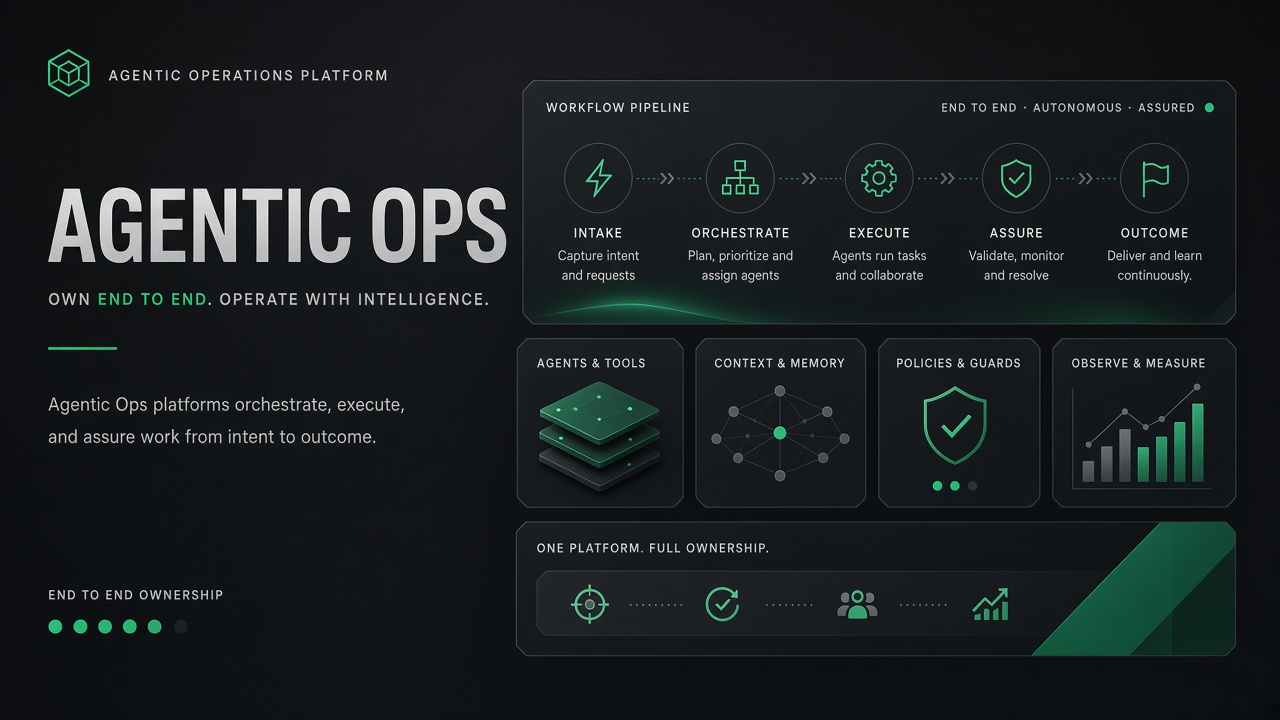
Enterprise software spent two decades selling seats and dashboards. Copilots added a drafting layer on top. A new category goes further: agentic operations platforms execute bounded workflows end to end, wire outcomes into proprietary data loops, and price on results where attribution is clear. Fravity (now RiskOS Agents at Socure), Genpact's agentic finance offerings, and vertical players in logistics and lending illustrate the shift from tools that assist to systems that operate. This guide defines the category, contrasts copilot software with workflow-owning agents, and gives B2B buyers an evaluation frame. Explore related patterns in AI automation and AI productivity categories across industries.
Copilot vs Agentic Operations: Different Products, Different Economics
Copilots suggest next steps inside software humans already operate; agentic operations platforms run the workflow, hand finished cases to humans only for exceptions, and learn from every resolved outcome. A copilot might draft an email or summarize a ticket. An agentic ops platform ingests a fraud alert, pulls account history, applies policy rules, gathers evidence, and closes or escalates the case with a full audit trail.
Deming Gate (demg.ai) frames the distinction sharply: dashboard-era SaaS showed operators charts and waited for clicks. Agentic operations software processes decisions at scale without a human touching most of them. Socure's acquisition of Fravity reflected valuation tied to billions of automated risk decisions annually, not seat count. The buyer pays for throughput and accuracy, not logins.
Copilots remain valuable for creative and ambiguous work. Agentic ops targets repetitive, rules-heavy processes with measurable KPIs: invoices processed, draws approved, claims triaged, loads dispatched, compliance cases resolved. The category does not replace strategic judgment; it collapses operational labor around it.
Workflow Ownership, Not Assistance
Agentic operations platforms own workflow state: they read inputs, execute policy, write outputs to downstream systems, and record evidence for audit. Ownership implies integration depth. A platform that cannot post to ERP, update CRM, or trigger payment holds only automates the easy half.
| Capability | Copilot-style tool | Agentic ops platform |
|---|---|---|
| Primary output | Suggestions and drafts | Completed cases and system updates |
| Data loop | Often stateless per session | Closed feedback from outcomes |
| Human role | Operator on every task | Exception handler and policy owner |
| Pricing anchor | Seats or tokens | Outcomes, actions, or hybrid |
Closed feedback loops separate durable platforms from static scripts. When every resolved fraud case, paid invoice, or approved draw trains the next decision, standalone agent vendors without first-party data struggle to match incumbents who already sit on transaction history. Demg.ai argues the formula is first-party data plus domain expertise plus an agent layer that closes its own loop.
Pricing by Outcome: Signal and Reality
Outcome-based pricing aligns vendor revenue with customer KPIs, but most 2026 deployments use hybrid models combining platform fees with per-action or per-resolution charges. Intercom's Fin charges per resolved support conversation. Salesforce Agentforce meters conversations and standard actions. Genpact underwrites finance outcomes such as cost per invoice processed, absorbing model cost risk when attribution is clean.
Pure outcome pricing works when three conditions hold: clear attribution, immediate measurement, and high value per outcome. Sierra AI's per-resolution model fits customer service where a solved ticket has obvious value. Complex B2B workflows often start hybrid: fixed platform fee plus usage, migrating toward outcome components as measurement matures. Gartner projects that by 2030 at least 40 percent of enterprise SaaS spend shifts toward usage, agent, or outcome-based pricing, per Deloitte's 2026 SaaS and agents analysis.
Buyers should negotiate definitions upfront. "Resolved invoice" must mean posted and reconciled, not merely OCR'd. "Approved draw" must exclude packages later reversed. Vendors need spend guards and model tiering so outcome pricing does not collapse margins when frontier model costs spike.
Domain Expertise Requirement
Agentic operations platforms fail without encoded domain expertise: policy libraries, exception playbooks, and integrations that reflect how an industry actually operates. Generic LLM wrappers cannot safely approve construction draws, triage insurance claims, or dispatch freight without SOPs expressed as executable rules and human escalation paths.
Domain expertise shows up in vendor hiring, customer success models, and product architecture. Winners embed former underwriters, construction credit analysts, or dispatch supervisors into implementation teams. They ship pre-built policy templates tuned to regulated workflows while allowing tenant-specific overrides. Alvys Foundry in freight explicitly rejects a single canonical detention process because every carrier's contracts differ; the platform ships blocks to express customer SOPs instead.
Buyers should weight reference customers in the same sub-vertical over generic AI benchmarks. A platform strong in accounts payable may fumble construction lien waiver logic without years of encoded edge cases.
Buyer Evaluation Framework
Evaluate agentic operations platforms on workflow coverage, evidence quality, integration depth, governance, and pricing alignment with the metric you already track. Use the checklist below during pilots.
- Metric match: Does the vendor move a KPI your executive team already reviews monthly?
- End-to-end scope: Can the platform complete the workflow or only prep inputs for humans?
- Audit trail: Does every action link to source documents, policy rules, and model version?
- Exception UX: How fast can analysts override, correct, and feed outcomes back?
- Data residency and training: Is customer data excluded from public model training?
- Parallel run: Can you shadow the agent against current staff before automate mode?
Procurement teams accustomed to seat-based SaaS must update security reviews for autonomous actions: which systems can agents write to, what dollar thresholds trigger human approval, and how are prompts and tools versioned. SOC 2 and industry certifications matter, but so does per-tenant governance like Alvys Agent Shield or Built's policy-as-code modes.
Category Examples by Vertical
Agentic operations platforms already operate in fraud and identity (Fravity/RiskOS Agents), finance operations (Genpact agentic AP), customer service (Sierra, Intercom Fin), and freight (Alvys Foundry, Numeo agents), each owning case workflow rather than drafting alone. The pattern repeats wherever buyers track a countable outcome: cases resolved, invoices processed, loads updated, draws funded. Horizontal CRM and ERP vendors add agent layers, but vertical platforms start with encoded SOPs and expand outward.
Build vs Buy for Enterprise Buyers
Enterprises with unique data assets and compliance regimes sometimes build internal agent orchestration; most mid-market buyers purchase vertical platforms to avoid multi-year integration programs. Build makes sense when workflow is proprietary competitive advantage. Buy dominates when time-to-value, encoded edge cases, and audit packaging from vendors shorten deployment from years to quarters. Hybrid approaches use vendor platforms for standard subprocesses and internal agents for differentiated steps, provided governance unifies logging.
Common Failure Modes
Agentic ops pilots fail when buyers expect copilot UX, skip parallel validation, underfund exception staffing, or choose vendors without write-back integrations. Another failure mode is outcome pricing without baseline measurement: if you cannot state current cost per invoice today, you cannot verify Genpact-style underwritten savings tomorrow. Successful programs assign executive sponsors to one metric, not twelve demo features.
Organizational Readiness for Agentic Ops
Technology alone does not create an agentic operations program; operations leaders must redefine roles, exception staffing, and KPI dashboards before automate mode scales. Credit analysts become exception adjudicators. Dispatchers become playbook authors. AP clerks audit sampled agent postings. HR and labor relations need transparent communication about role evolution, not surprise headcount targets tied to pilot demos.
IT and security teams must extend identity governance to non-human actors: service accounts, tool permissions, prompt version control, and rollback procedures when an agent misconfigures policy. Legal should review outcome SLAs and liability allocation when agents act without per-transaction human click. Change management is slower than model deployment; budget both timelines.
Maturity Model Summary
Most enterprises progress from assisted drafting to advisory agents to exception-only human touch to audited full automation on bounded process subsets. Skipping stages produces trust collapse when an agent auto-approves a high-risk case on week two. Demg.ai and Deloitte both emphasize hybrid pricing and hybrid autonomy as the stable 2026 state, not a temporary bridge.
Implications of Seat Decline
When agents absorb work previously done across many licensed seats, SaaS vendors reprice toward actions and outcomes while enterprises renegotiate EA renewals that assumed per-user growth. Procurement should model three-year scenarios where agent volume replaces headcount growth rather than augmenting it. Finance teams track agent spend as operational COGS adjacent to labor, not purely IT subscription. Boards asking for AI strategy updates should demand one owned workflow metric per quarter, not pilot slide decks without production case volume.
Frequently Asked Questions
What are agentic operations platforms?
Agentic operations platforms are B2B systems that execute entire operational workflows with minimal human intervention, learning from outcomes through integrated data loops. They differ from copilots by owning case state and downstream system updates, not just generating suggestions.
Do agentic ops platforms replace copilots?
They overlap in marketing but serve different jobs: copilots assist human operators; agentic ops platforms run bounded processes and escalate exceptions. Many enterprises will use both across different functions.
Who bears risk under outcome pricing?
Negotiation determines risk share; sophisticated vendors like Genpact underwrite outcomes when they understand baseline process cost, while immature vendors may push risk back via usage floors. Read SLAs on measurement disputes and exclusion criteria.
Why did Socure acquire Fravity?
Socure acquired Fravity (RiskOS Agents) to embed end-to-end fraud and risk workflow automation into its identity platform, compounding decision volume and data loops. The deal illustrated acquirer appetite for execution infrastructure, not dashboards alone.
Which verticals fit agentic ops first?
Compliance, lending operations, insurance claims, freight dispatch, accounts payable, and construction draw review share high document volume, clear policies, and measurable outcomes. Creative and strategic functions remain copilot territory.
Should we build agents in-house?
Build when workflow and data are unique strategic assets; buy when time-to-value and encoded domain expertise dominate. Most mid-market buyers lack integration and governance teams to match vertical vendors' parallel-run playbooks.
What do analysts predict for agent pricing?
Deloitte and Gartner expect hybrid usage and outcome models to grow through 2030, with experimentation dominant in 2026 as vendors prove consistent value delivery. Buyers should contract flexibility to migrate pricing as measurement matures.
Why do data loops matter for acquirers?
Acquirers pay premiums for platforms whose agents improve with transaction volume because loops create compounding defensibility beyond feature parity. Socure's Fravity acquisition reflected this logic.
Conclusion
Agentic operations platforms define a new SaaS category: software that owns workflows end to end, compounds through outcome-linked data loops, and prices on results where measurement is honest. Copilots accelerated drafting; agentic ops targets operational labor in compliance, logistics, lending, and finance. Buyers should evaluate metric alignment, audit depth, and hybrid pricing realism while running parallel validation before granting automate mode. Tie adoption to AI automation governance and AI productivity metrics your leadership already trusts. The category is young, but the direction is clear: infrastructure that executes, not software that waits.