What is Transformer Lab?
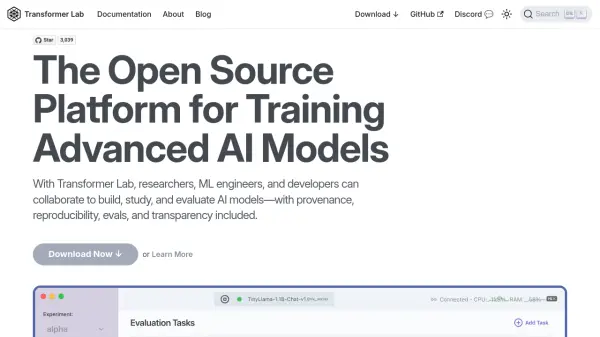
Transformer Lab provides an open-source environment designed for collaboration among researchers, machine learning engineers, and developers. It facilitates the building, study, and evaluation of advanced Artificial Intelligence models, emphasizing provenance, reproducibility, comprehensive evaluations, and transparency throughout the development lifecycle.
The platform supports a wide range of functionalities, including one-click downloads for popular models like Llama3, Phi3, and Mistral, as well as the ability to import any LLM from Huggingface. Users can train models from scratch, perform finetuning using various methods (DPO, ORPO, SIMPO, GRPO), conduct RLHF, and engage in reward modeling. It offers tools for interacting with models via chat interfaces, performing batch inference, calculating embeddings, and visualizing tokenizers. Transformer Lab ensures broad accessibility through its cross-platform support for Windows, MacOS, and Linux, leveraging Apple MLX for Apple Silicon and CUDA for NVIDIA GPUs, including multi-GPU setups.
Features
- Model Management: Download hundreds of popular models (Llama3, Phi3, etc.), download any LLM from Huggingface, train/use embedding models, convert formats (MLX, GGUF).
- Model Interaction: Chat with models, use preset prompts, manage chat history, tweak generation parameters.
- Inference Capabilities: Batch inference, calculate embeddings, visualize LogProbs and tokenizers, view inference logs.
- Advanced Training: Pre-training, finetuning, RLHF, DPO, ORPO, SIMPO, GRPO, and reward modeling.
- Comprehensive Evals: Eleuther Harness, LLM as a Judge, objective metrics, red teaming evals, visualization.
- Extensibility: Plugin support with a library and custom plugin creation.
- Retrieval Augmented Generation (RAG): Drag and drop file UI for RAG integration.
- Cross-Platform Support: Runs on Windows, MacOS, Linux with support for Apple MLX and CUDA (including multi-GPU).
Use Cases
- Collaborating on AI model development projects.
- Training custom AI models from scratch or finetuning existing ones.
- Evaluating and comparing the performance of different AI models.
- Deploying and interacting with large language models for various tasks.
- Extending AI model capabilities using custom plugins.
- Implementing Retrieval Augmented Generation for specific knowledge domains.
- Researching and studying the behavior of AI models.