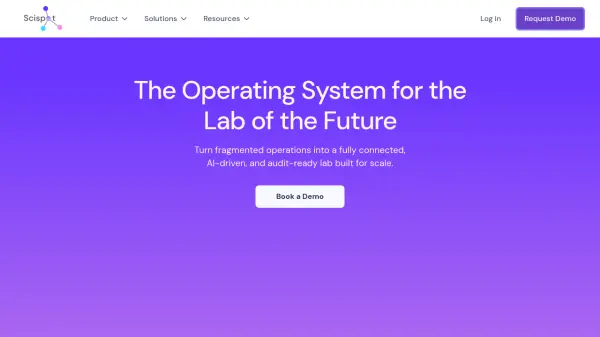
What is Scispot?
Scispot offers a comprehensive Lab Operating System (LabOS™) engineered to transform disjointed laboratory workflows into a cohesive, automated, and intelligent environment. It serves as a central platform connecting experiment planning, execution, documentation, and inventory management, thereby allowing research teams to concentrate on scientific discovery rather than administrative tasks.
The platform facilitates seamless integration of lab instruments, software, and databases through its GLUE integration engine, promoting real-time data synchronization and eliminating data silos. Scispot incorporates features like alt-LIMS for flexible sample management with full traceability and automated inventory systems to prevent stockouts. With built-in compliance tracking, it ensures that laboratory operations remain audit-ready and scalable for organizations ranging from startups to large enterprises. Additionally, its Scibot AI component acts as a personal lab assistant, enhancing data analysis and workflow efficiency.
Features
- Lab Operating System (LabOSᵀᴹ): Unified data and workflow platform for labs.
- GLUE Integration Engine: Toolkit links applications, instruments, and harmonizes data.
- alt-ELN: Flexible electronic lab notebook for both wet and dry labs.
- alt-LIMS: Configurable Laboratory Information Management System with no-code and API options.
- Scibot AI: Personal AI assistant integrated into the lab environment.
- Labflows: Automation focused on sample-centric lab workflows.
- Labsheets: Scientific databases equipped with templates for structured data entry.
- Labspace: Collaborative environment for experiment design and execution.
- Connectors & Agents: Enables one-click integration for lab instruments and applications.
- Inventory Automation: Automatically updates inventory levels during experiment execution.
- Sample Manager: Centralized system for managing laboratory samples.
- Workflow Automation: Connects various tools to automate laboratory processes.
- Computational Toolkit: Includes APIs, Jupyter Notebook, R Studio, and GPT-4 access for advanced computation.
- Analytics: Tools to create custom dashboards and analyze laboratory data.
Use Cases
- Unifying disparate lab operations into a single connected system.
- Automating sample tracking from receipt to disposal for complete traceability.
- Managing lab inventory automatically to prevent shortages and waste.
- Integrating various lab instruments, software (e.g., LIMS, ELN), and databases.
- Automating data analysis and sample processing using computational tools and APIs.
- Facilitating collaboration between lab teams on experiments and projects.
- Maintaining continuous compliance and audit readiness automatically.
- Exchanging R&D data securely with external partners and clinics.
- Connecting legacy systems, including external labs' LIMS, via APIs.
- Designing custom scientific databases.


![[FP]-LIMS](https://eliteai.tools/storage/tools/fp-lims/screenshot-large.webp)