What is MOSTLY AI?
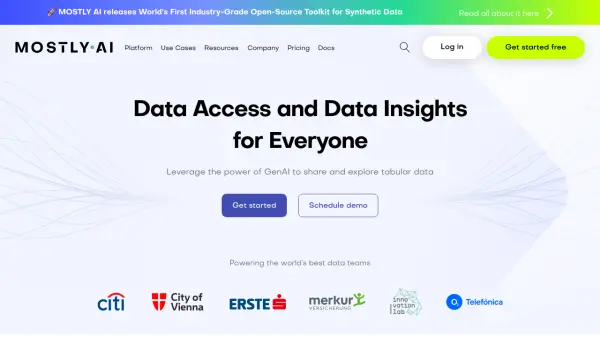
MOSTLY AI is a pioneering platform that enables true data democratization through advanced synthetic data generation. The platform utilizes GenAI models to create fully anonymous synthetic data that maintains the statistical properties of original datasets while ensuring compliance with privacy regulations like GDPR and CCPA.
The platform features a natural language interface for data exploration, supports multi-variate time series data, and offers enterprise-grade deployment options with ISO27001 and SOC2 Type 2 certifications. It includes a Python SDK for seamless integration into existing data workflows and provides capabilities for creating and enriching tabular data using fine-tuned language models.
Features
- GenAI Models: Proprietary architectures for highest accuracy synthetic data generation
- Privacy Protection: Fully anonymous synthetic data creation with regulatory compliance
- Natural Language Interface: AI-powered data exploration without specialized expertise
- Enterprise Integration: Kubernetes or OpenShift deployment with secure infrastructure
- Python SDK: Comprehensive client for workflow integration and management
- Multi-format Support: Handles multi-variate time series and relational databases
Use Cases
- Data sharing across organizations while maintaining privacy
- AI/ML model development with synthetic training data
- Testing and QA environments with representative data
- Self-service analytics for non-technical users
- Privacy-compliant data democratization
- Database population for development environments
FAQs
-
How does MOSTLY AI ensure data privacy?
MOSTLY AI creates fully anonymous synthetic data using optimized GenAI models, ensuring compliance with privacy regulations like GDPR and CCPA. The platform operates in air-gapped environments where no data leaves the secure infrastructure. -
What deployment options are available?
The platform can be deployed via SaaS, Cloud Marketplace, or custom deployment options, supporting both Kubernetes and OpenShift clusters for enterprise environments. -
How accurate is the synthetic data generated?
MOSTLY AI claims to generate the world's most accurate synthetic data, consistently benchmarked as highest accuracy in the market, making it suitable for sophisticated AI/ML use cases.