
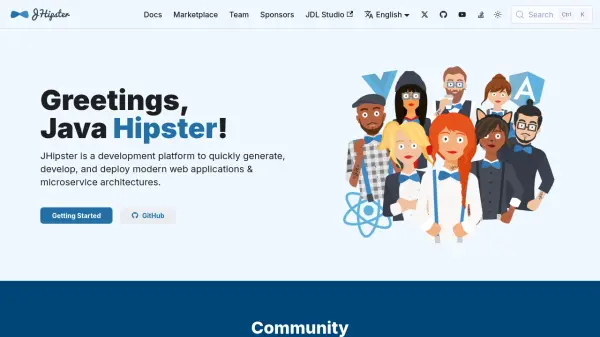
What is JHipster?
JHipster is a comprehensive development platform designed to accelerate the creation of modern web applications and microservice architectures. It provides developers with a unified solution for generating robust server-side stacks, sleek mobile-first user interfaces, and powerful build workflows. The platform supports various frontend technologies including Angular, React, and Vue, along with mobile app development for Ionic and React Native.
On the backend, JHipster offers compatibility with Spring Boot (using Java or Kotlin), Micronaut, Quarkus, Node.js, and .NET. For deployment, it embraces cloud-native principles with Docker and Kubernetes, supporting major cloud platforms such as AWS, Azure, Google Cloud Platform, Heroku, and OpenShift. The platform focuses on delivering excellent test coverage, resilient architectures, and infrastructure-as-code capabilities for efficient cloud deployment.
Features
- Frontend Technologies: Support for Angular, React, Vue, Ionic, and React Native
- Backend Technologies: Compatibility with Spring Boot (Java/Kotlin), Micronaut, Quarkus, Node.js, and .NET
- Cloud Deployment: Docker and Kubernetes integration with support for AWS, Azure, Google Cloud, Heroku, and OpenShift
- Build Workflow: Powerful workflow with Webpack and Maven or Gradle for application building
- Microservice Architecture: Resilient cloud-native architecture with infrastructure-as-code capabilities
Use Cases
- Generating complete web applications from scratch
- Developing microservice architectures for scalable systems
- Creating mobile applications with Ionic or React Native
- Deploying applications to cloud platforms using Docker and Kubernetes
- Building applications with modern frontend frameworks like Angular, React, or Vue
FAQs
-
What technologies does JHipster support for frontend development?
JHipster supports Angular, React, and Vue for web applications, plus Ionic and React Native for mobile app development. -
Which backend technologies are compatible with JHipster?
JHipster is compatible with Spring Boot (using Java or Kotlin), Micronaut, Quarkus, Node.js, and .NET for backend development. -
How does JHipster handle application deployment?
JHipster uses Docker and Kubernetes for cloud-native deployment, supporting AWS, Azure, Google Cloud Platform, Heroku, and OpenShift. -
What build tools does JHipster integrate with?
JHipster provides powerful workflows with Webpack and either Maven or Gradle for building applications.