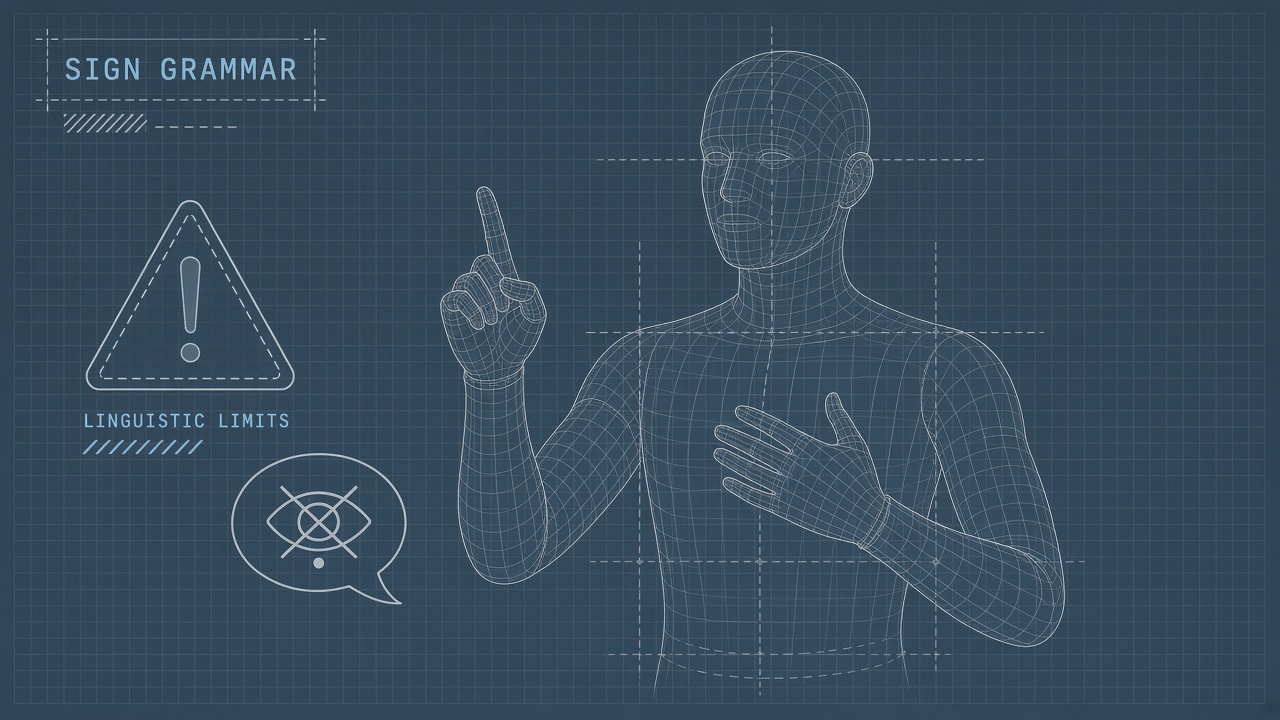
Three-dimensional sign language avatars that translate spoken or written language into animated signing proliferate at conferences, transit kiosks, and broadcast overlays. Vendors market them as scalable accessibility solutions cheaper than human interpreters. Deaf scholars and advocates, including critiques summarized by Maartje De Meulder in 2025, argue that many systems reproduce spoken-language word order, omit mandatory facial grammar, and deploy without Deaf community co-design. Comprehension studies such as SIMAX report roughly 52 percent understanding for avatar-produced sentences versus higher rates for skilled human signers. The ethical path forward expands choice rather than replacing interpreters, invests in linguistically faithful models co-developed with Deaf users, and restricts avatars to contexts where limitations are clearly disclosed. Readers comparing AI image generator and translation stacks or popular AI tools for accessibility should treat ai sign language avatar marketing skeptically until independent Deaf-led evaluation confirms fitness for each use case.
Promise of Scalable Sign Translation
Avatars offer always-on translation for emergency broadcasts, museum exhibits, and web video when booking interpreters lead time is unavailable or budgets are constrained. Rendered characters can loop explanations on kiosks, accompany AI-generated training videos, and localize content into national sign languages with 3D consistency. For hearing organizations facing legal pressure to provide accessible communication, avatars appear to solve supply shortages overnight. Pilot deployments at airports and government press briefings generate publicity and satisfy checkbox accessibility audits if reviewers lack signing fluency.
The promise assumes sign languages are gestural encodings of spoken words, a misconception linguists rejected decades ago. American Sign Language, British Sign Language, and other natural sign languages possess distinct phonology, morphology, and syntax. Machine translation pipelines trained on parallel text frequently map words to signs in spoken order, producing utterances Deaf viewers describe as exhausting or unintelligible. Without community governance, scalability amplifies error.
Deaf Community Critiques and Linguistic Limits
Deaf advocates highlight grammatical errors, cultural insensitivity, and replacement rhetoric that frames avatars as interpreter substitutes rather than optional supplements. Maartje De Meulder and colleagues document how missing non-manual markers, incorrect role shifting, and lack of classifier constructions break meaning in ways hearing reviewers miss. Facial expressions in sign carry syntactic force: raised brows mark questions, furrowed brows mark conditionals. Avatars with static faces or exaggerated cartoon expressions fail these requirements. Deaf professionals report that low-quality signing insults audiences and signals that organizations invested in spectacle over communication.
| Issue | Typical avatar failure | Human interpreter baseline |
|---|---|---|
| Word order | Signs follow spoken language sequence | Prosody and syntax follow sign grammar |
| Facial grammar | Static or cosmetic expressions only | Non-manual markers encode syntax and affect |
| Comprehension | SIMAX near 52 percent on test sentences | Skilled interpreters approach full comprehension |
| Governance | Hearing-led vendors set requirements | Deaf co-design and professional standards |
SIMAX Comprehension and Evaluation Gaps
SIMAX and related benchmarks quantify avatar comprehension percentages on controlled sentence sets, revealing large gaps versus human signers and exposing which linguistic phenomena break models. Reported comprehension near 52 percent means almost half of tested material fails basic understanding goals for informational content. Emergency instructions with ambiguity become dangerous when viewers misinterpret negation or time references. Vendors rarely publish failure modes by sentence type; aggregated scores hide that questions, conditionals, and spatial descriptions fail disproportionately.
Evaluation must involve Deaf native signers as raters, not hearing engineers guessing intelligibility. Machine metrics on gloss alignment do not capture pragmatic adequacy in context. Independent replication of SIMAX results should precede procurement for public sector kiosks. Until comprehension approaches interpreter baselines for target genres, avatars belong in experimental tiers with human fallback, not primary access channels.
Appropriate Use Cases Versus Harmful Replacement
Ethical deployment expands Deaf user choice: avatars may supplement recorded content previews, wayfinding loops with limited vocabulary, or internal prototyping when interpreters remain available for live events. Harm arises when organizations cancel interpreter contracts, cite avatar installations in accessibility statements, or stream avatar overlay as sole access during hearings and medical consultations. Regulatory guidance increasingly distinguishes between communication access realtime translation (CART) and sign access; conflating them misleads Deaf stakeholders.
Co-design with Deaf users from project inception, not post-hoc feedback on finished avatars, shifts requirements toward linguistically necessary features: eyebrow grammar, mouth morphemes, body role shift, and dialect variation. Paid Deaf consultant roles should exceed token advisory boards. Open signing corpora collected with consent can improve models, but data sovereignty matters for cultural signs and regional variants.
Standards and Procurement Questions
Buyers should demand per-genre comprehension studies, facial grammar support documentation, Deaf-led governance attestations, and contractual interpreter preservation before adopting ai sign language avatar platforms. Ask whether systems perform true sign-language translation or gloss sequencing. Request SIMAX or successor benchmark scores with sentence-type breakdowns. Verify kiosk deployments include QR links to human interpreter booking and maintenance contacts. Standards bodies working on ISO accessibility for signing technologies should center Deaf linguists, echoing critiques amplified in 2025 public scholarship.
Broadcasters experimenting with avatar overlays during live news should parallel stream certified interpreter feeds on secondary channels until comprehension studies cover breaking news cadence and fingerspelling for proper nouns. Education technology vendors must not substitute avatars for classroom interpreters in mainstreaming settings where nuance and interaction drive learning outcomes.
Technical Approaches and Why They Fall Short
Current avatar pipelines variously map spoken words to sign glosses, motion-capture human performers, or neural animation from video corpora, yet each approach struggles with syntax-level fidelity when deployed without Deaf linguistic oversight. Gloss-based systems inherit spoken word order because training pairs treat signs as tokens in sequential translation. Motion-capture avatars look natural while signing ungrammatical sentences because performers animate scripts written by hearing translators. Neural synthesis smooths awkward transitions, masking errors hearing reviewers interpret as fluency. None of these techniques automatically encodes eyebrow grammar or role shift without explicit linguistic models co-developed with native signers.
Maartje De Meulder's 2025 critiques emphasize that technology choices are political: funding flows to flashy 3D characters while community interpreter services remain underfunded. SIMAX comprehension near 52 percent should chill procurement, yet marketing continues citing accessibility without publishing sentence-level failure charts. Researchers pursuing better avatars must pair animation research with sign language corpus linguistics, not treat comprehension as a graphics problem alone.
Expanding Choice Without Replacing Interpreters
Ethical deployment frames avatars as optional channels alongside human interpreters, CART, and written summaries, letting Deaf users pick modes per context rather than accepting vendor defaults. A museum kiosk looping basic exhibit vocabulary differs ethically from a courtroom where nuance determines liberty. Deaf-led standards should define tiered use cases: green zones for prerecorded informational loops with disclaimers, yellow zones for triage when interpreters are en route, red zones prohibiting avatars as sole access for medical, legal, and employment proceedings.
Co-design processes recruit Deaf testers with paid compensation, veto authority over deployment contexts, and access to source code or prompt logs when cloud systems generate signing. Expand choice also means funding interpreter training pipelines and video relay services rather than diverting budgets to avatar licenses. Organizations claiming allyship should publish interpreter retention metrics alongside avatar pilot announcements.
Policy and Media Accountability
Journalists covering ai sign language avatar launches should interview Deaf community organizations before repeating vendor claims about revolutionary access. Broadcast segments that show avatars without side-by-side interpreter comparison mislead hearing audiences about comprehension quality. Regulators can require disclosure banners on avatar-only streams, similar to stock footage labels, stating that signing may not meet professional interpretation standards. Public procurement law should treat comprehension benchmarks like SIMAX as mandatory evidence packages, not optional marketing appendices.
International standards development for signing technologies must seat Deaf linguists as voting members, not advisory observers. Harmonizing avatar requirements across EU accessibility acts, ADA guidance, and national broadcast codes prevents vendors from forum-shopping weakest jurisdictions. Until facial grammar, dialect variation, and interactive repair behaviors match interpreter baselines, ethical posture is cautious experimentation with human fallback, not scalability at the expense of linguistic rights.
Frequently Asked Questions
Are sign avatars ready for emergencies?
Generally no as sole access. Comprehension near 52 percent in SIMAX studies is insufficient for life safety instructions without verified human interpreter backup and clear disclosure of limitations.
Why is facial grammar important?
In sign languages, eyebrows, mouth shapes, and head tilts encode syntax and meaning. Avatars without accurate non-manual markers produce ungrammatical or ambiguous signs.
Should avatars replace interpreters?
Deaf advocates argue for expanding choice, not replacement. Interpreters provide interactive, culturally competent communication avatars cannot yet match.
What is the spoken-language word order problem?
Systems that map each spoken word to a sign in sequence ignore sign-specific grammar, producing unnatural utterances Deaf viewers struggle to parse.
How should vendors involve Deaf users?
Co-design from inception, paid leadership roles, native signer evaluation panels, and transparent publication of failure modes by sentence type.
What is SIMAX?
SIMAX is a comprehension evaluation framework for sign language avatars, reporting aggregate understanding scores that highlight large gaps versus human interpreters on controlled materials.
Municipal accessibility offices should catalog where avatars already deploy and audit contracts for interpreter cuts tied to avatar purchases. Transparency builds trust more than marketing clips of fluent-looking characters that collapse under linguistic scrutiny.
Researchers improving animation rigs must pair graphics advances with syntactic models developed alongside Deaf linguists; higher frame rates do not fix word-order translation. Funding agencies should prioritize grants where Deaf principal investigators set comprehension thresholds for public deployment.
Hearing allies evaluating AI image generator pipelines should refuse demos that lack side-by-side interpreter comparison on identical content, making tradeoffs visible to procurement committees rather than hiding behind aggregate accessibility checkmarks.
Children learning sign in bilingual households may encounter avatars in classrooms before they develop critical literacy about grammatical quality. Educators should pair any avatar content with live Deaf role models and literature authored by Deaf writers, ensuring technology supplements rather than defines linguistic identity for the next generation.
Telehealth platforms experimenting with avatar interpreters during nursing shortages should publish adverse event reviews when patients misunderstand medication instructions, treating comprehension failures as safety data rather than public relations risks. Deaf patient advocates belong on institutional review boards evaluating such pilots.
Motion-capture studios marketing digital doubles of famous interpreters must secure performer consent and revenue sharing, avoiding extraction of signing labor into licensable avatars that undercut living professionals. Ethical licensing models treat signer performance as copyrighted artistic work, not disposable training fodder for generalized animation rigs.
Airport wayfinding pilots should display comprehension disclaimers in both signed and written formats, citing SIMAX-style scores and directing travelers to live interpreter services at information desks when avatar loops cannot answer interactive questions about gate changes or medical emergencies. Deaf travelers deserve honest labels, not marketing language implying interpreter-equivalent access from looping avatars alone in public transit hubs.