What is Hand Talk?
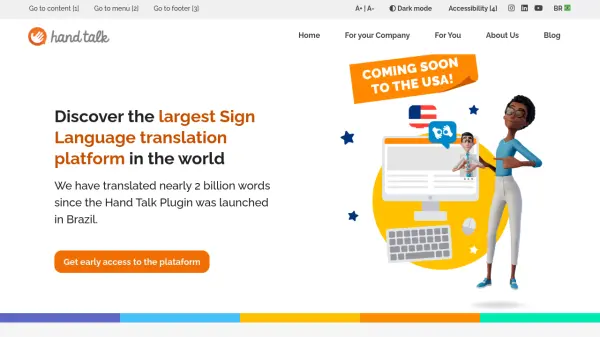
Hand Talk provides Sign Language translation solutions designed to enhance digital accessibility and communication for the Deaf community. It features AI-powered virtual translators, Hugo and Maya, who interpret content into American Sign Language (ASL) and Brazilian Sign Language (Libras). The service is available through a free mobile application, Hand Talk App, which functions as a pocket translator, available both online and offline.
In addition to the mobile app, Hand Talk offers a Plugin designed for websites, aiming to make online content accessible to Deaf users. This platform facilitates communication by breaking down barriers between hearing individuals and those who primarily use Sign Language. It serves as both a practical communication tool and an educational resource for learning Sign Languages in an engaging way.
Features
- AI Virtual Translators: Features Hugo and Maya for translating content.
- Multi-Language Support: Translates into American Sign Language (ASL) and Brazilian Sign Language (Libras).
- Mobile Application: Free app available for pocket translation.
- Offline Translation: Mobile app offers offline translation capabilities.
- Website Accessibility Plugin: Integrates with websites to translate content into Sign Language.
- Educational Resource: Helps users learn Sign Language vocabulary and communication.
Use Cases
- Learn Sign Language (ASL or Libras) in an interactive way.
- Communicate effectively with members of the Deaf community.
- Translate text or spoken words into Sign Language instantly.
- Improve website accessibility for Deaf users.
- Use as a teaching aid in classrooms for Sign Language education.
- Serve as a personal translator in various daily situations.
FAQs
-
Why are Hugo and Maya called virtual translators?
There is a difference between human translators, interpreters, and virtual translators like Hugo or Maya. Hand Talk uses this nomenclature for their AI avatars. -
Is it okay to say 'deaf people'?
Yes, 'deaf people' is the preferred term within the community. Using 'deaf-mute' is incorrect, as deafness and muteness are distinct, and deaf individuals often have vocal abilities. -
Is Sign Language made up of 'signs' or 'gestures'?
'Signs' are the components of Sign Languages used for communication. 'Gestures' are general body movements that might accompany communication but are not part of the formal language structure. -
Is there a difference between deaf and hearing-impaired people?
Clinically, the difference relates to the severity of hearing loss. However, the terms also carry cultural significance, particularly concerning identity and connection to Deaf culture and Sign Language, like ASL.