What is Graphbook?
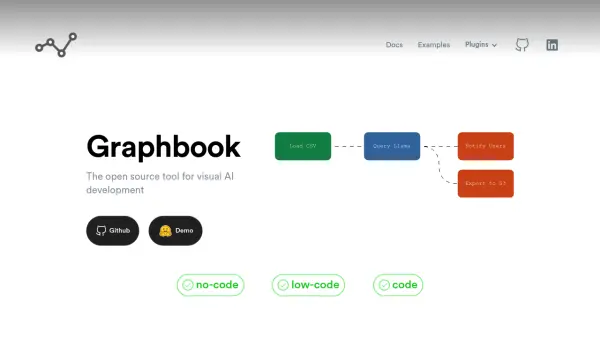
Graphbook is an MIT-licensed open source Python framework designed for building interactive and scalable AI applications. It provides a visual workflow editor with drag-and-drop functionality, enabling users to construct Directed Acyclic Graph (DAG)-structured AI and machine learning data pipelines without requiring frontend coding experience.
The framework supports batching and multiprocessing for efficient AI and machine learning operations, integrates with popular frameworks like PyTorch and TensorFlow, and offers scalability through Ray integration. Users can configure parameters in both code and UI, run workflows as regular code, and monitor model outputs in real-time with automated visualizations.
Features
- Web UI: Visual workflow editor with drag-and-drop functionality for no-code AI app building
- Extensible: Create custom functional nodes in Python for tasks like data ingestion and annotation
- Data Integration: Connect to multiple data sources including CSV files, S3, and GCP buckets
- Model Integration: Use off-the-shelf models from Hugging Face or custom ML models with configurable hyperparameters
- Interactive: Run entire graphs or single nodes, pause/resume pipelines, and sample data batches
- Optimization: Built-in batching and multiprocessing for maximizing GPU and CPU utilization
- Scalability: Easily deploy training and inference to Ray clusters for distributed computing
- Framework Agnostic: Compatible with PyTorch, TensorFlow, or other frameworks
Use Cases
- Building scalable AI applications with visual workflows
- Creating no-code ML solutions for business teams
- Developing interactive data pipelines for machine learning
- Experimenting with Hugging Face models in a visual environment
- Deploying AI workflows to production with Ray integration
FAQs
-
Is Graphbook a no-code machine learning tool?
No, Graphbook is not a no-code ML tool itself, but it enables users to build no-code ML solutions for customers and internal teams using its framework. -
Can I use version control systems with Graphbook?
Yes, nodes are written in Python, and pipelines can be serialized as .py or .json files for use with version control systems. -
How can I deploy Graphbook workflows to production?
Workflows can be used as-is in production, with variables such as database locations configurable directly within the workflow. -
Can I integrate LLMs like GPT-4o with Graphbook?
Yes, Graphbook supports any Python implementation, including sending API requests to OpenAI for LLM integration. -
How do I scale applications built with Graphbook?
The framework uses Ray to scale applications, allowing deployment to Ray clusters for distributed training and inference.