What is Deep Learning Platform (DLP)?
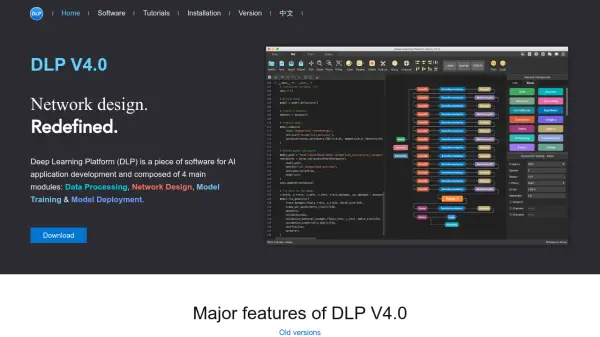
Deep Learning Platform (DLP) is a specialized software solution designed for AI application development, featuring four integrated modules: Data Processing, Network Design, Model Training, and Model Deployment. The platform streamlines the development process by providing intuitive tools for data labeling, network construction, training visualization, and model deployment, all accessible through a user-friendly interface.
DLP supports various AI tasks such as image classification, object detection, and image segmentation, with capabilities for collaborative labeling and parameter studies. It includes features like dark mode, grouping, code generation, and Docker integration, making it suitable for developers seeking to create and deploy AI models without extensive coding. The platform is available for macOS, Ubuntu, and Windows, requiring a license obtained via email.
Features
- Data Processing: Provides functions for image classification, object detection, and image segmentation with easy labeling and multi-user collaboration
- Network Design: Allows drag-and-drop construction of network structures for experimenting with different architectures
- Training Visualization: Monitors training progress with graphs and log panels, enabling efficient parameter studies and comparisons
- Model Deployment: Deploys trained models with simple configuration and one-click launching
- Code Generation: Automatically generates code for network designs and configurations
- DLP Docker Image: Offers containerized deployment options for easy integration and scalability
- Dark Mode: Includes a user interface option for reduced eye strain during extended use
- Grouping: Organizes network components and data for better management and clarity
Use Cases
- Developing AI models for image classification tasks
- Building object detection systems for computer vision applications
- Creating image segmentation models for medical or industrial analysis
- Experimenting with novel neural network architectures in a visual environment
- Training and visualizing deep learning models with real-time monitoring
- Deploying AI models to production environments with minimal configuration
- Collaborating on data labeling projects with multiple team members
- Conducting parameter studies to optimize model performance