What is Cradle (from 3SL)?
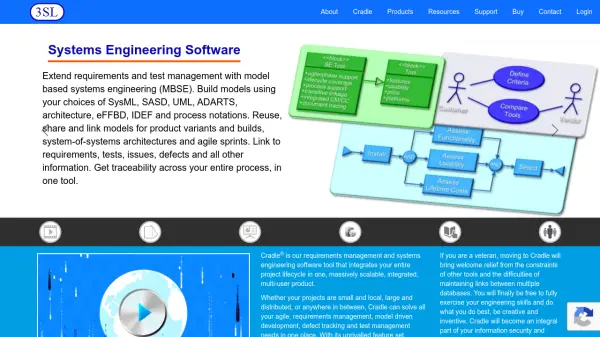
Cradle is a requirements management and systems engineering software tool that integrates the entire project lifecycle within one massively scalable, multi-user product. It supports agile development, requirements management, model driven development, defect tracking, and test management in a single environment. With flexibility to tailor the tool to any process, Cradle allows users to manage needs, epics, user stories, and product backlogs through sprints, while providing full traceability across the lifecycle.The tool stores all project data in an integrated database, enabling end-to-end traceability from source documents to deliverables. It includes built-in progress tracking, metrics, risk management, and formal document generation. Cradle supports both agile iterative processes and traditional phase-gate approaches, and offers multi-user client-server access with single sign-on and remote access capabilities.
Features
- Single Integrated Environment: Supports entire lifecycle from requirements through design, test, and delivery in one tool
- Full Lifecycle Traceability: End-to-end traceability and coverage analysis across all project artifacts
- MBSE Support: Over 20 diagram notations including SysML, UML, eFFBD, and IDEF for model-based systems engineering
- Agile & Phase-Based Processes: Supports both highly iterative sprints and traditional phase-gate processes
- Document Generation: Produce complete, accurate documentation directly from the database via Microsoft Word integration
- Change Control & Baselines: Built-in configuration management with full audit trails, versioning, and selective rollback
- Risk Management: Integrated risk register, risk assessment matrix, and visual risk graphs
- Arbitrarily Extensible Database: Schema defined by point-and-click UI, changeable at any time to fit any project size
Use Cases
- Capturing and managing system requirements from stakeholder documents
- Performing model-based systems engineering (MBSE) with SysML and other notations
- Managing product backlogs, sprints, and user stories in agile development
- Generating formal compliance documents with full traceability
- Tracking test execution and linking test results to requirements
- Performing risk assessment and maintaining a project risk register
- Connecting project work breakdown structure (WBS) to engineering data for progress tracking
FAQs
-
What industries use Cradle?
Cradle is used by hundreds of organizations across many industry sectors including aerospace, defense, automotive, and medical devices. -
Can Cradle support both agile and waterfall processes?
Yes, Cradle supports both agile iterative sprints and traditional phase-based processes with phase gates. -
Does Cradle integrate with Microsoft Word for document generation?
Yes, Document Publisher is seamlessly integrated with Microsoft Word to produce high-quality formal documents. -
Is Cradle a multi-user tool?
Yes, Cradle uses a client-server model allowing full multi-user access with individual locking of requirements.