Anon favicon

Anon
The Integration Platform for the AI Internet

What is Anon?

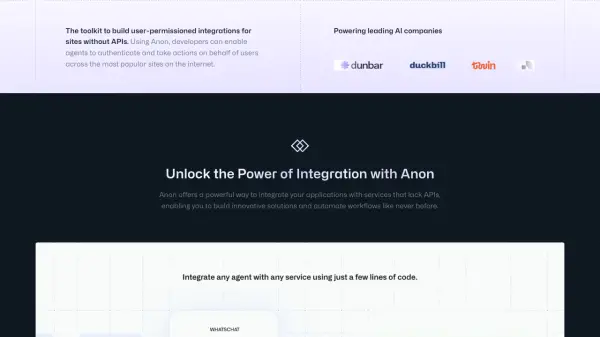
Anon is a pioneering integration platform that bridges the gap between AI applications and services lacking traditional APIs. It provides developers with a comprehensive toolkit to build user-permissioned integrations, enabling AI agents to authenticate and perform actions on behalf of users across various internet platforms.

The platform offers sophisticated session management capabilities with built-in security features, supporting various authentication types including SSO, OAuth, and 2FA. Using a zero-trust architecture, Anon ensures user credentials remain secure while enabling seamless automation across web, mobile, and desktop interfaces.

Features

  • Wide Range Support: Covers popular integrations across multiple verticals including data migration, payroll, messaging, and e-commerce
  • Granular Session Control: Advanced toolkit for user authentication and session management
  • Cross-Platform Compatibility: Supports web, mobile, and desktop interfaces
  • Security-First Architecture: Zero-trust security model protecting user credentials
  • Multi-Language Support: Compatible with various programming languages and frameworks
  • Authentication Coverage: Handles SSO, OAuth, 2FA, and CAPTCHA verification

Use Cases

  • Automating enterprise tasks in Sales, Marketing, and Recruiting
  • Data scraping and analysis automation
  • Social media automation and networking
  • Booking and reservation automation
  • Research and profiling automation
  • Customer service automation

FAQs

  • What authentication methods does Anon support?
    Anon supports SSO, OAuth, 2FA, CAPTCHAs, and other standard types of authentication methods.
  • How does Anon handle user credentials security?
    Anon implements a zero-trust architecture where user credentials are never seen or shared, ensuring maximum security for authenticated sessions.
  • What types of platforms does Anon support?
    Anon supports applications across mobile, web, and desktop interfaces, making it versatile for various integration needs.

Helpful for people in the following professions

Related Tools:

Blogs:

  • Best AI Tools For Startups

    Best AI Tools For Startups

    we've compiled a straightforward list of user-friendly AI tools designed to give startups a boost. Discover practical solutions to streamline everyday tasks, enhance productivity, and gain valuable insights without the need for a tech expert. Learn where and how these tools can be applied in your startup journey, from automating repetitive tasks to unlocking powerful data analysis. Join us as we explore the features that make these AI tools accessible and beneficial for startups in various industries. Elevate your business with technology that works for you!

  • Best AI tools for recruiters

    Best AI tools for recruiters

    These tools use advanced algorithms and machine learning to automate tasks such as resume screening, candidate matching, and predictive analytics. By analyzing vast amounts of data quickly and efficiently, AI tools help recruiters make data-driven decisions, save time, and identify the best candidates for open positions.

  • Top 6 AI note-taking tools for 2026: in-person, online, and hybrid use cases

    Top 6 AI note-taking tools for 2026: in-person, online, and hybrid use cases

    Most AI note-taking lists are really lists of meeting bots, which join your video call and transcribe it. That's useful, but it's half the picture. Decisions happen in hallway conversations, client dinners, on-site visits, and hybrid rooms where nobody is on a video link. This guide covers different parts of the note-taking workflow: hardware capture for in-person settings, platform-native tools for online calls, and AI layers for organizing and synthesizing what you've captured. It compares six tools by capture context, workflow fit, pricing, and limitations.

Didn't find tool you were looking for?

Be as detailed as possible for better results