What is Adoreboard?
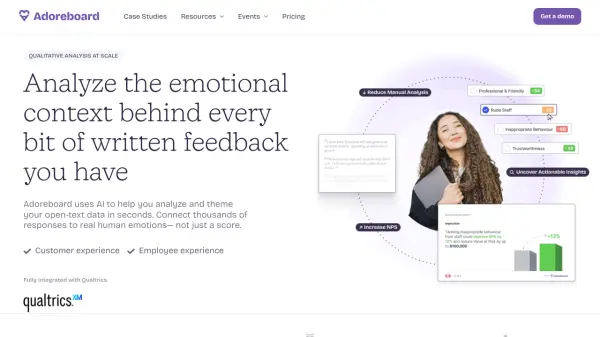
Adoreboard is an advanced AI-driven platform designed for customer and employee experience management. It analyzes vast amounts of open-text feedback from surveys, reviews, and research to reveal the underlying emotions and drivers that impact satisfaction and loyalty. By connecting responses to real human emotions rather than static scores, users gain precise, prioritized insights that drive meaningful business outcomes.
Supporting seamless integration with popular feedback tools like Qualtrics, Adoreboard employs its proprietary emotional database and scientifically proven methodology to generate actionable reports, identify recurring themes, and facilitate faster, unbiased qualitative analysis. The platform is enterprise-grade secure, offering instant analysis and easy visual reporting, all without requiring technical or coding expertise from users.
Features
- AI Theming: Instantly identify themes from thousands of open-text responses in seconds.
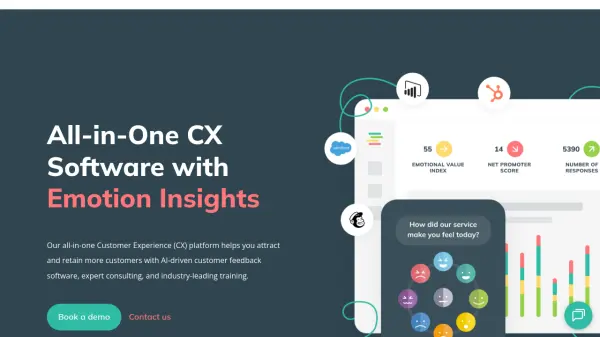
- Emotional Analysis: Evaluates feedback using 24 emotions across 8 indexes, based on Robert Plutchik’s wheel of emotions.
- One-Click Reporting: Generate actionable insight reports with prioritized actions and visuals.
- Integration Support: Connect seamlessly with platforms such as Qualtrics, Medallia, SurveyMonkey, Zendesk, Twitter/X, and Reddit.
- Unbiased Qualitative Analysis: Eliminates manual research bias by using AI-driven methods.
- Data Security: Enterprise-grade security with ISO certifications, data privacy, and user control.
- Proprietary Emotional Database: Built on scientifically validated research methodology.
- Customizable Metrics: Users can augment AI findings with additional business metrics and context.
- Benchmarking and Trend Detection: Compare datasets and detect time-based trends.
- Guest Access and Collaboration: Share datasets and reports easily with stakeholders.
Use Cases
- Analyzing customer feedback from surveys to inform service improvements.
- Extracting emotional insights from employee experience reviews to enhance workplace culture.
- Linking revenue data to emotional drivers for targeted business decision-making.
- Prioritizing actions based on emotional intent behind user comments.
- Benchmarking and monitoring experience metrics across business units.
- Generating executive-ready reports for leadership based on real-time emotional analysis.
- Speeding up qualitative analysis for large-scale research projects.
- Integrating open-text data from multiple feedback platforms for unified insights.
FAQs
-
How does Adoreboard analyze open-text feedback?
Adoreboard uses AI algorithms and a proprietary emotional database to analyze the emotional context of open-text feedback, identifying key themes and emotional drivers. -
What types of integrations does Adoreboard support?
Adoreboard integrates with platforms including Qualtrics, Medallia, SurveyMonkey, Zendesk, Twitter/X, and Reddit for seamless data imports. -
Is user data used to train Adoreboard’s AI models?
No, user data is never used to train Adoreboard’s AI models, ensuring data privacy and security. -
What security certifications does Adoreboard have?
Adoreboard maintains enterprise-grade security with ISO 27001 and ISO 19001 certifications. -
Can Adoreboard generate visual reports from analyzed data?
Yes, Adoreboard provides one-click reporting features to create visual, actionable reports for stakeholders.