A warehouse pick starts with a customer order, continues through slot assignment in dense storage, and ends when the correct SKU reaches a pack station without damaging adjacent inventory. For decades that loop relied on human pickers or rigid automation tuned SKU by SKU. Warehouse picking embodied AI treats robots as agents that perceive clutter, predict grasp success, plan motion under uncertainty, and coordinate with hundreds of mobile units in the same aisle. Amazon's 2024 Covariant licensing deal, live deployments such as Vulcan Pick, and Symbotic fleet orchestration research illustrate how foundation models and reinforcement learning move picking from scripted demos to multi-shift operations.
Supply chain leaders comparing automation options should distinguish item-level grasp intelligence from fleet-level traffic intelligence. For adjacent AI operator tooling, see AI chatbot workflows; for more technical explainers visit the EliteAI.tools blog index.
What Warehouse Picking Embodied AI Means in Plain Language
Warehouse picking embodied AI is the combination of physical robots, multimodal perception, and learned decision policies that select, grasp, and move ordered items from storage without reprogramming every new product shape. "Embodied" emphasizes closed-loop interaction: cameras and tactile sensing update beliefs as shelves deform, packages slide, or lighting changes. An agent that only outputs pick coordinates from a static photo is not embodied; one that replans after a failed suction cup seal is.
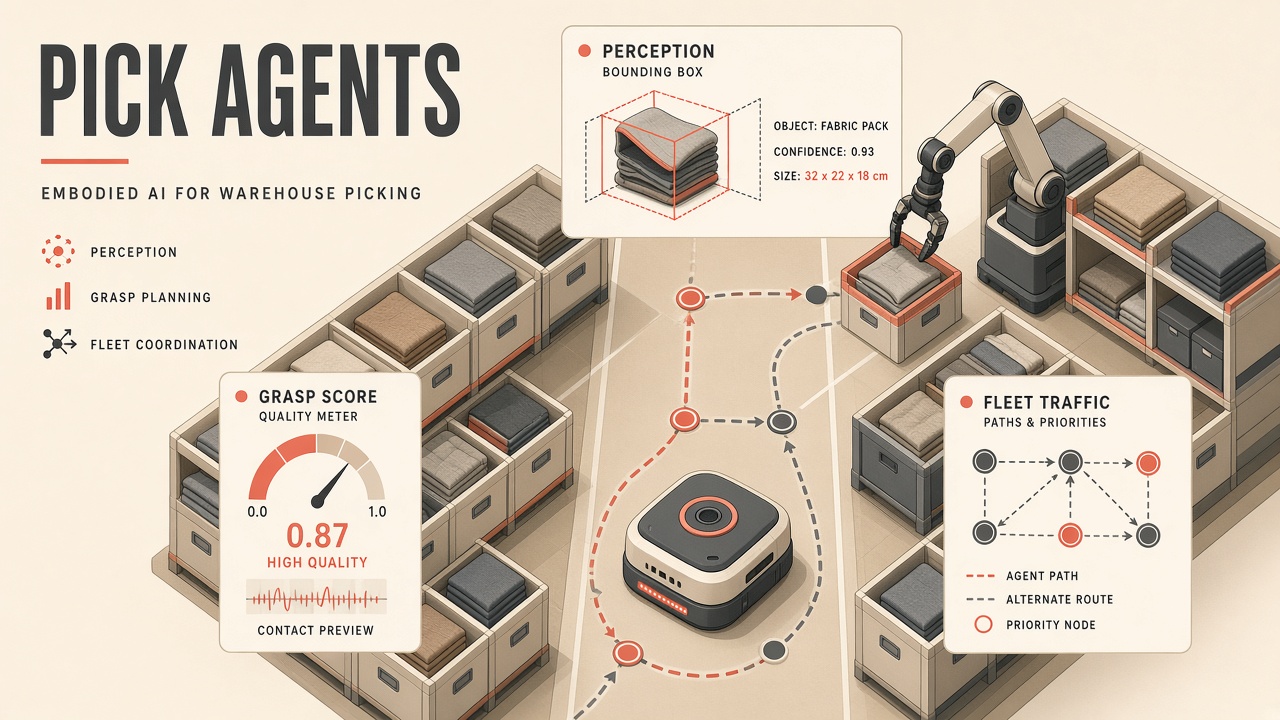
Modern systems stack three layers. At the edge, manipulators (parallel jaw grippers, suction tools, custom end-effectors) execute grasps. At the perception-planning layer, computer vision segments objects in clutter and motion planners avoid collisions with bins and neighboring SKUs. At the fleet layer, mobile robots and storage retrieval systems negotiate paths, priorities, and handoffs. Failure at any layer appears as a missed pick, a dropped item, or an aisle jam.
| Layer | Function | Example signals |
|---|---|---|
| Manipulation | Grasp, lift, place | Force torque, suction pressure, slip detection |
| Perception and planning | Identify target SKU, plan collision-free motion | Depth images, segment masks, pick success scores |
| Fleet orchestration | Route bots, prioritize orders, avoid congestion | RL priority policies, traffic graphs, task queues |
Embodied agents versus disembodied software
Warehouse management systems optimize slotting and wave planning but do not close the loop on grasp failure; embodied agents must observe outcomes and adapt. Covariant's RFM-1 foundation model targets reasoning over robot actions in warehouse contexts, including asking humans for help when confidence is low. Disembodied analytics might forecast demand; embodied AI executes the pick and learns from misses.
Integration architecture for operators
Embodied picking agents connect to warehouse execution systems (WES), inventory databases, and labor management software. Order waves arrive as pick tasks with SKU identifiers and quantity; agents return completion events, exceptions, and telemetry for retraining. Without this integration layer, even accurate grasps fail operationally because totes miss ship windows or inventory records desync. Architecture reviews should cover latency from scan to grasp commit, failover when models downgrade confidence, and audit trails for food or regulated goods.
Human-robot collaboration in pick zones
Many facilities run hybrid zones where humans handle irregular items while robots cover high-volume lanes. Embodied agents must detect human presence, slow end-effectors, and yield aisle right-of-way. ISO/TS 15066 collaborative robot speed and force limits apply when workers enter shared cells. Fleet RL prioritization must not starve stations where humans already cleared backlogs, or labor morale and throughput both suffer.
How the Underlying AI Pipeline Works
Production picking pipelines fuse classical robotics (motion planning, kinematics) with learned models (segmentation, grasp scoring, success prediction) trained on operational logs and simulation. Amazon Robotics Robin singulation handles up to millions of packages per day using pick rankers trained on real production data. Vulcan Pick integrates 3D scene understanding, adaptive motion control, and custom hardware for fabric pod shelves where adjacent items must not spill.
Perception and grasp selection
Pick planning begins with scene reconstruction: depth cameras or structured light build point clouds of cluttered piles or pod openings. Segmentation models isolate the target SKU boundary. A success predictor estimates grasp reliability before the arm moves, reducing costly failures. Amazon research replaced hand-tuned heuristics with online rankers that prioritize high-confidence picks in Robin induction, learning from billions of historical package manipulations.
Motion execution and continuous feedback
Vulcan Pick emphasizes continuous visual feedback during shelf extraction because deformable fabric pods and dense packing risk pulling neighbor items. Planners generate approach vectors that minimize lateral forces; if monitoring detects slip, the system can abort and replan. This closed loop embodies the agent: perception informs control at tens of hertz, not only at plan time.
Fleet-level reinforcement learning
Symbotic and MIT collaborators published reinforcement learning for robot priority assignment during dense-storage replanning, reporting roughly 25% throughput improvement over random priority baselines in simulation, with larger gains as aisles narrowed. The bottleneck shifts from individual bot speed to traffic coordination when storage density rises. Embodied AI at warehouse scale therefore includes multi-agent path planning, not only arm policies.
| Component | Role in picking | Learning approach |
|---|---|---|
| Pick success predictor | Rank candidate grasps | Supervised ML on production logs |
| RFM-style foundation model | Generalize across SKUs and tasks | Large multimodal pretraining, fine-tuning |
| Fleet priority RL | Reduce aisle congestion | Simulation-trained policy deployment |
| Classical motion planner | Guarantee kinematic feasibility | Optimization, rule-based safety envelopes |
Typical workflow steps
- Ingest order wave and assign pick tasks to stations or mobile robots.
- Navigate to storage location using fleet coordination and ASRS retrieval.
- Capture scene data; segment target item and score candidate grasps.
- Execute motion with monitoring; replan on slip or collision risk.
- Place item in tote or conveyor; confirm via weight, vision, or barcode.
- Log outcome to retrain success predictors and update exception queues for humans.
Real Deployments and Published Evidence
Amazon documents multi-billion-package manipulation through Robin induction and months-long live operation of Vulcan Pick processing thousands of customer orders from fabric pods. The September 2024 Covariant agreement licenses robotic foundation models to Amazon Fulfillment Technologies and Robotics, with founders Pieter Abbeel, Peter Chen, and Rocky Duan joining to integrate Covariant Brain capabilities into existing fleets including Proteus, Sequoia, and Robin.
Covariant Brain reduces per-SKU programming by learning general pick strategies across warehouses. RFM-1 adds planning and human-in-the-loop escalation. Symbotic operates large autonomous mobile robot fleets in customer distribution centers, pairing hardware with AI orchestration software; published RL research supports throughput claims in dense layouts. These deployments sit alongside human pickers in hybrid operations: automation targets repetitive, injury-prone, or throughput-constrained tasks first.
Amazon robot fleet context
Amazon Fulfillment Technologies and Robotics operates multiple robot families beyond picking arms: Proteus autonomous mobile robots move carts, Sequoia systems assist container handling, and Robin singulates packages at induction. Embodied AI for picking sits inside this broader automation portfolio. Licensing Covariant foundation models aims to improve generalization across SKUs and reduce engineering time when new products enter fulfillment centers, rather than replacing every legacy heuristic overnight.
Deformable storage and shelf picking
Fabric pod shelves deform when robots pull items, unlike rigid bin walls. Vulcan Pick's Amazon Science publication documents over six months of live operation processing more than 12,000 customer orders, highlighting continuous visual feedback to avoid pulling adjacent inventory. This embodied loop differs from singulation piles where Robin handles parcels: shelf extraction requires 3D scene understanding of occluded neighbors and adaptive retraction speeds. Failure modes include double picks, shelf damage, and dropped items on the floor, each feeding back into model retraining and hardware iteration.
Limits, Risks, and Ethical Guardrails
Embodied picking agents struggle with novel packaging, transparent or reflective materials, extreme SKU proliferation, and adversarial inventory layouts unless retrained or supervised. Foundation models reduce setup cost but do not eliminate edge cases. Dense storage increases collision and double-pick risk when perception mis-segments overlapping items.
- Workforce: Automation should be paired with retraining and safety programs; pick labor displacement raises union and community concerns.
- Safety: Human-robot collaborative zones need speed and force limiting; fleet jams must not block egress.
- Data governance: Warehouse video logs contain worker images; retention and annotation policies need review.
- Vendor lock-in: Integrated ASRS plus AI stacks complicate multi-vendor sites.
- Environmental claims: Throughput gains must be weighed against embodied energy of large robot fleets.
Ethical deployment publishes exception rates, maintains meaningful human override paths, and avoids measuring success only on curated demo aisles that omit deformable, fragile, or irregular items common in general merchandise.
Who Should Use This and Who Should Wait
High-volume e-commerce fulfillment centers with stable SKU families, capital for integrated automation, and data engineering teams should pilot embodied picking agents now, often via established robotics vendors. Small merchants with volatile catalogs and low daily order counts should wait: integration cost dominates until volume amortizes hardware and model maintenance.
| Audience | Recommendation | Caveat |
|---|---|---|
| Large fulfillment operator | Evaluate foundation-model picking plus fleet RL orchestration | Demand production failure statistics, not lab demos |
| 3PL with mixed clients | Start with singulation or narrow SKU lanes | SKU churn increases retraining burden |
| Robotics startup | Focus on one embodied loop (shelf pick or tote transfer) | General warehouse AGI narratives outpace evidence |
| Small retailer | Wait; use WMS optimization and human pick assist | ROI rarely closes below mid-six-figure automation spend |
Frequently Asked Questions
How accurate is warehouse picking embodied AI compared to humans?
Accuracy varies by SKU mix, storage type, and exception handling; published systems report high success on targeted lanes but rarely claim universal superhuman accuracy across all items. Compare pick-to-light error rates in your facility against vendor success metrics on analogous inventory before contracting.
Are autonomous warehouse pickers regulated?
Industrial robots fall under machinery safety standards (ISO 10218, ISO/TS 15066 for collaboration) and local workplace rules; AI models do not replace risk assessments for human-robot proximity. Embodied agents must integrate estops, fencing, and maintenance lockout like any automated cell.
How much data do embodied picking models need?
Amazon-scale operators leverage billions of pick logs; startups often pretrain foundation models then fine-tune on thousands of site-specific grasps. Covariant Brain targets reduced per-SKU engineering, not zero data collection. Expect continuous logging after go-live.
What did Amazon's Covariant deal change?
Amazon licensed Covariant foundation models non-exclusively and hired key Covariant researchers to embed the technology into existing fulfillment robotics. Covariant continues as an independent company serving other customers; the deal accelerates Amazon's internal embodied AI roadmap rather than eliminating third-party options.
Is fleet RL or arm intelligence the bigger bottleneck?
In dense storage, Symbotic-associated research argues fleet coordination limits throughput more than individual robot speed; in sparse layouts, grasp success may dominate. Site layout determines which layer to invest in first.
When should picks escalate to humans?
Foundation models such as RFM-1 explicitly plan human help requests when confidence is low; production systems also route exceptions via warehouse execution software. Designing clear escalation paths prevents agents from repeating destructive grasps on fragile inventory.
Covariant RFM-1 and foundation model role
Covariant detailed RFM-1 as a robotic foundation model enabling robots to plan task execution and request human assistance when uncertain. For warehouse picking, foundation models aim to reduce the engineering cost of teaching each new gripper approach for each SKU geometry. Amazon's non-exclusive license allows internal integration while Covariant continues serving other retailers, preserving competitive optionality for operators evaluating multiple embodied AI vendors. Proof remains in exception rates on live pick lanes, not model parameter counts alone.
Symbotic throughput evidence
Symbotic's published collaboration with MIT on reinforcement learning for robot prioritization during replanning reports average throughput improvements near 25% versus random priority ordering in dense simulated warehouses, with larger gains as navigable space tightened. The result supports investing in fleet intelligence when storage density rises, even if individual manipulator cycle times plateau. Operators should ask whether similar policies ran on their aisle geometries or only in vendor simulators before signing throughput guarantees.
Conclusion
Warehouse picking embodied AI closes the loop between perception, grasp execution, and fleet coordination so robots adapt to clutter, deformable storage, and traffic rather than following frozen scripts. Amazon's Covariant integration, Vulcan Pick live operation, Robin success predictors, and Symbotic RL orchestration show the stack maturing from research to multi-shift use. Leaders should evaluate embodied agents on exception rates, workforce plans, and site-specific SKU economics, not demo videos alone. High-volume operators with integration capacity can pilot now; smaller or highly variable catalogs should strengthen WMS and human workflows until embodied ROI clears realistic thresholds.