What is Smithery?
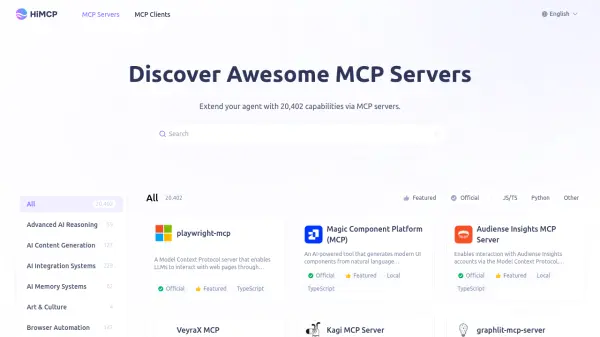
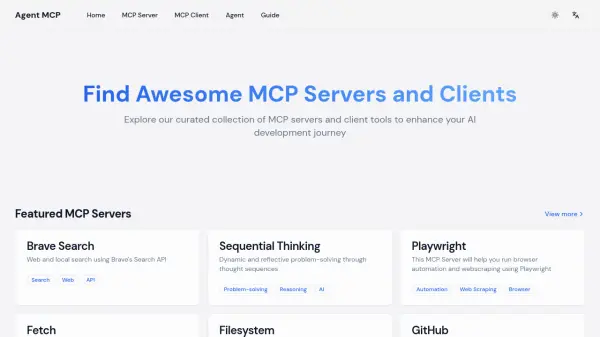
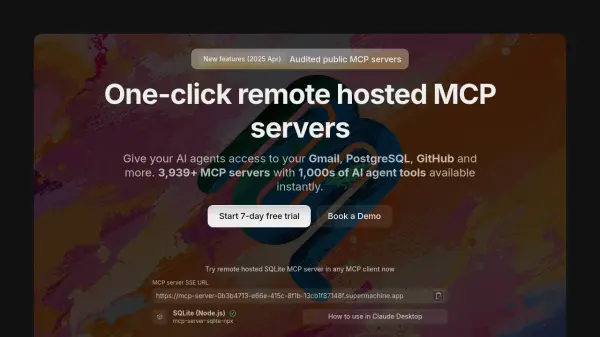
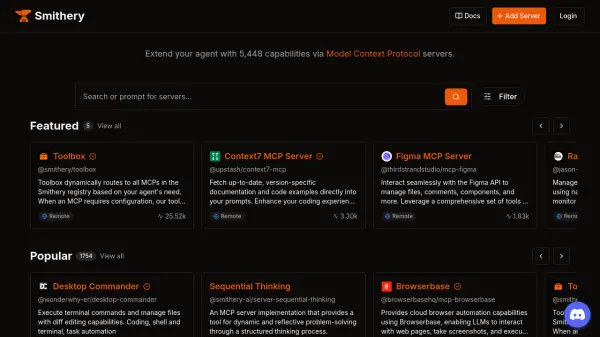
Smithery serves as foundational infrastructure designed to significantly expand the capabilities of AI agents. It facilitates the connection between agents and a vast registry of Model Context Protocol (MCP) servers, currently numbering over 5,400 distinct capabilities. This allows agents to access and leverage a wide array of external tools and functionalities directly within their operational workflow.
Through Smithery, agents can dynamically interact with services ranging from web search and browser automation to memory management, financial data retrieval, file operations, and advanced reasoning tools. The platform features components like a Toolbox that intelligently routes agent requests to the appropriate MCP server based on need, simplifying the integration process and unlocking powerful new applications for AI agents across various domains.
Features
- MCP Server Integration: Connects agents to a registry of over 5,400 MCP servers for extended capabilities.
- Dynamic Routing Toolbox: Automatically routes agent requests to the appropriate MCP server based on need.
- Web Search Capabilities: Integrates with various search engines like Brave, DuckDuckGo, Exa, Tavily, and Perplexity.
- Browser Automation Tools: Enables agents to interact with web pages, take screenshots, and execute JavaScript via servers like Playwright, Browserbase, and Puppeteer.
- Memory Management Solutions: Offers capabilities for agents to store and retrieve user-specific information or project context across sessions.
- File & System Operations: Allows agents to execute terminal commands and manage local files.
- Financial Data Access: Provides real-time and historical stock market and cryptocurrency data.
- API Integration: Facilitates interaction with APIs such as GitHub, Figma, Notion, and Railway.
- Advanced AI Reasoning: Includes tools designed to enhance agent problem-solving with structured thinking processes.
Use Cases
- Extending the functionality of AI agents like Claude with external tools.
- Automating web interactions, scraping, and data extraction using AI agents.
- Providing AI assistants with persistent memory and context recall.
- Integrating real-time web search results into AI agent responses.
- Enabling AI agents to perform complex problem-solving and structured reasoning.
- Managing cloud infrastructure or databases using natural language commands via an agent.
- Allowing AI agents to interact programmatically with design tools (Figma) or code repositories (GitHub).
- Accessing and analyzing financial market data through AI-driven interfaces.