What is Scaleflex?
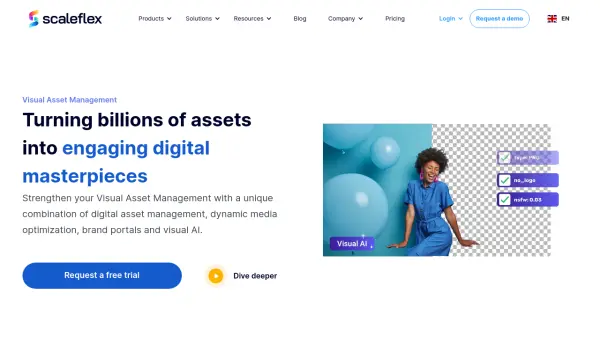
Scaleflex offers a comprehensive Visual Experience Platform designed to streamline the management and delivery of digital assets. The platform integrates four key modules: Digital Asset Management (DAM) for centralizing and organizing media, Visual AI for automating image classification, moderation, and generation, Portals for secure asset sharing with stakeholders, and Dynamic Media Optimization for fast, multi-channel delivery of optimized images and videos. This combination enables businesses to handle large volumes of visual content efficiently, ensuring assets are readily available, properly tagged, and delivered with optimal performance across various devices and platforms.
The system focuses on improving operational speed and agility through capabilities like AI-powered classification, user-generated content moderation, and headless DAM features for flexible integration with existing tech stacks. It supports scaling from hundreds to billions of assets, enhances website performance through smart media optimization and compression, and provides tools for team collaboration and brand consistency. The platform aims to accelerate the content journey, improve user engagement, and maximize the return on investment for visual assets.
The system focuses on improving operational speed and agility through capabilities like AI-powered classification, user-generated content moderation, and headless DAM features for flexible integration with existing tech stacks. It supports scaling from hundreds to billions of assets, enhances website performance through smart media optimization and compression, and provides tools for team collaboration and brand consistency. The platform aims to accelerate the content journey, improve user engagement, and maximize the return on investment for visual assets.
Features
- Digital Asset Management (DAM): Centralize, store, organize, and manage large volumes of media assets in a single source-of-truth.
- Visual AI: Automate image/video classification, tagging, moderation (NSFW detection), and generation (background removal/fill, enhancement).
- Dynamic Media Optimization (DMO): Optimize images and videos on-the-fly for faster loading, improved Core Web Vitals, and multi-channel delivery via CDN.
- Portals: Create customizable interfaces (light CMS) for secure sharing of approved brand assets with internal and external stakeholders.
- Headless Architecture: Allows flexible integration with existing CMS, PIM, and other tech stacks via Media APIs and widgets.
- AI-powered Content Moderation: Automatically flag Not Safe for Work (NSFW) content in user-generated visuals.
- Smart Content Classification & Tagging: Leverage AI to automatically organize and tag large quantities of images and videos.
- Generative AI Enhancements: Create tailored product descriptions from visuals, adaptive image backgrounds, and visual enhancements.
- Workflow Automation: Streamline content operations with approval workflows, collaboration tools, and event triggers.
- Multi-CDN Acceleration: Ensure fast global delivery of assets, including optional China acceleration.
Use Cases
- Centralizing and managing large visual asset catalogs for enterprises and SMBs.
- Automating image and video tagging and categorization using AI.
- Moderating user-generated visual content for compliance and brand safety.
- Optimizing website images and videos for improved performance (Core Web Vitals) and SEO.
- Syndicating visual content across multiple platforms, marketplaces, and media channels.
- Creating secure brand portals for sharing assets with partners, retailers, and internal teams.
- Integrating media management seamlessly into existing tech stacks (CMS, PIM).
- Enhancing e-commerce product visuals with AI-generated backgrounds and descriptions.
- Reducing website carbon footprint through efficient media optimization.
- Accelerating content-to-market workflows for marketing and creative teams.