What is Otto DIY?
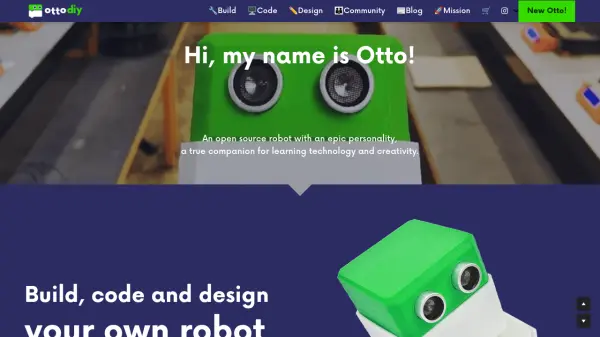
Otto DIY is a versatile, open-source robotics kit developed to foster creativity and technological learning for both education and hobbyist purposes. This interactive robot comes in modular forms and offers users the unique opportunity to build, modify, and program their own robot, featuring obstacle avoidance, line following, sound and music output, and glowing LED eyes. Tailored for broad accessibility, Otto DIY supports multiple programming environments including its proprietary web-based coding interface, Scratch graphical blocks, Arduino IDE, and MicroPython, making it compatible with Windows, Mac, Linux, Chromebooks, and tablets.
With its expandable design, modular hardware, and a range of optional sensors and modules, Otto DIY provides engaging, project-based STEAM learning, incorporating electronics simulation and a BETA AI extension for advanced experimentation. Comprehensive resources such as build manuals, coding guides, and robotics STEAM lessons are included to support users and educators in maximizing their experience with Otto DIY, making it a robust platform for anyone keen on exploring robotics and coding.
Features
- Modular Robotics Kit: Build and customize a robot with expandable components.
- Cross-Platform Coding: Supports web-based coding, Scratch mode, Arduino IDE, and MicroPython.
- Obstacle Avoidance: Incorporates sensors for obstacle detection and navigation.
- Line Following: Uses specialized sensors to follow drawn lines.
- Sound and Music Output: Capable of producing sounds and melodies.
- Programmable Glowing Eyes: Customizable RGB LED eyes enhance interactivity.
- Electronical Simulation: Simulates circuits and programming logic in an online environment.
- AI Extension (BETA): Early-stage artificial intelligence features for experimentation.
- Bluetooth and Wi-Fi Connectivity: Enables remote control and IoT capabilities.
- Free STEAM Lessons: Includes educational resources for robotics and programming.
Use Cases
- Teaching robotics and coding concepts in K-12 and higher education.
- After-school STEAM clubs and maker spaces.
- Hobbyist exploration of modular robotics and electronics.
- Hands-on introduction to programming with graphical and textual languages.
- Developing custom robotic behaviors and projects in DIY settings.
- Creating educational IoT demonstrations and experiments.
- Remote control and sensor integration for interactive learning.
- Prototyping and testing AI algorithms in an accessible format.