What is Imagen?
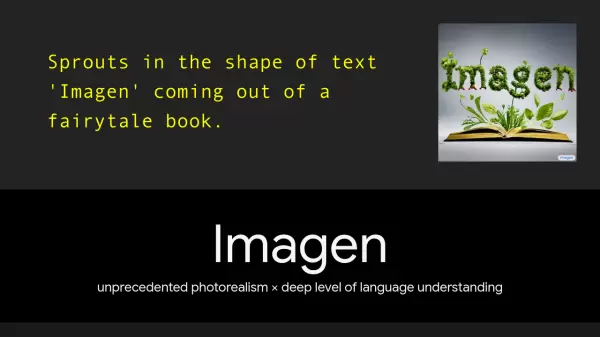
Imagen represents a breakthrough in text-to-image generation technology, achieving unprecedented levels of photorealism and language comprehension. The system leverages the power of large transformer language models for text understanding while utilizing diffusion models for high-quality image creation.
The technology has achieved state-of-the-art performance with a FID score of 7.27 on the COCO dataset without specific training on COCO data. Through human evaluation on DrawBench, a comprehensive benchmark for text-to-image models, Imagen has demonstrated superior performance in both image quality and text alignment compared to other leading models.
Features
- Photorealistic Image Generation: Creates highly detailed and realistic images from text descriptions
- Advanced Language Understanding: Uses large pretrained frozen text encoders for superior text comprehension
- High Resolution Output: Generates images up to 1024x1024 resolution through cascaded diffusion
- Efficient U-Net Architecture: Provides improved compute efficiency and faster convergence
- State-of-the-art Performance: Achieves leading COCO FID score of 7.27
Use Cases
- Digital Art Creation
- Visual Content Generation
- Creative Concept Visualization
- Marketing Material Design
- Storyboard Generation
- Research and Development
- Educational Content Creation
FAQs
-
What makes Imagen different from other text-to-image models?
Imagen's unique approach uses large pretrained frozen text encoders and demonstrates that scaling the text encoder size is more important than scaling the diffusion model size. It achieves better results than other models without needing to learn a latent prior. -
Why isn't Imagen available for public use?
Due to ethical concerns, potential misuse risks, and inherent social biases in the training data, Google has decided not to release Imagen for public use until proper safeguards are in place. -
What are Imagen's technical limitations?
Imagen shows limitations in generating images of people, with decreased image fidelity compared to non-human subjects. It may also reflect social biases and stereotypes inherited from its training data.