

What is Home Assistant?
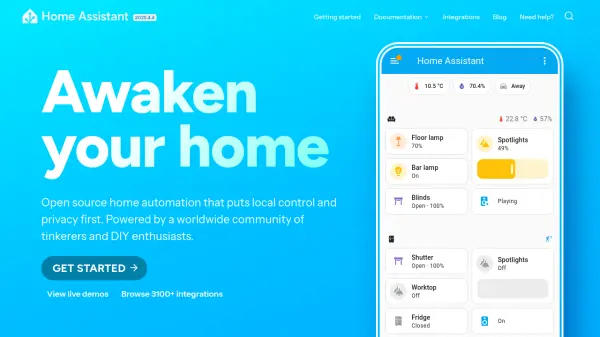
Home Assistant is an open-source home automation platform designed with local control and user privacy as top priorities. Powered by a global community of DIY enthusiasts and tinkerers, it allows users to integrate and manage a wide array of smart home devices and services directly within their own network. The platform automatically scans the local network upon startup to discover compatible devices, simplifying the setup process for users.
Beyond device integration, Home Assistant offers a powerful automation engine for creating complex routines, versatile dashboards for visualizing data and controlling devices, and its own private voice assistant, Assist, for natural language control. It supports extensions through add-ons for enhanced functionality, such as ad-blocking or integrating third-party automation engines. All user data is processed and stored locally, minimizing reliance on cloud services and enhancing data security. Companion mobile applications are available for remote control and presence detection.
Features
- Extensive Integration Support: Works with over 3100 different devices and services.
- Powerful Automation Engine: Create custom rules and routines to automate home tasks.
- Customizable Dashboards: Design personalized interfaces to monitor and control devices.
- Local Voice Assistant (Assist): Control your home using natural language processing, prioritizing privacy.
- Add-on Support: Extend functionality with applications like AdGuard, NodeRed, and more.
- Local Data Processing: Ensures user data stays private and is processed locally, not in the cloud.
- Companion Mobile Apps: Control and monitor your home remotely via iOS and Android apps.
- Home Energy Management: Monitor energy usage, optimize solar production, and save money.
Use Cases
- Centralizing control of diverse smart home devices.
- Creating sophisticated home automation routines.
- Building custom dashboards for home monitoring.
- Implementing a privacy-focused smart home system.
- Using voice commands for home control without cloud dependency.
- Monitoring and optimizing home energy consumption.
- Extending smart home capabilities with community add-ons.