
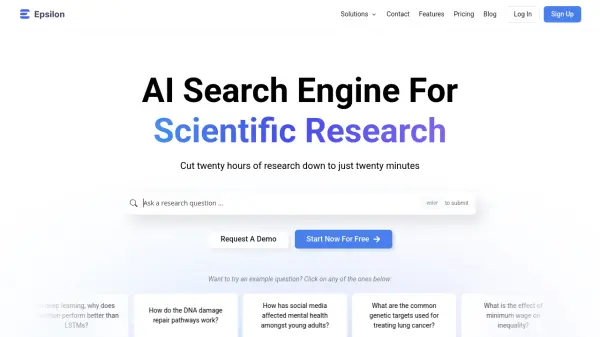
What is Epsilon?
Epsilon is an AI search engine designed to streamline the research process for scientists and academics. It leverages a vast dataset of over 200 million academic papers from sources like Semantic Scholar, PubMed, arXiv, and Papers With Code. The platform allows users to ask research questions, search for publications and patents, extract information from multiple papers simultaneously, and synthesize research findings.
By utilizing advanced AI, including GPT-4, Epsilon provides summarized answers with inline citations, groups search results, and facilitates paper management through customizable libraries. This helps to ensure all responses are factual and linked directly to the original source content.
Features
- Investigate: Get Answers With Citations to any research question.
- Search: Search For Publications and Patents.
- Validate: Extract Information From Multiple Papers At Once.
- Synthesize: Save, Summarize, and Search Across Papers.
Use Cases
- Searching For Evidence
- Finding Citations
- Writing Grants
- Running Literature Reviews
- Conducting Meta-Analyses
- Evaluating Research Questions
- Drafting Proposals
- Executing Projects
- Writing Papers
- Searching For Patents
- Onboarding Team Members
- Learning New Topics
FAQs
-
What dataset does Epsilon use?
Epsilon uses a dataset provided by Semantic Scholar, which contains over 200 million academic papers including ones from PubMed, arXiv, Papers With Code, and more. -
What AI technology does Epsilon use?
For each search query, Epsilon finds the top 100 related papers and passes them along with your query to GPT-4 to generate a summary of the scientific information. Because it uses citations to academic literature, Epsilon is a factual and trustworthy way to use AI for your research. -
What about user data Privacy?
Epsilon passes search queries to third party infrastructure providers like OpenAI. However, none of this data can be traced back to you individually. The same is true for the papers that you add to your library.