What is Dapr?
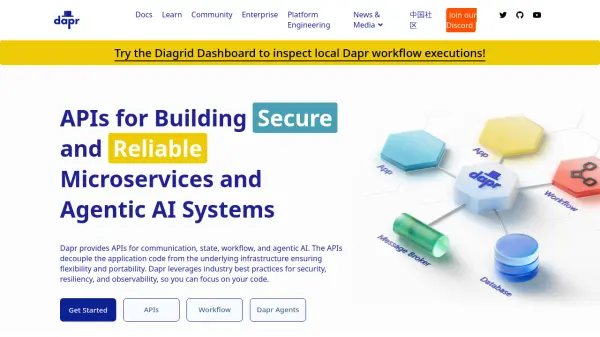
Dapr provides a comprehensive set of APIs for communication, state management, workflow automation, and agentic AI development. These APIs decouple application code from underlying infrastructure, ensuring flexibility and portability across different environments. The platform leverages industry best practices for security, resiliency, and observability, allowing developers to focus on business logic rather than boilerplate code.
The component model enables integration with various infrastructure choices through simple configuration changes, supporting multiple message brokers, state stores, and secret management systems. Dapr applications can run on Kubernetes or self-hosted environments, making them deployable on any cloud or edge infrastructure while maintaining consistent security and reliability features.
Features
- Service Invocation: Enables applications to communicate through HTTP or gRPC with built-in service discovery and distributed tracing
- State Management: Provides key/value-based state and query APIs with pluggable state stores for persistence
- Workflow API: Allows definition of long-running, persistent processes spanning multiple microservices
- LLM Conversation: Reduces complexity of interacting with Large Language Models at scale with prompt caching and PII obfuscation
- Security Features: Includes end-to-end security with authentication, access policies, and automatic mTLS encryption
Use Cases
- Building distributed microservices applications
- Developing agentic AI systems with secure LLM integration
- Automating complex business processes with durable workflows
- Creating resilient applications with built-in fault tolerance
- Implementing secure communication between services in cloud environments
FAQs
-
What infrastructure does Dapr support for running applications?
Dapr applications can run on Kubernetes or self-hosted on any virtual or physical machine, enabling deployment on any cloud or edge infrastructure. -
How does Dapr handle application security?
Dapr includes built-in security features that are enabled by default, with automatic mTLS encryption for communication and application-centric policies for limiting access to APIs and services. -
Can Dapr be integrated into existing architectures?
Yes, Dapr can be introduced incrementally into existing architectures, with Dapr applications able to call non-Dapr endpoints while still benefiting from resiliency policies and observability features.