What is BabyAGI?
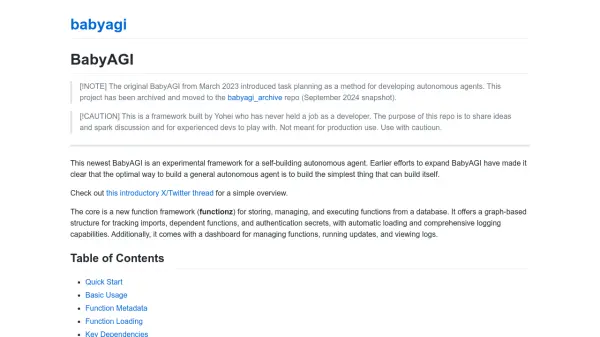
BabyAGI is an experimental framework focused on the development of self-building autonomous agents. Originally conceived to explore task planning for agents, the current iteration centers on creating the simplest possible system that can construct itself. It is built around 'functionz', a novel function framework designed for storing, managing, and executing functions from a database. This framework employs a graph-based structure to effectively track function imports, dependencies between functions, and necessary authentication secrets, featuring capabilities like automatic loading and comprehensive logging.
Complementing the core framework is a user-friendly dashboard that facilitates function management, allows for running updates, provides access to detailed logs, and enables secure handling of secret keys. BabyAGI includes pre-loaded function packs for basic operations and AI-driven tasks like description generation. It also showcases experimental self-building agents that demonstrate how the system can leverage existing functions to generate new code based on user requirements. Users should note this framework is intended for experimentation and discussion among developers, not for production deployment.
Features
- Function Framework (functionz): Stores, manages, and executes functions from a database using a graph-based structure.
- Dependency Tracking: Tracks function imports, dependent functions, and authentication secrets.
- Automatic Loading: Automatically loads necessary functions and dependencies for execution.
- Comprehensive Logging: Logs all function executions, interactions, inputs, outputs, errors, and timings.
- Management Dashboard: Provides a UI for managing functions, viewing logs, handling keys, and setting triggers.
- Key Management: Allows storing and managing secret keys via code or the dashboard.
- Pre-loaded Function Packs: Includes default functions (execution, key management, triggers, logs) and AI functions (description/embedding generation, function selection).
- Experimental Self-Building Agents: Demonstrates agents using existing functions to write new ones based on user prompts.
Use Cases
- Developing autonomous AI agents
- Experimenting with self-modifying code systems
- Managing complex function dependencies in AI projects
- Automating tasks through function chaining and triggers
- Researching agent architecture and capabilities
- Building proof-of-concept AI assistants
FAQs
-
What is the core component of BabyAGI?
The core is a function framework called 'functionz' for storing, managing, and executing functions from a database, featuring a graph-based structure for dependencies and comprehensive logging. -
Is BabyAGI suitable for production environments?
No, it is explicitly described as an experimental framework primarily for developers to explore ideas and is not intended for production use. -
How can I manage functions and view logs in BabyAGI?
BabyAGI includes a dashboard accessible via a web browser (typically http://localhost:8080/dashboard) for managing functions, running updates, viewing logs, and handling secret keys. -
How does BabyAGI handle dependencies between functions?
It uses a graph-based structure within its 'functionz' framework to track imports, dependent functions, and required keys, automatically loading them as needed and logging the interactions. -
Can BabyAGI generate code or new functions?
Yes, it includes experimental self-building agents (like `process_user_input` and `self_build`) designed to leverage existing functions to write new ones based on user prompts, although this capability is developmental.