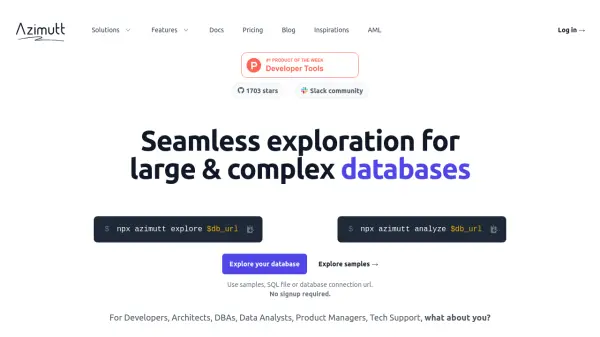
What is Azimutt?
Azimutt enables seamless understanding, design, and management of large and complex database systems. Users can visualize, document, and optimize their database architectures with dynamically scalable ER diagrams, intuitive design tools, and advanced analysis to ensure consistency and highlight potential improvements. The platform is suitable for relational and document databases, giving users the flexibility to import schemas via connection URLs, SQL files, or JSON formats.
With features tailored for teams and enterprises, Azimutt supports collaborative documentation, custom property annotations, and data exploration with AI-assisted query generation. It empowers developers, architects, and data professionals to efficiently explore new database structures, improve onboarding, and ensure best practices in database design and maintenance.
Features
- AI Analysis: Identifies schema inconsistencies and optimization opportunities
- Scalable ER Diagrams: Customizable visualization with selective display of tables, columns, and relations
- AML Design Language: Minimalistic DSL for fast database schema design
- Collaborative Documentation: Table and column notes, layout memos, and saved views for team efficiency
- Multi-Database Support: Compatible with both relational and document-based databases, extensible via JSON
- Data Exploration: Follow relations, search everywhere, and path discovery between tables
- Export Capabilities: Export schemas as SQL, AML, or JSON
- Shareable Diagrams: Embed diagrams or share via secret links
- Project Management: Organize layouts, document findings, and collaborate on large projects
- Linter Rules: Tens of automated checks to ensure adherence to database best practices
Use Cases
- Visualizing and understanding large, complex database schemas
- Onboarding new developers or analysts into existing database systems
- Collaborative design and documentation for engineering teams
- Optimizing database schema and maintaining consistency over time
- Query generation and exploration for support teams and bug investigation
- Improving organizational knowledge sharing on database architectures
- Ensuring database best practices with automated AI-powered checks
FAQs
-
Which databases are supported?
Azimutt supports most major relational databases such as PostgreSQL, MySQL, SQL Server, Oracle, and MariaDB, as well as document-oriented databases like MongoDB and Couchbase, through direct connection, SQL schema, or JSON import. -
What measures are in place for data privacy?
Azimutt prioritizes data privacy and offers open source code for auditability, local project storage, in-browser schema parsing, and self-hosting options to ensure users retain full control over their sensitive database information.