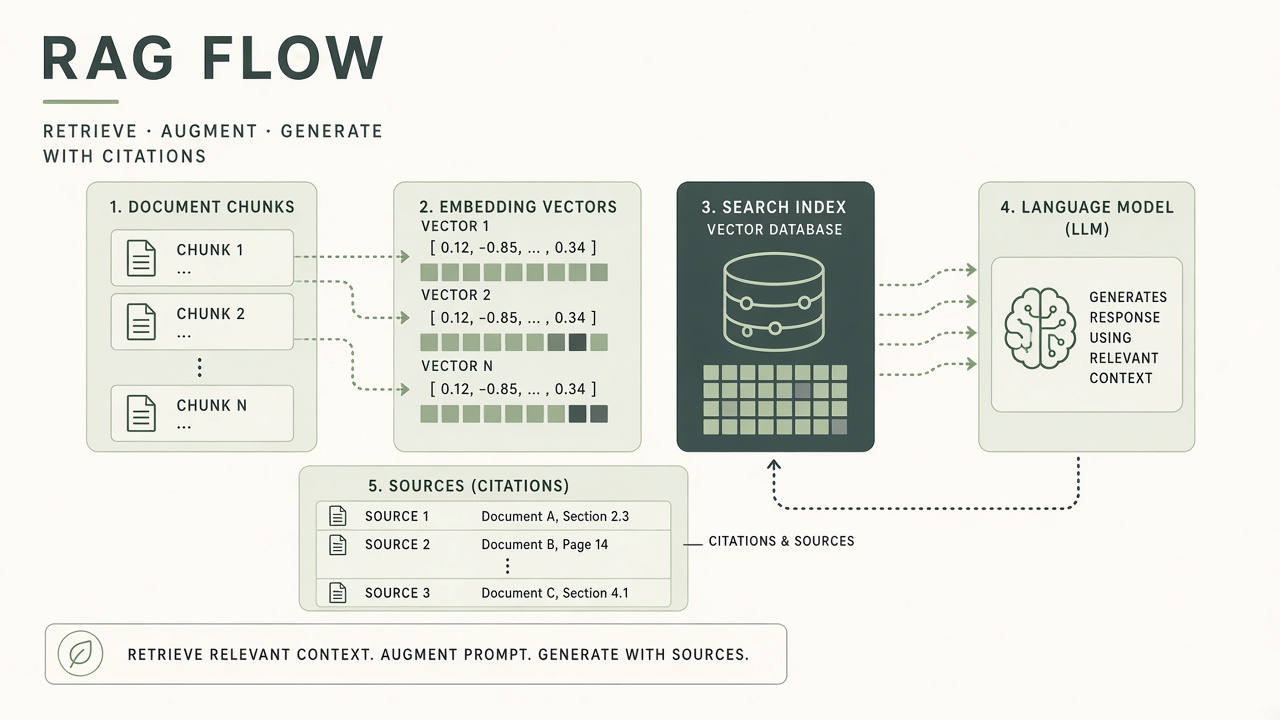
An employee asks the internal helpdesk bot, "What is our parental leave policy in Germany?" The model was trained months ago and might hallucinate HR rules. Retrieval augmented generation explained in one sentence: search your approved documents first, inject the top matching passages into the prompt, then let the language model compose an answer citing those passages instead of guessing from parametric memory alone. RAG is the default pattern behind enterprise knowledge assistants, support copilots, and many AI code tools that pull repository context before suggesting patches, as well as AI research products that summarize paper libraries with source links.
RAG in One Sentence
RAG combines information retrieval (find relevant chunks in your corpus) with text generation (write a natural language answer conditioned on retrieved chunks). The retrieval step reduces fabrication, enables fresh updates without retraining the base model, and supports citation of internal policies, tickets, and product docs. RAG does not guarantee correctness: bad retrieval still poisons the answer.
Indexing, Chunking, and Embeddings
Indexing transforms source documents into searchable chunks, often with embedding vectors stored in a vector database plus optional keyword indexes for hybrid search. Chunking strategy drives recall: fixed token windows (300 to 800 tokens) are common; structure-aware splits respect headings, tables, and code fences. Metadata tags (product, region, effective date) filter retrieval before semantic ranking.
| Indexing choice | Benefit | Risk |
|---|---|---|
| Small chunks (200 tokens) | Precise matches | Loses broader context |
| Large chunks (1k+ tokens) | More surrounding context | Diluted embeddings, noise in prompt |
| Parent-child chunks | Retrieve small, expand to section | More engineering complexity |
| Frequent reindex | Fresh policies reflected | Stale embeddings during rollout |
Embedding model selection
Embedding models map text to vectors so cosine similarity approximates semantic relatedness; match embedding model to query language and domain (legal, medical, code). Re-embed the corpus when you change embedding models. Some stacks add late interaction rerankers after first-stage vector retrieval.
Retrieval: Semantic and Hybrid Search
At query time, RAG embeds the user question (or a rewritten variant), retrieves top-k chunks, and may blend semantic vector search with BM25 keyword search for exact SKU, statute, or error codes. Query transformation techniques include HyDE (hypothetical document expansion), multi-query fan-out, and step-back prompting to improve recall on vague questions.
Hybrid retrieval reduces misses when users copy ticket IDs or policy numbers that embeddings alone rank poorly. Metadata filters enforce tenant isolation and document classification before similarity scoring runs.
Generation, Citation, and Abstention
The generator model reads retrieved chunks in a structured context block and produces an answer with inline citations or footnotes; abstention prompts instruct the model to say "not found" when chunks do not support a claim. Citation quality depends on chunk boundaries and whether the UI links to source offsets. Grounded generation reduces but does not eliminate hallucination if the model overgeneralizes beyond provided text.
Typical RAG prompt structure
- System rules (tone, refusal, citation format)
- Retrieved context blocks labeled with source IDs
- User question
- Instruction to answer only from context or explicitly state gaps
Test RAG Before Production
Evaluate RAG with a golden question set covering paraphrases, negation, multi-hop facts, and adversarial "unanswerable" queries; track retrieval recall, answer faithfulness, and citation accuracy separately. Offline benchmarks (RAGAS-style metrics) help, but domain experts must review failures on real policies.
| Metric | What it measures | Red flag |
|---|---|---|
| Context recall | Right chunk retrieved? | Correct answers impossible |
| Faithfulness | Answer supported by chunks? | Confident inventions |
| Citation precision | Links match claims? | Trust erosion in UI |
| Abstention rate on unknowns | Refuses when evidence missing? | Guessing on gaps |
Questions to ask RAG vendors
- How often is the index refreshed and how are deletes propagated?
- Is retrieval hybrid and can you inspect ranked chunks per answer?
- What ACL model enforces document-level permissions at query time?
- Can you export evaluation runs and human review labels?
RAG Architecture Components
Enterprise RAG stacks split into ingestion connectors, chunking pipelines, embedding jobs, vector and keyword indexes, query routers, rerankers, prompt templates, guardrails, and feedback loops for retraining retrieval. Managed platforms hide these behind a "upload PDF" button; build-your-own teams assemble them from LangChain, LlamaIndex, Haystack, or cloud-native offerings.
Ingestion connectors
Connectors sync Confluence, SharePoint, Google Drive, Slack exports, Zendesk articles, and Git repositories. Incremental sync must delete or tombstone removed pages so retired policies do not resurface. Permission inheritance from source systems is non-negotiable for employee-facing bots.
Advanced retrieval patterns
- Multi-vector per chunk: Title embedding plus body embedding for better recall.
- Graph RAG: Entity relationships supplement flat chunks for org charts and dependencies.
- Agentic RAG: Model decides when to search again mid-answer.
- Compression: Summarize long chunks before generation to save context window.
Common RAG Failure Modes in Production
Production RAG fails when indexes are stale, ACL filters leak or over-block, chunk boundaries split tables, multilingual content uses monolingual embeddings, or evaluation stops at demo questions. Incident reviews often reveal retrieval returned a deprecated PDF because nightly sync failed silently.
| Failure | User-visible symptom | Operational fix |
|---|---|---|
| Stale index | Quotes old policy numbers | Monitor sync lag alerts |
| ACL mismatch | "Not found" for accessible docs | Replay query with filter debug |
| Chunk splits table | Wrong pricing tier cited | Table-aware chunking |
| Overlong context | Slow answers, ignored middle chunks | Rerank top 5, compress rest |
Chunking Strategies by Content Type
Policies and contracts need section-aware chunking; API docs need code-fence preservation; support tickets need metadata filters on product SKU and locale. One global chunk size rarely fits an enterprise corpus. Run A/B chunk configs on the golden set before reindexing production.
| Content type | Chunking approach | Metadata to index |
|---|---|---|
| HR policies | Heading hierarchy, 400 to 600 tokens | Region, effective date, version |
| Engineering runbooks | Code block intact, smaller prose chunks | Service name, environment |
| Sales battlecards | One competitor per chunk | Competitor, product line |
| PDF tables | Table-aware parser, row groups | Sheet name, table caption |
RAG vs Fine-Tuning vs Long Context
Long-context models that ingest entire manuals reduce retrieval engineering but raise cost, latency, and lost-in-the-middle risk; RAG keeps prompts smaller and citations explicit. Fine-tuning teaches style and format, not a substitute for nightly policy updates unless retrained continuously. Most enterprises combine RAG for knowledge with prompt templates or light adapters for tone.
Frequently Asked Questions
Is RAG better than fine-tuning?
RAG excels when knowledge changes frequently and citations matter; fine-tuning excels when behavior or style must be deeply customized and facts are stable. Many products combine both: RAG for facts, light fine-tuning or prompt templates for tone.
Do I need a separate vector database?
Not always; pgvector, OpenSearch, and embedded stores suffice at moderate scale, while dedicated vector databases help high-QPS semantic search. Choose based on ops skills, filtering needs, and hybrid search requirements.
How does RAG handle confidential documents?
Enforce access control at retrieval time so embeddings never return chunks the user cannot read in the source system. Logging retrieved chunks may create new leakage paths; redact in traces.
Can RAG still hallucinate?
Yes, especially when retrieval misses the right chunk or the model synthesizes beyond provided text. Abstention training, citation-required formats, and human review on high-risk answers reduce risk.
What chunk size should we use?
Start near 400 to 600 tokens with heading-aware splits, then tune using your golden set recall metrics. Legal and API docs often need table-aware chunkers, not naive fixed windows.
Building a Golden Evaluation Set
A golden set lists questions, expected answer facts, required source document IDs, and tags for difficulty (paraphrase, multi-hop, unanswerable). SMEs write fifty to two hundred items before launch, then add one new item for every production incident. Run the set nightly against staging indexes to catch connector regressions before users do.
Split metrics by tag: retrieval recall on multi-hop questions often lags single-fact lookups. Unanswerable questions should trigger abstention; scoring false positives here erodes trust faster than minor wording differences on easy items.
Human review loop
Sample live answers weekly for faithfulness checks. Reviewers click cited chunks and mark supported, unsupported, or missing citation. Feed labels back into reranker tuning or chunk size experiments. Close the loop when legal or HR disputes an answer: trace retrieval log, fix document or chunking, add case to golden set.
Operational Runbook Essentials
Production RAG needs runbooks for index rebuilds, embedding model upgrades, poisoned document removal, and incident response when users report wrong policy answers. Assign owners for connector health, chunking rule changes, and golden-set regression tests that run on every deploy.
- Monitor index lag and alert if sync misses two consecutive schedules.
- Version embedding models; schedule reindex windows with user comms.
- Log retrieved chunk IDs per answer for replay during incidents.
- Publish a "sources last updated" timestamp in the bot UI when possible.
- Collect thumbs-down feedback linked to retrieval traces for tuning.
Security and compliance
RAG expands attack surface: malicious documents can inject instructions into retrieved context ("prompt injection via corpus"). Sanitize uploads, scan for hidden text, and apply output filters independent of retrieval. For regulated industries, log which document versions grounded each answer for audit trails.
Buyer RFP Questions for RAG Vendors
Procurement teams should ask RAG vendors about connector coverage, ACL enforcement point, reindex SLAs, embedding model portability, citation UI, abstention configuration, and evaluation tooling exports. Request a proof-of-concept on your messiest document type (scanned PDFs, nested Confluence pages, multilingual policies) before enterprise rollout.
- How do you prevent retrieval of documents the user cannot access in SharePoint?
- What happens when the same policy exists in PDF and wiki; which version wins?
- Can we bring our own embedding model and vector database?
- Do you log retrieved chunk text in SIEM integrations?
- How do you score faithfulness on our golden set during POC?
RAG Maturity Model
Level 1 RAG uploads PDFs to a shared index; Level 2 adds ACL-aware connectors and hybrid search; Level 3 runs golden-set regression and citation UI; Level 4 closes feedback loops into chunking and reranker tuning. Most enterprises stall at Level 1 and wonder why answers cite outdated pages. Budget engineering for Levels 2 and 3 before marketing "enterprise knowledge AI" externally.
Level 4 organizations treat RAG as living infrastructure: embedding upgrades trigger reindex playbooks, incident retros add golden questions, and legal signs off on abstention wording for regulated topics. Tool buyers should ask vendors which maturity level their managed service actually delivers out of the box versus as paid professional services.
When Not to Use RAG
Skip RAG when answers require live transactional data (inventory counts, account balances), heavy numerical computation across rows, or creative tasks with no authoritative corpus. Point those queries to APIs, calculators, or pure generation paths with clear disclaimers. Misapplied RAG retrieves irrelevant policy chunks and confuses users who needed a database lookup instead.
Hybrid products increasingly expose query routers that send transactional questions to SQL agents and policy questions to RAG indexes. Buyers should verify routing transparency: users deserve to know whether an answer came from a document chunk or a live system query, especially in regulated advice scenarios.
Cost drivers in RAG
RAG costs split across embedding API calls during ingest, vector storage, retrieval compute per query, reranker calls, and generation tokens for long context blocks. Reindexing one million chunks after an embedding upgrade can dwarf monthly query spend. Model total cost of ownership with finance before choosing chunk sizes that maximize recall without stuffing every answer prompt with twelve full pages. Right-size reranker depth: retrieving fifty chunks but reranking only eight often matches quality of reranking thirty at lower latency.
Conclusion
Retrieval augmented generation explained for tool buyers is index plus retrieve plus generate: chunk your corpus, embed and search with hybrid retrieval when needed, ground answers with citations and abstention rules, operate connectors with ACL-aware filters, and evaluate recall and faithfulness before launch. RAG makes AI answers auditable; it does not remove the need for document governance, security review, and continuous testing as policies change.