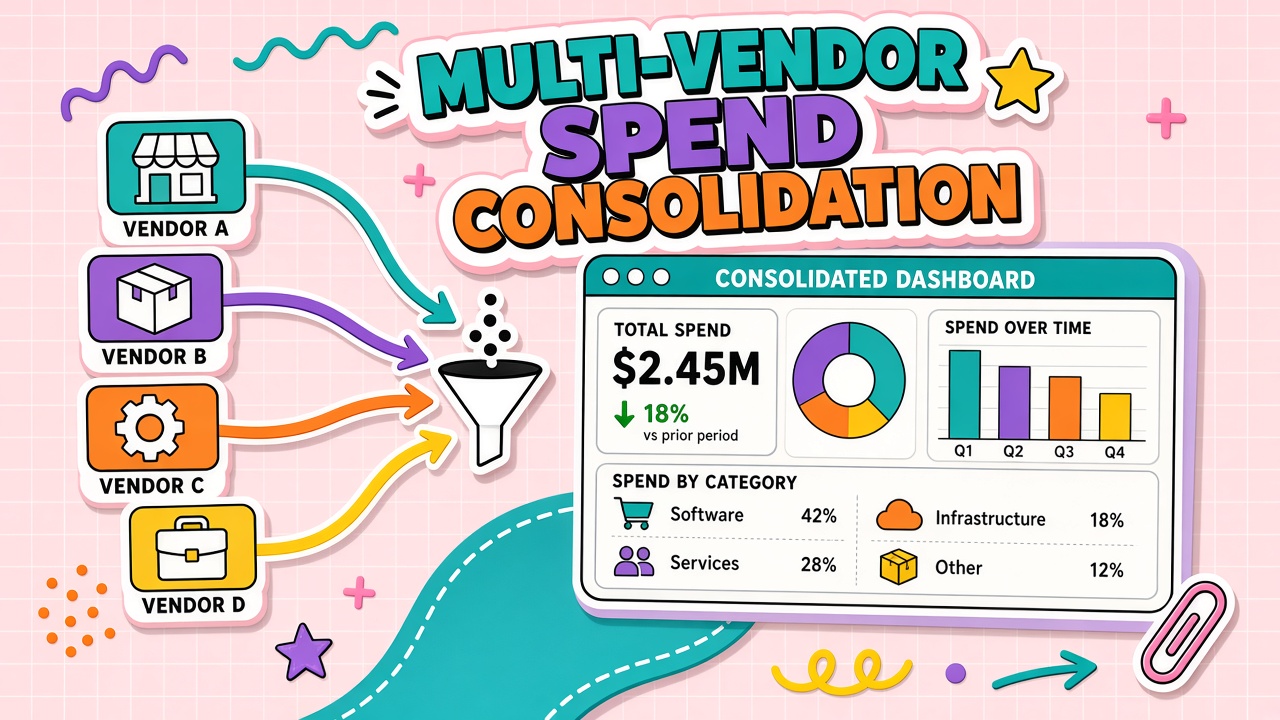
Marketing pays for three writing tools. Engineering subscribes to two coding assistants. Support trials a fourth chatbot. Total spend looks manageable per team; rolled up, it shocks leadership. Consolidate ai vendor spend by mapping capabilities, not logos, then sunsetting duplicates without breaking workflows that genuinely need different strengths.
Consolidation is not always one vendor wins. Sometimes it means one invoice, shared enterprise agreement, and retired shelfware. Teams in AI writing and AI marketing often accumulate overlapping tools from parallel pilots that never officially ended.
Map Spend by Capability Not Brand
Group subscriptions by job: draft generation, image creation, meeting transcription, code completion, embedding search. Two brands in the same cell are consolidation candidates.
Include shadow spend: personal reimbursements, team credit cards, API keys in unnamed cloud accounts. Incomplete maps hide duplicates.
Weight by active users last thirty days, not licensed seats. Shelfware looks like capability gap when it is actually waste.
Identify True Duplicates vs Complements
Duplicates solve the same job for the same users with similar quality. Complements serve different modalities, regions, or compliance tiers. Keeping both may be rational.
Run side-by-side eval on representative tasks with shared scorecard. Qualitative "we like both UIs" is not enough for duplicate paid tools.
Embedded AI inside CRM or design suites may duplicate standalone tools but integrate deeply. Migration cost may exceed license savings short term.
Executive Reporting Without Overselling Savings
Present consolidation as risk reduction plus cost opportunity, not only slash-and-burn. Executives approve when they see capability preserved, security improved, and duplicate spend quantified with migration cost included. Show one slide with gross spend, duplicate spend, migration cost, and net savings by quarter. Hide vendor names in executive view if politics are sensitive; show capabilities instead.
Track shadow re-purchase as KPI. If duplicate spend resurfaces within six months, the sunset failed socially even if licenses were cut. Quarterly stack review should reopen the capability matrix, not only invoice totals.
Shadow IT Discovery Before Consolidation
Expense reports, SSO logs, and DNS egress monitoring reveal tools finance never saw. Interview team leads with structured questions: what do you use when the approved tool is slow, what personal accounts exist, what API keys live in CI secrets. Consolidation without shadow discovery pushes spend off-ledger until audit.
Offer amnesty window: report shadow tool, get migration slot, no blame. After window, new shadow purchases trigger exception process. Pair with marketing ops review of MarTech invoices where AI features hide as add-on lines.
Negotiate Volume Across Related Products
Bundle negotiations with single vendor across writing, API, and enterprise support. Volume commitments trade consolidation for discount and simplified procurement.
Multi-product deals need exit clauses if one product underperforms. Avoid locking entire commit to a weak module to get discount on strong module unless total economics still work.
Reseller aggregators can consolidate billing while preserving multi-model access. Finance gets one invoice; engineering keeps model choice if architecture supports it.
Sunset Plan with User Migration
Sunset tools with dated milestones: communicate, export data, train alternatives, disable SSO, reclaim seats. Abrupt shutdown breeds shadow tool resurgence.
Assign migration champions per department. Provide prompt libraries and template equivalents in the surviving tool. Measure adoption of replacement weekly during ninety-day transition.
Document exceptions: teams with approved waiver and review date. Permanent exceptions should be rare and exec-approved.
Capability gap checklist before sunset
- Does replacement meet minimum quality score from eval?
- SSO, DLP, and logging parity achieved?
- Data export and prompt migration completed?
- Integration endpoints updated (CRM, IDE, CMS)?
- Support runbooks and training sessions delivered?
- Executive waiver documented for holdout teams?
Overlap Analysis Method
Step one: inventory all SKUs and monthly spend. Step two: map to capability matrix. Step three: score overlap one to five for each capability pair. Step four: interview power users on top three overlaps. Step five: mark sunset candidate with lowest adoption and no unique compliance feature. Step six: validate sunset candidate in two-week parallel run before cutover.
Capability Gap Checklist
Before sunset, verify: SSO, data residency, audit logs, export formats, API access, mobile apps, language support, integration connectors, SLA, and training materials. Gaps become migration project line items, not launch day surprises. Reduce AI vendor sprawl cost only after gap checklist passes for target platform.
AI Spend Consolidation Negotiation
Bring consolidated spend map to largest vendor first. Request unified admin, combined true-up, and sunset credits for duplicate SKUs. Smaller vendors may match or accept reduced scope. Rationalize ai subscriptions in waves: duplicates first, complements later after integration proof.
Sunset Communication Template
Announce date, retiring tool, replacement tool, feature parity gaps, training schedule, support channel, and executive sponsor. Weekly reminders at thirty, fourteen, seven days. Office hours twice weekly during migration month. Surveys at day thirty after sunset to catch shadow re-adoption early.
Consolidate ai vendor spend succeeds when users feel migrated, not dumped. Capability gap checklist honesty builds trust even when gaps exist.
Operational Checklist
Assign a single owner for monthly refresh. Publish assumptions where finance and engineering both edit. Tie forecast or policy changes to ticket IDs. Review variance before month close, not after invoice payment. Run tabletop exercises when vendors announce pricing or deprecations. Keep archived exports for audit comparison quarter over quarter.
Document decisions in plain language any new hire can follow. Operational discipline matters as much as spreadsheet formulas or contract clauses. Teams that treat AI spend as unplannable noise get unplannable invoices. Teams that treat spend as a managed metric catch drift early and negotiate from data.
Cross-Functional Alignment
Platform owns technical tags and caps. Finance owns forecast and chargeback posting. Procurement owns contract language. Product owns workflow rollout dates that drive usage. Security owns trial data classification. Weekly five-minute sync during rollout quarters prevents each function optimizing locally while global spend drifts. Alignment is boring work that prevents exciting overage surprises.
Common Mistakes to Avoid
Mistake one: single org-wide average hiding squad spikes. Mistake two: ignoring human review labor in ROI or unit economics. Mistake three: annual commit sized on peak pilot week. Mistake four: alerts configured without owners. Mistake five: sunset without migration support. Mistake six: treating free tier as production. Mistake seven: streaming timeouts fixed by disabling streams without root cause. Mistake eight: duplicate responses patched in UI only while webhooks still double-write. Avoiding these patterns saves more than marginal token discounts.
Migration Communications That Prevent Revolt
Consolidation fails in Slack threads, not spreadsheets. Publish decision record: capability kept, capability lost, workaround for gap, date of license cut, who to ping for help. Train managers on approved talking points before all-hands. When writing teams lose a favored editor, show export path for prompts and style guides on day one.
Measure sentiment weekly during migration with three-question pulse: can you do your job, do you know where to get help, do you understand why we switched. Spiking "no" on job ability signals parity matrix was wrong, not user stubbornness.
Metrics to Track Monthly
Track spend variance versus plan, tag coverage percentage, alert acknowledgment time, dispute count, unused license count, cost per usable output where applicable, stream completion rate for customer-facing apps, and duplicate side effect rate for integrated workflows. Pick three metrics primary for your pillar; log the rest as secondary. Review trend not single points. A metric without owner and target is dashboard decoration.
Share metrics with department leads in language they can act on. Finance sees dollars. Engineering sees error rates and timeouts. Product sees adoption and quality. Same underlying data, different emphasis, one source of truth export from vendor and internal logs reconciled monthly.
Implementation Timeline
Week one: assign owners and export baseline data from vendor admin or application logs. Week two: draft spreadsheet, policy, or runbook sections relevant to your pillar. Week three: pilot with one squad and fix tagging or alert noise. Week four: publish org-wide with office hours. Month two: first variance or true-up review and adjust assumptions. Month three: executive summary with decisions made from metrics, not only spend totals.
Skipping the pilot week creates alert fatigue and mistrust in chargeback numbers. Investing four weeks upfront pays back when finance, security, and engineering reference the same artifacts instead of rebuilding from scratch each quarter. Treat this as operational infrastructure parallel to the AI features themselves.
Frequently Asked Questions
We have API commits with vendor A but want UI from vendor B.
Model gateway patterns route UI to one vendor and API to another only if contracts and data paths allow. Consolidation may be billing-only via aggregator without forcing single model vendor.
Embedded AI in Salesforce/Adobe counts?
Yes in spend map. Embedded tools may be complements if deeply integrated. Compare exit cost vs standalone license before cutting either.
Users revolt when we kill their favorite tool.
Involve champions early, run transparent eval, offer feedback window. Political cost of consolidation is real; budget it in program management hours.
Marketing insists on two writing tools for tone experiments.
Time-box experiments with shared credits. If one tool wins eval after ninety days, sunset the other or downgrade loser to free tier for individuals only per policy.
Review this guide quarterly against your vendor admin console and finance exports. Interfaces change; caps move; new premium toggles appear inside familiar SKUs. A quarterly thirty-minute review keeps policy, forecast, and contract language aligned with what the product actually bills. Assign the review to a named role, not a mailing list.
When in doubt, measure for two weeks before committing annually or sunsetting a vendor. Short measurement windows beat long debates. Export logs, tag them, compute the metric or variance, then decide. Data ends internal stalemates that otherwise consume more payroll than the AI line item under discussion.
The Bottom Line
Reduce ai vendor sprawl cost by capability mapping, honest duplicate detection, bundled negotiation, and migration discipline. Consolidate spend without blindly consolidating tools when complements earn their place.