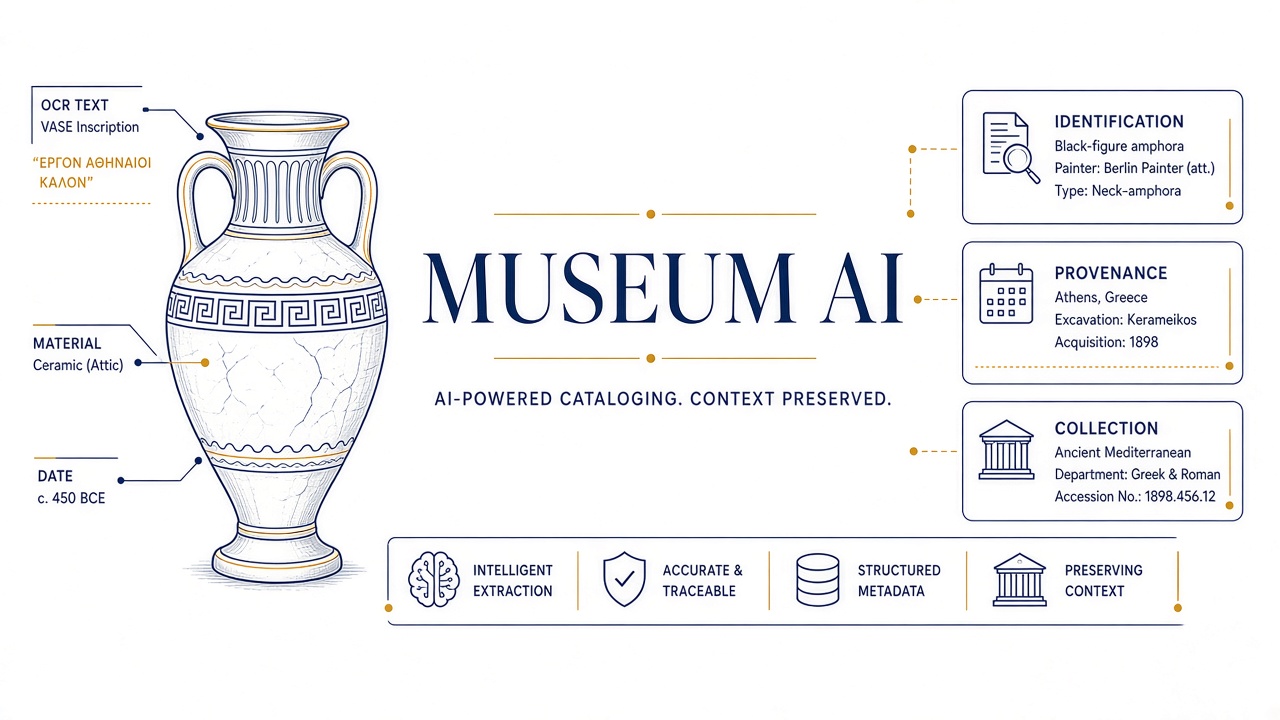
Museums hold millions of objects, photographs, and manuscripts that never received full catalog entries. Manual description is accurate but slow. In 2026, institutions from the Musée des Arts Décoratifs in Paris to regional archives deploy computer vision, optical character recognition, and vision-language models to draft metadata at scale. AI does not replace curatorial judgment. It shifts labor toward verification, bias review, and standards alignment. This workflow guide covers digitization pipelines, metadata standards, labeling bias, public access gains, and labor context for teams exploring AI image tools and AI writing assistants in cultural heritage settings. The goal is not maximum automation; it is trustworthy metadata at a scale manual cataloging cannot reach without multi-decade backlogs staying offline. Curators remain the authors of public truth; AI supplies drafts and search leverage at scale previously reserved for the best-funded institutions.
The Museum Digitization Pipeline
A practical AI cataloging pipeline moves from imaging and OCR through object detection or VLM captioning, then curator review, authority control, and publication to IIIF or collection management systems. Each stage produces machine drafts that humans must approve before records become authoritative. Skipping review steps to meet throughput targets creates catalog errors that propagate to public portals and research datasets.
- Capture: High-resolution photography or scanning with color targets and scale references.
- Text extraction: OCR for labels, ledger pages, and exhibition catalogs; human correction of low-confidence glyphs.
- Visual understanding: Object detection (YOLO-class models), segmentation, or VLM captions for object type and visible attributes.
- Metadata drafting: LLM or VLM proposes titles, descriptions, materials, and subject headings from OCR plus images.
- Curator review: Approve, edit, or reject each field; document AI involvement for transparency policies.
- Authority linking: Map terms to Getty AAT, Wikidata, or internal thesauri.
- Publication: Push verified records to public APIs, IIIF manifests, and linked open data exports.
The TORNE-H project at MAD Paris applied YOLO detection and CLIP retrieval to Jean Royère's archive of 18,000 drawings, iterating annotations with data augmentation to improve model accuracy. ArchiveGPT studies at humanities labs used InternVL2 vision-language models to draft descriptions for archaeological photographs, then evaluated expert ability to distinguish AI text from human catalog entries. Both projects emphasize human-in-the-loop design rather than unattended bulk upload.
| Stage | Typical AI tool | Failure mode | Human fix |
|---|---|---|---|
| OCR | Tesseract, commercial OCR APIs | Historic fonts, marginalia | Transcriptionist correction |
| Object ID | YOLO, Detectron-style detectors | Rare object classes underrepresented | Retrain with curator labels |
| Captioning | Vision-language models | Hallucinated details | Field-level reject and rewrite |
| Enrichment | LLM summarization of OCR text | Anachronistic terminology | Thesaurus alignment |
Metadata Standards and Interoperability
AI-generated metadata must map to institutional schemas (Dublin Core, CIDOC CRM, LIDO) and authority files so enriched records interoperate with research portals and linked open data networks. Exhibition catalog digitization projects at institutions like RKD Netherlands show that "messy" historical sources need taxonomy for document-level, cross-catalogue, and contextual complexity before automation helps. Vision-language models preserve entry boundaries better than OCR-plus-LLM pipelines on some multilingual catalog layouts, but both approaches fail on fields requiring historical knowledge, such as price formats or obsolete addresses.
Structured extraction pipelines like Lot Machine for German auction catalogs demonstrate constrained JSON decoding from VLM outputs, benchmarking commercial endpoints against locally hosted models for privacy-sensitive institutions. Valid JSON does not guarantee semantic accuracy. Curators still validate lot descriptions against page images. AI writing assists drafting prose fields but should not invent provenance chains or donor histories absent from source documents.
Bias in Object Labels
Object labeling bias enters when training data underrepresent cultures, when VLMs default to Western category names, or when automated subject headings encode outdated colonial terminology. A detector trained mostly on European decorative arts may misclassify African textiles. VLMs may describe ritual objects with generic "statue" language that erases function. Gender and ethnicity descriptors generated from portraits risk stereotyping unless curators enforce community-informed vocabularies.
Bias review should be a named workflow step, not an informal correction. Sample AI drafts stratified by collection region and medium. Track correction rates by category. When certain object types show higher rejection rates, pause bulk processing and augment training labels with expert annotators. Project SPOT and EU AI Act transparency discussions highlight that museums must disclose AI-influenced public metadata without undermining trust. Display layers can note "description reviewed by curator; AI-assisted draft" where policy requires.
Public Access Benefits
Verified AI-assisted cataloging expands public access when more objects gain searchable descriptions, IIIF viewers, and linked data connections previously limited to fully manually cataloged highlights. Henrot's 430,000 photographs at MAD and large undescribed backlogs worldwide remain invisible without scalable description. Semi-automated pipelines let smaller museums publish beyond star objects, supporting education and repatriation research. Full-text OCR alone is insufficient for analytic research; structured lot- or object-level metadata enables market history, provenance tracing, and cross-collection linking to Wikidata.
Public benefit depends on quality gates. Publishing unreviewed VLM captions can mislead students and contaminate downstream datasets researchers treat as ground truth. Embargo AI drafts internally until curator sign-off. Open APIs should expose which fields are human-authored, AI-assisted, or machine-only with confidence scores where available. Transparency increases long-term trust more than speed alone.
Union and Labor Context
AI cataloging reshapes museum labor: it can eliminate tedious transcription while threatening roles if leadership treats AI drafts as final output without redeploying staff to higher-judgment work. Registrars, catalogers, and digital imaging specialists have union representation at many public institutions. Contract negotiations in 2025 and 2026 increasingly include language on AI use, disclosure, and retraining obligations. Ethical deployment assigns AI to first drafts and quality sampling while preserving curatorial authorship on public records.
Productive framing positions AI as expanding capacity to catalog backlog collections that would otherwise never reach online portals, not as replacing tenured expertise. Train staff to prompt, audit, and fine-tune models on domain collections. Share time savings metrics with unions: hours moved from rote typing to community engagement or conservation photography. Without that bargain, staff may resist workflows that appear designed primarily to cut headcount.
Curator-in-the-Loop Interfaces
Interface design determines whether AI cataloging respects curatorial authority or erodes it through bulk-approve shortcuts. Project SPOT and similar research prototypes surface AI suggestions as editable fields with provenance tags, not as final labels. Good UIs show side-by-side image crops, OCR confidence heatmaps, and thesaurus suggestions ranked by match score. Curators reject single fields without discarding entire records. Bad UIs present a single "accept all" button optimized for throughput metrics that leadership tracks monthly.
Training matters as much as models. Catalogers need workshops on prompt refinement for AI writing assistants: how to ask for material descriptions without inventing maker names, how to spot anachronistic adjectives, when to escalate uncertain VLM outputs to subject specialists. Digital imaging staff should understand that compression artifacts degrade detection models, linking capture quality directly to downstream AI error rates.
Linked Open Data After Enrichment
Once curators verify AI-assisted records, museums can publish to Wikidata, Europeana, and IIIF aggregators with richer discoverability than OCR-only dumps. Structured fields enable queries like "show bronzes with AI-assisted subject headings reviewed in 2026" for research governance. Linked open data also exposes errors faster: external scholars flag mislabeled objects, creating feedback loops that improve training sets. Treat public release as part of the workflow, not an afterthought, so enrichment serves access rather than internal search alone.
Quality Sampling and Audit Trails
Run random post-publication audits on AI-assisted records: sample five percent of published entries quarterly and compare public fields to source images. Audit trails should store model name, prompt version, curator editor ID, and timestamp for each field. When a visitor reports an error, staff can trace whether the mistake originated in OCR, VLM captioning, or human typo. Audit culture prevents AI from becoming a blame sink where curators absorb reputational damage for model hallucinations leadership rushed to production. Share audit summaries with digital staff and union representatives so quality standards stay collective, not punitive toward individual catalogers correcting AI drafts all day.
Frequently Asked Questions
Can AI replace museum curators?
No for authoritative catalog records. AI accelerates drafts for OCR, detection, and description, but curators retain responsibility for accuracy, cultural context, and public trust. Final metadata should carry human authorship with optional AI assistance disclosure.
OCR plus LLM or vision-language models first?
Depends on source layout. VLMs handle complex page structure and multilingual exhibition catalogs well. OCR plus LLM suits clean typed ledgers. Pilot both on a stratified sample before scaling either pipeline.
How should museums measure accuracy?
Track field-level precision and recall against curator-edited gold sets. Monitor rejection rates by collection and language. Run periodic blind reviews where experts rate AI drafts without knowing the source model version.
What about AI image generators?
AI image generators are distinct from cataloging VLMs. Museums should not synthesize collection objects for public display as if they were authentic artifacts. Generators may assist educational reinterpretation when labeled clearly as reconstructions, separate from catalog metadata for real holdings.
How does the EU AI Act affect museums?
Transparency obligations push institutions to design interfaces and metadata that signal AI involvement on public pages. Curator-in-the-loop workflows align with limited-risk use cases when humans verify outputs before publication.
What is a minimum viable pilot?
Select 500 diverse objects with existing partial records. Run capture, AI draft, curator review, and publish to a staging portal. Compare time per record and error types against a fully manual control batch before institution-wide rollout.
International collaboration adds complexity. Multilingual catalogs require language-specific OCR models and thesaurus mappings. AI drafts in one language should not auto-translate to public portals without bilingual curator review. UNESCO-aligned digitization goals emphasize equitable access; automation should widen representation in online collections, not only accelerate cataloging of already well-documented Western holdings. Bias review must ask who benefits from faster metadata and whose objects remain invisible because training data skipped them.
What about donor and provenance privacy?
Can small museums start without GPUs?
Yes. Many pipelines run OCR and commercial VLM APIs on batched scans during off-peak hours. Locally hosted quantized models suit privacy-sensitive collections when IT can maintain hardware. Start with typed ledgers or high-contrast labels before tackling handwritten archives. Partner with universities for student annotators to build domain training sets instead of accepting generic ImageNet labels for specialized ceramics or textiles.
Success metrics for AI image and vision tools in museums are curator hours saved per verified record and error rate on public fields, not raw image counts processed. A smaller verified batch beats a massive unpublished draft catalog that erodes trust when errors surface on the collection portal. Report both throughput and correction rate in board updates so leadership sees quality, not only volume. Union partners can co-design audit sampling so quality metrics support staffing arguments instead of disguising layoff plans.