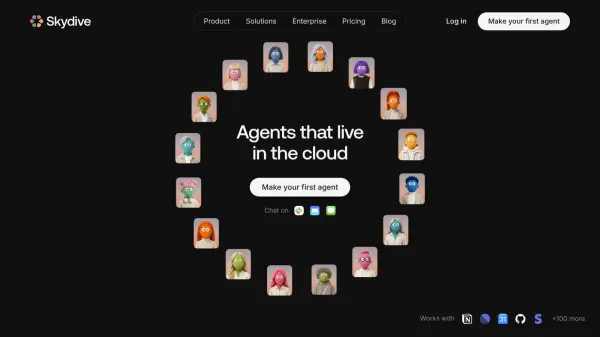
What is Skydive?
Skydive provides a comprehensive AI agent platform designed for teams seeking to automate recurring tasks and workflows across their existing tool ecosystem. Unlike traditional chatbots or workflows, Skydive agents are autonomous entities with designated names, roles, and access to over 600 integrations including Gmail, GitHub, Notion, Linear, Slack, and more. These agents operate continuously in the cloud, monitoring processes, taking action, and maintaining work momentum even when team members are offline.
The platform features a multi-channel architecture that allows users to interact with the same agent across web, Slack, email, or iMessage while maintaining consistent memory and identity. Each agent possesses its own virtual computer environment where it can browse the web, create and organize files, and complete end-to-end tasks independently. Through continuous learning capabilities, agents improve with every interaction by remembering user preferences, learning from corrections, and applying that knowledge to future tasks. Agents can also collaborate with each other to tackle larger projects, sharing context and working as a cohesive team to deliver results.
Features
- Multi-Channel Communication: Interact with agents across web, Slack, email, or iMessage with unified memory and identity
- 600+ Tool Integrations: Connect to Gmail, GitHub, Notion, Linear, Asana, Figma, and hundreds more tools
- Autonomous Task Execution: Agents have virtual computers to browse web, create files, and complete end-to-end tasks independently
- Continuous Learning: Agents remember preferences, learn from corrections, and improve with every interaction
- Agent Collaboration: Multiple agents can work together, sharing context to complete larger projects
- Automated Routines: Set up recurring workflows that monitor, take action, and keep work moving 24/7
- Pre-Built Templates: Get started quickly with templates for support, marketing, sales, engineering, and operations
- Self-Improvement Capabilities: Agents carry knowledge from past interactions into future work automatically
Use Cases
- Customer support queue management and ticket resolution
- Marketing campaign coordination and content publishing
- Engineering workflow automation from commit to merge
- Project management and roadmap tracking across tools
- Weekly report generation and data summarization
- Email drafting and response management
- Calendar management and meeting coordination
- Cross-tool task completion and file organization
- Team collaboration and handoff automation
- Billing and refund processing workflows
FAQs
-
What makes Skydive agents different from chatbots?
Skydive agents are autonomous entities built to do real work with designated names, roles, and access to your tools. Unlike chatbots, they operate continuously in the cloud, complete end-to-end tasks independently, learn from every interaction, and can collaborate with other agents to tackle larger projects. -
Can I use the same agent across different platforms?
Yes, you can talk to the same agent on web, Slack, email, or iMessage. Each agent maintains one identity and one memory across all channels, so your conversations and context are consistent wherever you work. -
How do Skydive agents learn and improve over time?
Agents improve through continuous learning by remembering your preferences, learning from corrections you make, and carrying that knowledge into future work. Every interaction makes your agent better at understanding how you and your team work. -
What tools can Skydive agents integrate with?
Skydive agents can connect to over 600 integrations, including Gmail, GitHub, Notion, Linear, Asana, Figma, Slack, and many more. Agents work directly inside the tools your team already uses to complete tasks. -
Can multiple agents work together on tasks?
Yes, Skydive agents can work as a team by collaborating with each other and sharing context to complete bigger jobs. This allows for complex workflows that require coordination across different roles and functions.